


The headlines have been dramatic, painting a picture of a $2.02 trillion private credit market in freefall. Depending on the publication, readers are presented with narratives ranging from imminent systemic collapse to a slow-motion replay of the 2008 financial crisis. However, a closer examination of the data reveals a more nuanced reality, with the current discourse often conflating distinct issues – redemptions, defaults, and structural complexities – into a single, misleading crisis narrative. This conflation risks eroding trust in a vital asset class and undermining the industry’s analytical credibility when genuine challenges arise.
Separating the Conversations: Redemptions, Credit Quality, and Structural Risk
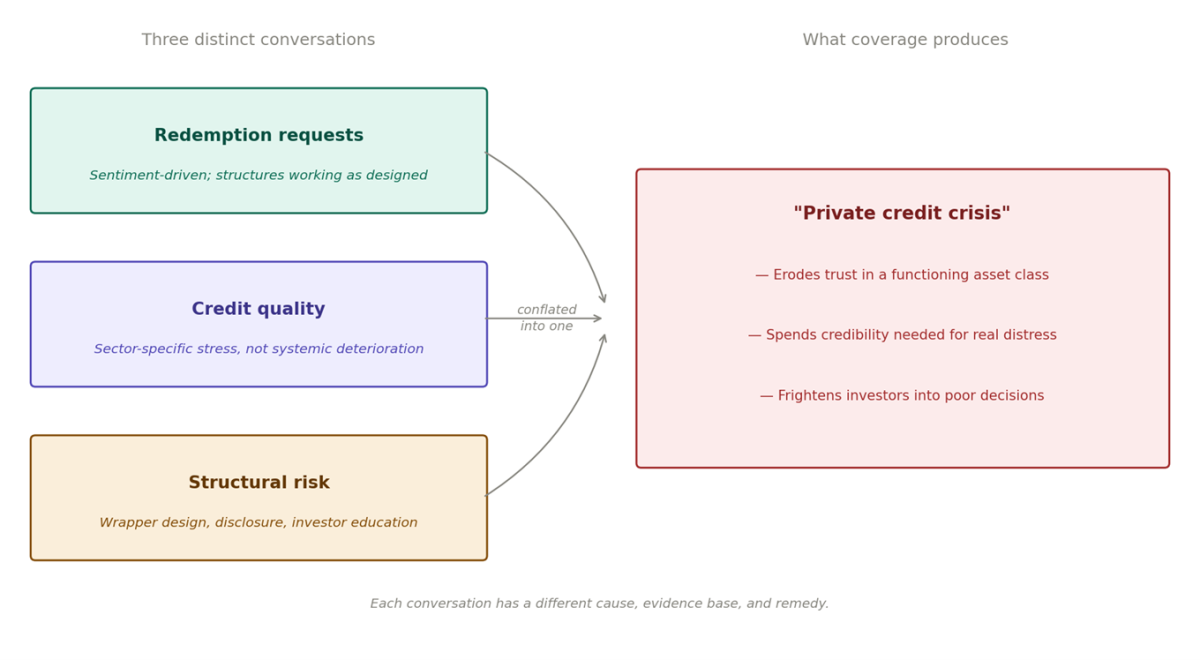
The prevailing media coverage often merges three separate conversations: the surge in redemption requests from retail investors in non-traded Business Development Companies (BDCs) and semi-liquid vehicles, the underlying credit quality of private credit portfolios, and the inherent structural risks within certain investment products. By presenting these as a unified crisis, the discourse misrepresents the current state of the market and its underlying dynamics.
The Nuances of Redemption Activity
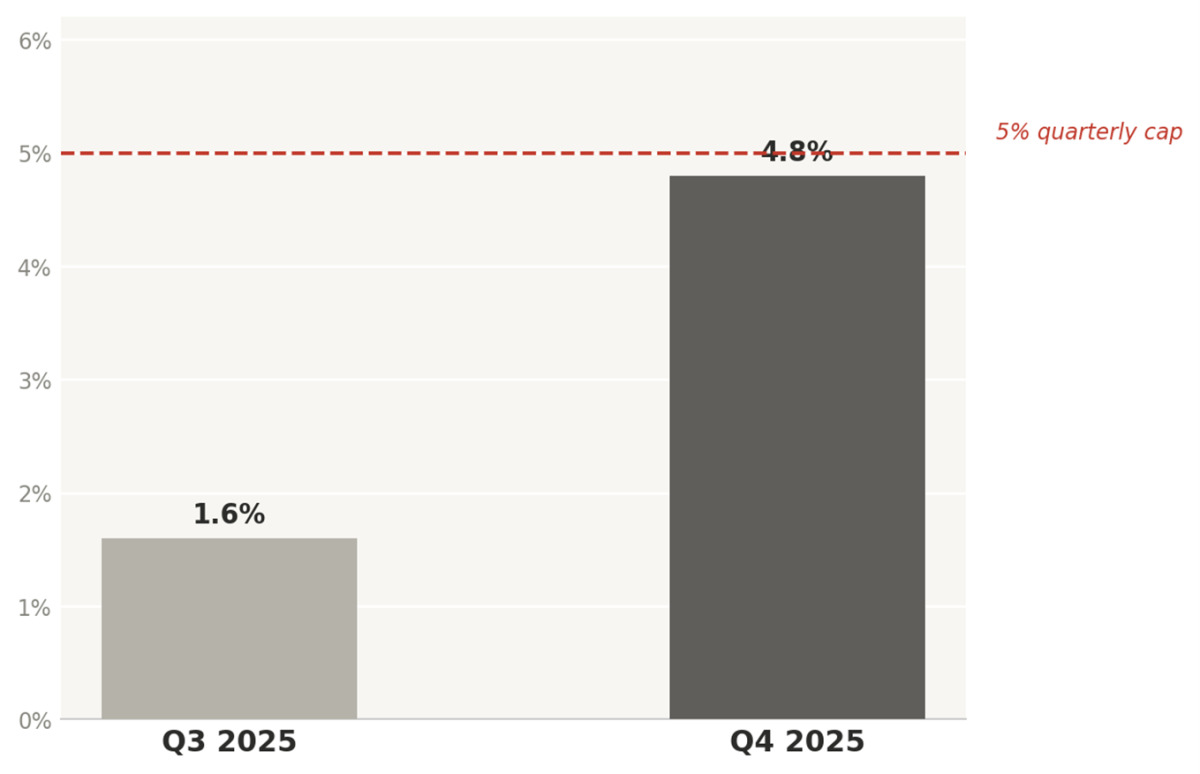
A significant driver of the current narrative is the elevated redemption requests from retail investors in non-traded BDCs and semi-liquid vehicles. These requests have triggered quarterly caps, leading to capital being locked for some investors. While headlines have interpreted this as a sign of a collapsing asset class, it is crucial to distinguish between redemption requests and actual redemptions. Actual redemptions – the capital returned to investors – are capped at 5% of Net Asset Value (NAV) per quarter by design, a feature intended to protect the integrity of loan portfolios and the returns for remaining investors.
In the fourth quarter of 2025, average redemptions for perpetually non-traded BDCs rose to 4.8% of NAV, a notable increase from 1.6% in the previous quarter. Five BDCs even funded tenders above the standard 5% quarterly cap, fueling the sensationalist headlines. However, Fitch Ratings suggests that these redemption requests are largely driven by investor sentiment rather than a broad-based deterioration in credit quality. Concerns, particularly surrounding the potential impact of Artificial Intelligence (AI) disruption on software companies, have fueled investor apprehension.
The structures in place, such as the quarterly 5% cap, are not emergency measures but pre-existing features designed to manage liquidity and protect portfolio stability. A manager adhering to this cap is fulfilling the product’s design. The significant oversubscription to these redemption requests, however, raises a critical question: was the long-term, illiquid nature of these vehicles adequately communicated and understood by the investors who subscribed to them?
The financial health of these BDCs appears robust, contradicting the crisis narrative. Fitch reports that average debt-to-equity ratios for seven rated perpetually non-traded BDCs stood at a conservative 0.71x, significantly lower than the 1.13x for other rated BDCs. Asset coverage cushions averaged 38.6%, well above the 22% average for both public and private BDCs. These metrics suggest a sector that, while experiencing liquidity pressures from investor sentiment, is not facing a balance sheet crisis.
Furthermore, Fitch identifies a potential structural silver lining: a slowdown in fundraising could ease competitive pressures that have compressed spreads and impacted BDC earnings in recent years, leading to a market rebalancing rather than a crisis.

Moody’s has noted a shift in inflows for perpetually non-traded BDCs, moving from inflows to outflows in the first quarter of 2026. Publicly traded BDCs, meanwhile, have maximized leverage, leaving less room for error. A significant factor contributing to this dynamic is the concentration of software companies within BDC portfolios. Moody’s estimates this sector represents roughly 25% of BDC portfolios on a median basis and flags AI as a developing credit risk. However, their own analysis provides a balanced perspective, stating, "Asset quality metrics have so far remained largely benign, and software loan maturities do not increase more meaningfully until 2028-2029, suggesting AI risk will be a sentiment and monitoring issue in the near term rather than an immediate ratings driver."
Non-Traded BDC Redemptions Surge in Q4 2025
(Illustrative data based on provided charts, actual data would be sourced from financial reports)
| Metric | Q3 2025 | Q4 2025 | Change |
|---|---|---|---|
| Average Redemptions (% NAV) | 1.6% | 4.8% | +3.2 pp |
| BDCs Above 5% Cap | N/A | 5 | N/A |
Source: Cliffwater; Robert A. Stanger & Co. Analysis.
The Rise of Software Exposure and the AI Disruption Factor
The substantial exposure of private credit to the software sector is a key element of the current discussion. SaaS companies have long been favored by private credit lenders due to their predictable recurring revenue, sticky customer bases, high margins, and scalability. Outstanding loans to SaaS firms surged from approximately $8 billion in 2015 to over $500 billion, representing 19% of total direct loans by the end of 2025. This trend accelerated as direct lenders captured an increasing share of large leveraged buyouts, rising from 34% in 2022 to a record 54% in 2023, according to PitchBook LCD. This marked a significant reversal from the pre-pandemic era when syndicated loan markets dominated buyout financing.
The catalyst for the recent surge in redemption requests appears to be the unveiling of advanced agentic AI tools. These tools, capable of performing complex professional tasks, have raised concerns about the potential disruption of traditional SaaS business models, leading to a sell-off in software data provider shares and heightened investor anxiety. Within weeks of these AI product launches, reports indicated over $10 billion in investor withdrawals from private credit funds driven by fears of over-exposure to vulnerable software companies.
A deeper concern lies in the opacity surrounding private credit loans. Loans are often held at par value, and borrowers do not publicly disclose earnings. Deteriorations in a borrower’s business model may not become apparent until a covenant breach or maturity event forces disclosure, by which point options for remediation may be significantly limited.
Emerging stress indicators warrant careful attention. As of the fourth quarter of 2025, 6.4% of private credit loans carried "bad PIK" – interest deferred due to liquidity strain rather than structured in at origination. This figure is nearly triple that of 2021 levels. Lincoln International considers this a shadow default rate, placing implied distress closer to 6% against a headline rate of around 2%. Furthermore, approximately 70% of private credit issuance is not covenant-lite, meaning the crucial early warning systems that once flagged borrower stress before a missed payment are largely absent. This lack of transparency can lead rational investors, particularly retail investors with quarterly redemption windows, to exit before potential issues become fully apparent.
Blue Owl: A Case Study in Redemption Pressures
Blue Owl became a prominent example of the redemption request wave, with investors seeking to withdraw significant portions of their holdings from its technology-focused vehicles and credit income funds. These requests were primarily attributed to sentiment and fears surrounding the software sector, rather than any substantial deterioration in the underlying loan portfolios. Blue Owl’s technology-focused vehicles had reportedly delivered returns in line with the Cliffwater Direct Lending Index since inception, with non-accruals at a low 0.6%.
The company’s attempt to address a liquidity mismatch by merging one of its vehicles into its publicly traded BDC, at terms that would have imposed a significant haircut on investors due to the BDC’s discount to NAV, triggered a class-action lawsuit and considerable media attention. Allegations suggested the firm had downplayed redemption pressures while withdrawals were accelerating. The proposed merger was ultimately terminated, redemption mechanics were restructured to eliminate quarterly tender offers, and Moody’s revised its outlook to negative. Crucially, Moody’s simultaneously affirmed that asset quality remained solid, suggesting that the issues were with the product wrapper and disclosure, not the underlying credit assets.
Investors’ decisions to redeem were driven by fear, amplified by negative media coverage that then cited these redemptions as evidence of a crisis. The perception of "semi-liquid" offerings being more accessible than their quarterly cap mechanics allowed also played a role. This situation highlights a broader challenge: the psychological impact of investor sentiment, often amplified by market narratives, can create liquidity pressures that are not directly tied to fundamental credit deterioration.
This scenario raises a critical question about investor education and product suitability. When redemption requests massively oversubscribe pre-defined caps in vehicles designed for long-term illiquidity, it prompts an inquiry into whether the fundamental nature of these vehicles was adequately communicated or understood. The term "semi-liquid" itself may imply a degree of accessibility that the underlying mechanics do not support.
The industry faces a fundamental challenge in aligning product wrappers, investor education, and the inherent illiquidity of private market assets, especially as it seeks to expand into the retail channel. The current structures and messaging may not be fully fit for purpose, potentially serving neither investors nor the broader system effectively. A re-evaluation of wrapper design may be necessary before further expansion into the retail investor base.
Examining Credit Quality in Detail
While redemption pressures are a significant part of the narrative, the underlying credit quality of private credit is a separate, crucial conversation. There are indeed meaningful pockets of stress. The software and tech sector, estimated to represent around 26% of direct lending portfolios, is under pressure due to AI disruption, which casts doubt on the long-term viability of SaaS business models underwritten for predictable recurring revenue.
Highly leveraged healthcare roll-ups and smaller middle-market borrowers, priced for an era of low interest rates, are also showing strain. The prevalence of covenant-lite structures, common during the inflow frenzy of 2021-2024, offers less protection than lenders may have assumed.
Morgan Stanley has warned that direct lending default rates, currently around 5.6%, could reach 8%, a significant increase from the historical average of 2-2.5%. While concerning, this projected rate is described by Morgan Stanley analysts as "significant but not systemic." KBRA’s rated BDC universe showed no rating changes or negative outlook revisions through the third quarter of 2025, although selective downgrades followed in the fourth quarter. The stress observed is real and concentrated in specific sectors, but it does not indicate broad-based deterioration across the entire $2 trillion private credit market.

This distinction is critical: concentrated credit stress in software and leveraged healthcare is primarily a reflection of manager selection and underwriting discipline, rather than an indictment of the private credit asset class as a whole. While AI disruption is a genuine risk, its impact is not universal across all private loans, much like in any other sector. However, the interconnectedness of the financial system means that such sector-specific stresses can have ripple effects.
Systemic Risk: A Different Landscape Than 2008
The invocation of the 2008 Global Financial Crisis (GFC) during periods of financial stress is a common, though often inaccurate, practice. Private credit, structurally, differs significantly from the banking system that underpinned the GFC. There are no depositors to run, no repo lines to freeze, and no overnight funding markets to collapse. The feedback loop that made subprime mortgages systemic – with losses embedded in bank balance sheets backstopped by government-insured deposits – does not exist in the same form within private credit.
However, this does not imply zero systemic risk. Contagion channels, while different, are present. Mark-to-model valuations can mask deterioration until it becomes undeniable. The growing entanglement with insurance vehicles, which now fund a substantial portion of private credit, means that losses could ultimately impact the retirement savings of policyholders who are unaware of their exposure. These are tangible risks, though distinct from those of 2008.
A less-discussed but potentially significant wrinkle lies in the AI ecosystem itself. The dependencies within this ecosystem – Microsoft’s integration with OpenAI, Google and Amazon’s involvement with Anthropic, and Nvidia’s foundational role across virtually all AI models – create circular dependencies that bear resemblance to the interconnectedness observed in the pre-2008 financial system. This complex web of capital flows, infrastructure reliance, and strategic entanglement among major AI players could be likened to a single organism with multiple faces.
The AI Ecosystem’s Circular Dependencies
(Conceptual illustration of interdependencies)
| Player | Key Dependencies | Capital/Strategic Significance |
|---|---|---|
| OpenAI | Microsoft (Cloud, Funding), Nvidia (Compute) | High |
| Anthropic | Google (Cloud, Funding), Amazon (Cloud), Nvidia (Compute) | High |
| Nvidia | All major AI developers (Compute infrastructure) | Foundational |
| Microsoft | OpenAI (AI development), Cloud infrastructure | High |
| Anthropic (AI development), Cloud infrastructure | High | |
| Amazon | Anthropic (AI development), Cloud infrastructure | High |
Note: Arrow thickness indicates relative capital or strategic significance. Infrastructure dependencies reflect GPU/compute reliance on Nvidia across all major AI developers.
If a significant node within this AI ecosystem falters, private credit portfolios exposed to SaaS companies reliant on this ecosystem could experience repercussions. The diversification that many investors believe they possess may be more theoretical than real. Understanding these interdependencies is crucial for informed analysis, not to incite panic, but to learn from past systemic failures.
Why Conflation is the Core Problem
The conflation of redemption requests, credit quality, and systemic risk is, in itself, the primary problem. Redemption requests do not directly cause defaults. A company does not fail on its loan obligations solely because retail investors in a non-traded BDC sought liquidity.
While the ecosystem is interconnected, with persistent outflows potentially tightening lending conditions at the margins, the chain of causation is long and indirect. The media narrative has compressed this complex chain into a single, alarming story. This compression has significant consequences: when every instance of a redemption gate is framed as a systemic crisis, and every gated fund is presented as evidence of a collapsing asset class, the media loses its ability to effectively signal genuine distress when it truly occurs.
The Path Forward: Recalibration, Not Crisis
Private credit may not be in a crisis, but it is undergoing a period of recalibration. This recalibration involves real stress in specific sectors, necessitates a critical examination of structural questions regarding semi-liquid wrapper design, and highlights real risks that demand rigorous oversight and honest analysis. What it does not deserve is the kind of breathless conflation that obscures the differences between a wrapper problem, a sector-specific issue, and a systemic one.
The distinction between these categories is analytically vital. It marks the difference between informed markets and frightened ones. The CAIA Association’s latest report, "The World Rewired," delves into these broader shifts, offering a framework for understanding the evolving investment landscape.
The future of private credit hinges on clear communication, robust product design, and diligent investor education. Addressing these foundational elements will be crucial for the continued development and stability of this increasingly important asset class.
