

The National Venture Capital Association (NVCA) frequently convenes its "Meet a VC" series, a pivotal platform designed to demystify the venture capital landscape by spotlighting the influential figures, diverse perspectives, and core convictions that animate this critical industry. This month, the series features Will Borthwick, a distinguished General Partner at BOLD Capital Partners. BOLD Capital has carved a niche for itself by strategically investing in visionary founders dedicated to developing "exponential technologies" – innovations poised to fundamentally advance humanity. Borthwick’s insights offer a comprehensive look into the evolving dynamics of venture capital, the challenges and triumphs of fostering groundbreaking innovation, and a deeply held optimism for the future driven by technological progress.
A Journey from Traditional Finance to the Vanguard of Innovation
Will Borthwick’s career trajectory is a testament to the diverse backgrounds that converge in venture capital, offering a unique blend of financial acumen and a keen eye for transformative potential. His professional journey began within the hallowed halls of the Federal Reserve, an institution synonymous with macroeconomic stability and monetary policy. This foundational experience provided him with an unparalleled understanding of global financial systems and market dynamics. Following his tenure at the Fed, Borthwick transitioned into the demanding world of investment banking, where he honed his skills in complex financial transactions and strategic advisory. His path then led him to private equity, focusing on the buyouts of large technology companies. This phase of his career offered deep exposure to established tech giants, their operational complexities, and the strategic levers for growth and value creation in mature markets.
However, approximately eight and a half years ago, Borthwick made a deliberate pivot, joining BOLD Capital Partners. This decision was driven by a compelling confluence of factors: the magnetic pull of a team composed of seasoned entrepreneurs and investors, and a groundbreaking investment thesis centered on what BOLD Capital terms "exponential technologies." These are not merely technologies that improve incrementally; rather, their capabilities expand at an exponential rate, meaning what was considered infeasible just 18 months prior often becomes achievable today. This rapid acceleration creates unprecedented opportunities to tackle some of humanity’s most significant and impactful challenges. Borthwick succinctly captures this ambition, articulating BOLD Capital’s core question: "How do you fundamentally move the needle to make humanity better?"
BOLD Capital’s investment portfolio vividly illustrates this audacious ambition. Their ventures span diverse and often futuristic domains, including stratospheric drones designed for long-duration atmospheric flight and data collection, groundbreaking de-extinction projects aiming to bring back species, the development of advanced humanoids poised to revolutionize labor and companionship, and sophisticated AI-enabled hardware pushing the boundaries of intelligent systems. These investments underscore a commitment to backing technologies that are not just innovative, but truly transformative, promising to reshape our world in profound ways.
The Evolution of Venture Capital: A Shift in Scale and Scrutiny
Borthwick’s tenure in venture capital has coincided with a period of unprecedented transformation within the industry. Reflecting on his earlier career, he admits to an initial misconception regarding the ease of building a successful company. Witnessing the meteoric rise of companies like Facebook and Snapchat from nascent startups to multi-billion-dollar valuations, often originating from dorm rooms, could indeed create an illusion of effortless success. However, direct involvement in the ecosystem quickly disabused him of this notion. "It turns out it’s incredibly hard. It’s even harder to build a generational company," Borthwick states, acknowledging the immense challenges entrepreneurs face. This difficulty extends equally to investors: "But it’s also very hard to invest, support, and find the entrepreneurs capable of doing it."
Perhaps the most significant shift Borthwick has observed is the dramatic increase in the sheer volume of capital flowing into venture capital. What was once described as a "small, cottage, bespoke, artisanal industry" has transformed into a global financial powerhouse. When Borthwick began his career in venture, a Series A funding round of $15-20 million was considered substantial, often signaling significant market validation and potential. Today, the landscape is dramatically different, with Series A rounds frequently reaching $150 million, and even higher figures becoming part of routine industry conversations.
This surge in capital can be attributed to several macroeconomic factors and evolving investment trends. A decade of low interest rates globally encouraged institutional investors – pension funds, endowments, sovereign wealth funds – to seek higher returns in alternative assets, with venture capital proving to be a highly attractive, albeit riskier, proposition. The spectacular successes of tech giants emerging from venture-backed ecosystems further fueled this influx, creating a virtuous cycle where past successes attracted more capital, which in turn funded more ambitious ventures. According to PitchBook-NVCA Venture Monitor reports, global VC funding witnessed exponential growth, with total capital invested regularly exceeding hundreds of billions of dollars annually in recent years, a stark contrast to the pre-2010 era. This capital influx has led to increased competition among VCs, longer private company lifecycles, and a greater emphasis on scale and market dominance from an earlier stage.
Beyond the Check: The Enduring Partnership of Venture Capital

Borthwick strongly advocates for a redefinition of the venture capitalist’s role, moving beyond the simplistic notion of merely allocating capital. He asserts that venture capital is "not a fancier broker-dealer collecting a fee on the wire. It’s what happens after." This perspective fundamentally reframes the relationship between VC and founder, characterizing it as a deep, committed partnership. "When we invest into a company, it’s truly a marriage – not a date or a fling. We get in the bunker with you through thick or thin," he emphasizes. This analogy highlights the long-term commitment and shared destiny inherent in successful venture partnerships.
Being a founder, particularly a CEO, is widely recognized as one of the most isolating and demanding roles in the professional world. The ultimate responsibility, the proverbial buck, invariably stops with them. In this high-pressure environment, the true value of a venture capitalist extends far beyond financial investment. It encompasses being a consistent presence – offering strategic advice, facilitating critical introductions to potential customers or executive talent, and providing an invaluable network of connections. Crucially, it also involves offering personal support. "Whether it’s a shoulder to cry on or a person to scream at, that’s an important part of the role," Borthwick notes, underscoring the emotional and psychological support founders often need. This holistic approach transforms the VC into a true partner, deeply embedded in the company’s journey. Borthwick concludes this point by stating, "We are capital allocators and investors, but in a lot of ways we’re entrepreneurs ourselves. I’d view it almost as an operator-investor." This distinction is vital, suggesting that effective VCs bring not just financial backing, but also operational experience and empathy gleaned from their own entrepreneurial or hands-on business backgrounds.
Challenging Perceptions: Founders, VCs, and the Engine of Progress
Borthwick also highlights two critical areas where public and policymaker understanding often falls short, leading to unnecessary friction and misconceptions. The first pertains to founders themselves. He wishes more people understood the extraordinary difficulty of building a company and the often-unnecessary roadblocks entrepreneurs encounter. Founders, he argues, "start companies to change the world in an impactful way. It comes from a place of good." This altruistic motivation, often overlooked in narratives focusing solely on financial gain, is a powerful driver of innovation. Borthwick firmly believes that technology is the primary engine that has propelled humanity forward, and entrepreneurialism is the fundamental mechanism through which this technology is conceived, developed, and scaled.
The second area of misunderstanding concerns venture capitalists themselves. The popular "cartoon version" of a VC – characterized by brief, superficial meetings, handing out massive checks with little follow-up, and then walking away – bears scant resemblance to the reality Borthwick experiences daily. This caricature often fuels skepticism and resentment, ignoring the deep engagement and value creation intrinsic to modern venture capital. As he reiterates, "We are capital allocators and investors, but in a lot of ways we’re entrepreneurs ourselves. I’d view it almost as an operator-investor, rather than a passive investor." This active, engaged model is a hallmark of successful venture firms today, where VCs are deeply invested in the strategic and operational success of their portfolio companies.
This disconnect between perception and reality can have significant implications for public policy. Policymakers, driven by a desire to regulate or influence the tech sector, may implement measures based on incomplete or inaccurate understandings of how startups operate, how venture capital functions, and the motivations of those involved. This can inadvertently stifle innovation, particularly in sensitive areas like AI ethics, biotechnology regulation, or even the space economy, where regulatory clarity and support are paramount. A more nuanced understanding of the founder-VC ecosystem could lead to more effective policies that foster responsible innovation while minimizing unnecessary burdens.
Optimism in an Uncertain World: The Democratization of Capability
Despite the acknowledged uncertainties of the contemporary world – a sentiment often amplified by our pervasive information environment – Will Borthwick remains profoundly optimistic about humanity’s future trajectory. He frames this optimism through the lens of a "longer arc of democratization of capability." This concept posits that access to powerful tools and technologies, once exclusive to large institutions or highly specialized individuals, is steadily becoming more widespread and accessible to everyone.
Borthwick illustrates this historical progression with compelling examples. Twenty years ago, building a significant tech enterprise required substantial upfront investment in physical infrastructure, such as proprietary server racks and data centers. The advent of cloud computing dramatically democratized this capability, allowing startups and individuals to access immense computational power on demand, paying only for what they used. Today, this trend continues with the proliferation of "intelligence on demand" – sophisticated AI tools and processing power readily available in the palm of our hands through smartphones and accessible platforms.
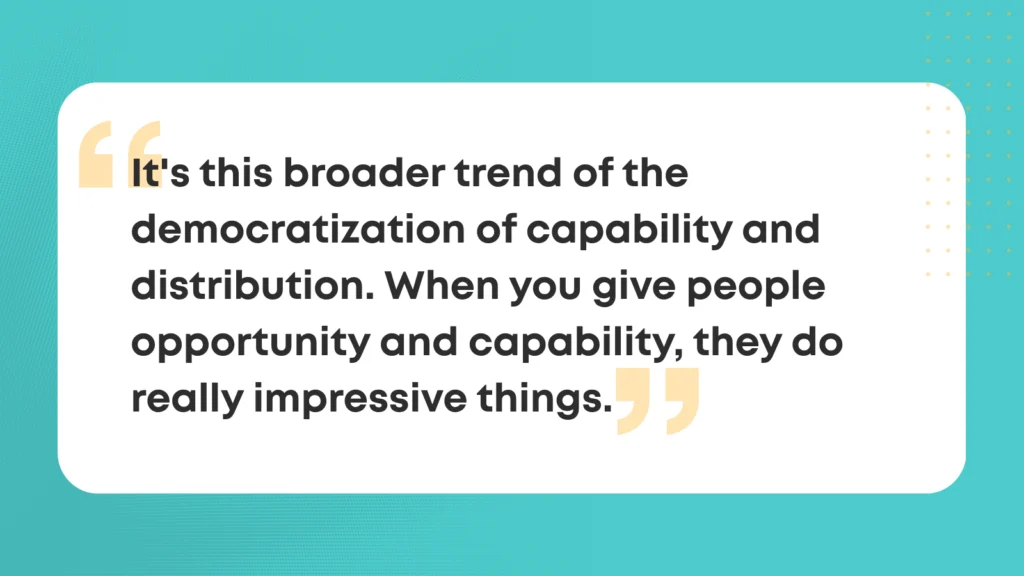
"When you give people opportunity and capability, they do really impressive things," Borthwick asserts, highlighting the inherent human capacity for innovation when provided with the right tools. He firmly believes this trend will only accelerate: "And it’s only going to get better tomorrow, and a year from now, and five years from now. It’s like we have superpowers – and our superpowers just keep getting stronger." This vision speaks to a future where individual and collective human potential is continually unlocked by advancing technology, leading to unprecedented problem-solving capacity.
This unwavering optimism is the driving force that keeps Borthwick engaged and committed to his work at BOLD Capital. The companies that BOLD backs are not merely developing new products or services; they are, in Borthwick’s view, actively "building the infrastructure of what humanity will be capable of next." This perspective elevates their mission beyond commercial success to one of fundamental societal advancement. By investing in areas like advanced robotics, synthetic biology, next-generation computing, and space exploration, BOLD Capital is helping to lay the groundwork for a future where humanity’s reach, capabilities, and capacity for addressing global challenges are dramatically expanded. The convergence of these exponential technologies, from AI and quantum computing to advanced materials and biotechnology, promises a future of profound transformation, addressing everything from climate change and disease to energy scarcity and interstellar exploration. The venture capital industry, through firms like BOLD Capital, stands at the forefront of this exciting, often challenging, but ultimately hopeful journey into the future.
