

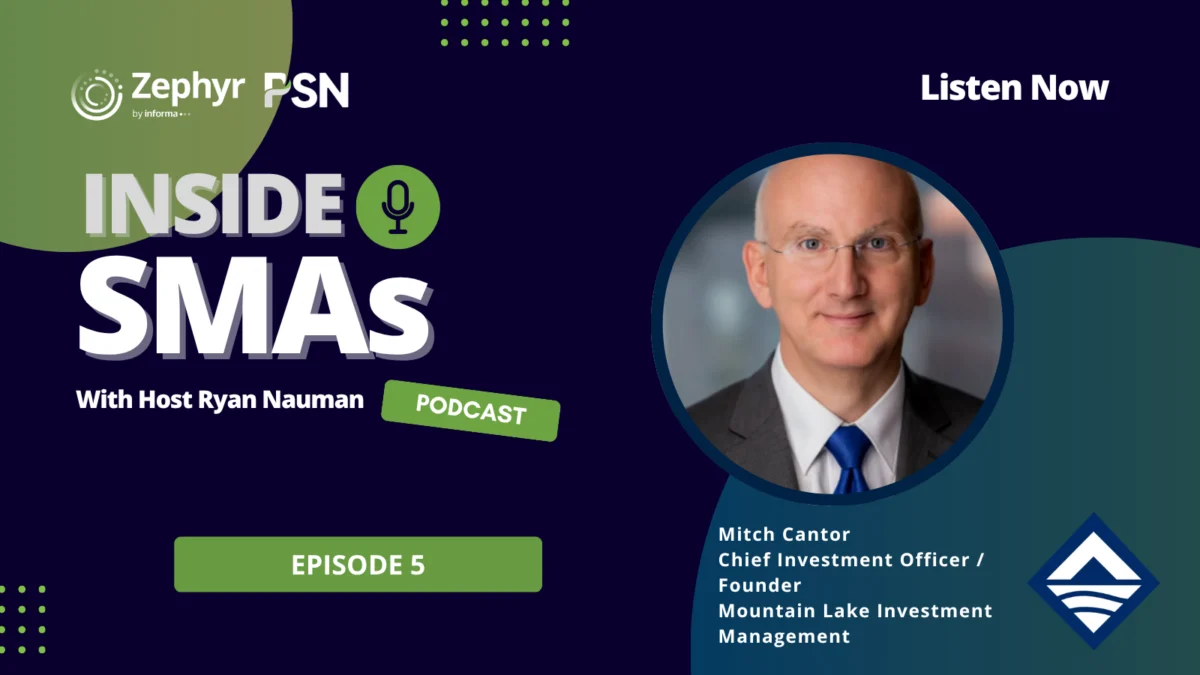
Ryan Nauman, host of the "Inside SMAs" podcast, recently welcomed Mitch Cantor, founder and Chief Investment Officer of Mountain Lake Investment Management, for an in-depth discussion on the firm’s distinctive approach to equity investing. The conversation, which delves into the people, structure, and core strategy of Mountain Lake, offers valuable insights for investors and financial advisors seeking to understand a philosophy that prioritizes capital preservation and long-term growth through a concentrated portfolio.
Cantor’s career trajectory provides a significant backdrop to his entrepreneurial venture. His foundational experiences at esteemed financial institutions such as Sanford Bernstein, Goldman Sachs Asset Management, and Weiss, Peck & Greer endowed him with a comprehensive understanding of market dynamics and investment management. These early years were crucial in shaping his perspective on what constitutes effective and sustainable investment practices. It was this accumulated knowledge and a desire to forge a path aligned with patient capital that ultimately led him to establish Mountain Lake Investment Management in 2001.
The founding of Mountain Lake was not merely an opportunistic move, but a deliberate strategic decision driven by a desire to rectify what Cantor perceived as a misalignment between many investment firms’ operational timelines and the true demands of long-term investing. He articulated this rationale by explaining that by establishing his own firm, he could directly influence the firm’s time horizon, ensuring it mirrored the patient, multi-year perspective required to harness the power of compounding and identify fundamentally sound businesses poised for sustained appreciation. This commitment to a long-term vision is a cornerstone of Mountain Lake’s identity.
Firm Structure and Investment Philosophy
At the heart of Mountain Lake Investment Management’s operational framework is a lean and highly focused investment team. Cantor highlighted the crucial partnership he shares with Patricia Coronado, his co-partner, emphasizing the synergistic dynamic that underpins their decision-making process. This two-person core allows for agility and deep collaboration, essential components for their concentrated investment approach.
A key differentiator for Mountain Lake is its unwavering commitment to fully in-house research. This means that every investment decision is rooted in proprietary analysis, free from the influence of external research reports or consensus views that might steer the firm away from potentially undervalued opportunities. This dedication to self-sufficiency in research enables a more independent and conviction-driven investment process.
The firm’s portfolio construction is characterized by its concentrated and unconstrained nature. Typically, Mountain Lake holds approximately 30 distinct names. This deliberate concentration is not arbitrary; it reflects a high degree of conviction in each selection. The top ten holdings often represent around half of the entire portfolio, underscoring the significant weight placed on their highest-conviction ideas. This approach stands in contrast to more diversified strategies that might hold hundreds of positions, aiming for broader market exposure rather than deep conviction in a select few.
Cantor elaborated on the core tenets of Mountain Lake’s investment philosophy, which is built upon a three-part foundation: capital preservation, inflation protection through equities, and an emphasis on attractive entry prices.
- Capital Preservation: This is not interpreted as a passive avoidance of risk, but rather an active strategy to protect investors’ principal from permanent erosion. This involves rigorous due diligence and a deep understanding of the businesses in which they invest, focusing on those with durable competitive advantages and sound financial health.
- Inflation Protection through Equities: In an environment where inflation can erode purchasing power, Cantor sees equities as a potent tool for maintaining and growing real wealth. He believes that well-selected companies, particularly those with pricing power, can pass on increased costs to consumers, thereby preserving their own profit margins and, by extension, the real value of investor capital.
- Attractive Entry Price: Even the highest-quality business can be a poor investment if acquired at an exorbitant price. Mountain Lake’s strategy meticulously seeks out opportunities where the market has undervalued a company’s intrinsic worth, creating a margin of safety for investors. This discipline is crucial in avoiding speculative bubbles and ensuring that investments are made with a favorable risk-reward profile.
Beyond these core principles, Cantor revealed that Mountain Lake strategically incorporates periodic holdings of cash and physical gold. This tactical allocation serves as a prudent measure to navigate periods of market uncertainty or when compelling equity investment opportunities are scarce. These "dry powder" reserves, along with gold’s historical role as a store of value, provide an additional layer of risk management and flexibility, allowing the firm to capitalize on dislocations when they arise.
The Evolution of Mountain Lake: A Chronology of Growth and Refinement
The establishment of Mountain Lake Investment Management in 2001 marked the beginning of a deliberate journey, shaped by Cantor’s prior experiences and a clear vision for long-term value creation. The early years were characterized by the foundational work of building the firm’s infrastructure, refining its investment processes, and cultivating a client base that shared its long-term investment ethos.
2001: Founding of Mountain Lake Investment Management by Mitch Cantor. The primary objective is to create an investment firm with a time horizon aligned with patient, long-term investing, a stark contrast to the often short-term pressures faced by larger institutions.
Early 2000s: Cantor, along with his early team, meticulously develops the firm’s proprietary research framework. This period is dedicated to identifying the core principles of business quality, management quality, and attractive entry price, which would become the pillars of their investment strategy. The initial portfolio is likely small, built with high conviction in a select group of companies identified through rigorous, in-house analysis.
Mid-2000s: The firm’s commitment to a concentrated portfolio, typically around 30 names, begins to take shape. This structure allows for deep dives into each holding, fostering a profound understanding of their respective industries and competitive landscapes. The partnership with Patricia Coronado solidifies, creating the core investment team.
Late 2000s: The global financial crisis of 2008 presents both challenges and opportunities. Firms like Mountain Lake, with a focus on capital preservation and quality businesses, are tested. Their strategy of holding cash and potentially gold likely provided a degree of resilience during this turbulent period, allowing them to weather the storm and potentially acquire high-quality assets at distressed prices.
2010s: As markets recovered and stabilized, Mountain Lake continues to execute its long-term strategy. The firm’s disciplined approach likely attracts investors seeking an alternative to more speculative or short-term oriented strategies. The emphasis on business quality and management quality becomes increasingly relevant in a complex and evolving economic landscape.
Early 2020s: The podcast interview in 2024 reflects the maturity of Mountain Lake’s strategy. The firm has navigated multiple market cycles, demonstrating the enduring relevance of its core investment philosophy. The ongoing emphasis on capital preservation, inflation protection, and attractive entry prices positions it to address current economic concerns, such as persistent inflation and geopolitical uncertainty. The mention of "Energy Bets Explained" suggests a tactical adaptation to specific market opportunities, while maintaining the overarching long-term focus.
Supporting Data and Market Context
While the podcast does not provide specific performance figures, the underlying principles of Mountain Lake’s strategy can be contextualized by broader market data and academic research. The emphasis on "business quality" and "management quality" aligns with factors often cited in studies of successful long-term equity investing. For instance, research from firms like McKinsey and academic papers on factor investing have consistently highlighted metrics such as return on equity (ROE), profit margins, and low debt-to-equity ratios as indicators of strong business quality. Similarly, the reputation and track record of management teams are qualitative but crucial elements in assessing a company’s future prospects.
The "attractive entry price" component is directly linked to the concept of value investing, a strategy that has demonstrated its efficacy over long periods. While growth investing focuses on companies with high growth potential, value investing seeks out undervalued assets. Historical data from sources like the Russell Value Index versus the Russell Growth Index, over extended periods, often show periods where value outperforms growth, and vice versa. However, the long-term average performance of value strategies, when implemented with discipline, has been robust.
The inclusion of "periodic cash and physical gold holdings" reflects a prudent risk management approach. Cash provides liquidity and optionality, allowing the firm to deploy capital when opportunities arise. Gold, traditionally seen as a safe-haven asset, has a long history of performing well during periods of high inflation, economic uncertainty, and geopolitical instability. Data from the World Gold Council often illustrates gold’s inverse correlation with stock market performance during crises, and its ability to retain value when fiat currencies are devalued.
The mention of a "value tilt" in performance discussions further solidifies the firm’s strategic positioning. A value tilt means that the portfolio tends to favor stocks that are trading at lower valuations relative to their fundamental worth. This approach can be particularly beneficial in environments where market sentiment may be overly optimistic or pessimistic, leading to mispricings.
The podcast also touches on "Energy Bets Explained," indicating that Mountain Lake is not rigidly adhering to a static set of industries but is willing to allocate capital to sectors where it sees compelling long-term opportunities, even if they are currently out of favor or experiencing secular shifts. This suggests a dynamic, rather than purely passive, approach to sector allocation, driven by fundamental analysis.
Broader Impact and Implications
The insights shared by Mitch Cantor on the "Inside SMAs" podcast have significant implications for several key stakeholders in the financial industry:
- For Financial Advisors: The discussion provides a clear model of how a firm can operate with a disciplined, long-term investment philosophy. It offers a potential solution for advisors seeking to incorporate strategies into client portfolios that emphasize capital preservation and inflation protection, particularly in the current economic climate. Understanding Mountain Lake’s approach can help advisors identify SMA managers whose philosophies align with their own client objectives. Zephyr’s PSN data, mentioned in the podcast, is a tool that advisors can leverage to discover and evaluate such managers.
- For Individual Investors: The podcast demystifies a sophisticated investment approach. It highlights the importance of understanding not just what an investment firm does, but why it does it. Investors who are concerned about market volatility, inflation, and the long-term erosion of purchasing power can find resonance in Mountain Lake’s focus on quality businesses, prudent risk management, and patient capital deployment.
- For the SMA Industry: Mountain Lake’s operational structure and investment strategy exemplify the value proposition of Separately Managed Accounts (SMAs). SMAs offer customization and transparency, allowing investors to directly own underlying securities and understand the manager’s specific approach. The firm’s concentrated, unconstrained strategy, driven by in-house research, showcases the diverse range of management styles available within the SMA universe.
The podcast episode, by featuring Cantor’s detailed explanation, contributes to a broader understanding of how niche investment strategies can thrive by adhering to fundamental principles. It underscores that success in investment management often hinges on a clear vision, a robust process, and the discipline to execute that vision consistently, regardless of prevailing market trends. The "Inside SMAs" podcast, through these conversations, serves as a vital platform for disseminating such knowledge and fostering informed investment decision-making.
