

The tragic assassination of UnitedHealthcare CEO Brian Thompson in December 2024 sent shockwaves through the corporate world, igniting a critical re-evaluation of executive security protocols. Boards of directors and compensation committees across the nation have since been engaged in intensified discussions, weighing the necessity of introducing or augmenting personal security measures for their senior leadership. While this devastating event served as a stark catalyst, a closer examination of proxy disclosures reveals that the trend toward enhanced CEO personal security perquisites was already in motion and has continued unabated, suggesting a deeper, pre-existing concern for executive well-being.
The Evolving Landscape of Executive Protection
Executive security programs are not a novel concept in corporate governance. For many years, publicly traded companies have incorporated security-related benefits into their executive compensation packages as a component of comprehensive risk management strategies. These often include provisions for residential security systems, dedicated personal security personnel, and secure transportation. Furthermore, these security measures frequently intertwine with policies governing the personal use of corporate aircraft. Companies may, in fact, mandate or strongly encourage CEOs to utilize company planes precisely to mitigate the inherent risks associated with public travel and to ensure a more controlled and secure transit environment. This practice, while often framed under the umbrella of security, also offers significant convenience and efficiency for executives.
The challenge in precisely quantifying the immediate impact of the Thompson incident lies in the timing of corporate disclosures. The majority of proxy statements filed for the 2025 fiscal year reflect compensation decisions and practices that were established prior to the fatal shooting. To gain an early understanding of emerging board attitudes and potential shifts in policy, Compensation Advisory Partners (CAP) undertook an analysis of companies with fiscal years concluding between March and November of 2025. This period encompasses several months following the UnitedHealthcare tragedy, providing a crucial initial snapshot of how boards are approaching security-related perquisites in its wake.
Key Findings: A Steady Ascent in Security Provisions

CAP’s comprehensive analysis of proxy statements from 90 large-cap U.S. public companies, with fiscal years ending between March and November 2025, has revealed several significant trends:
-
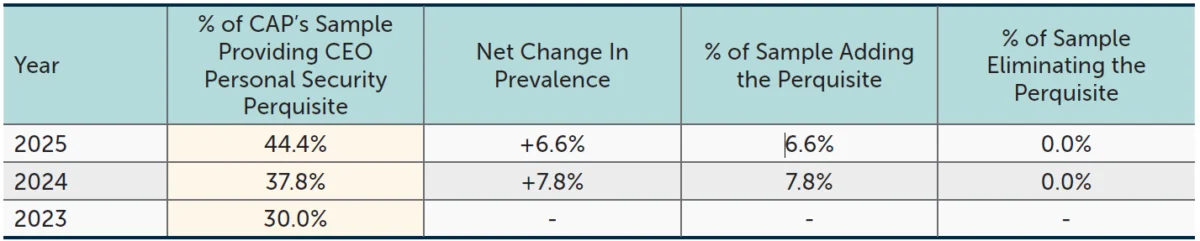
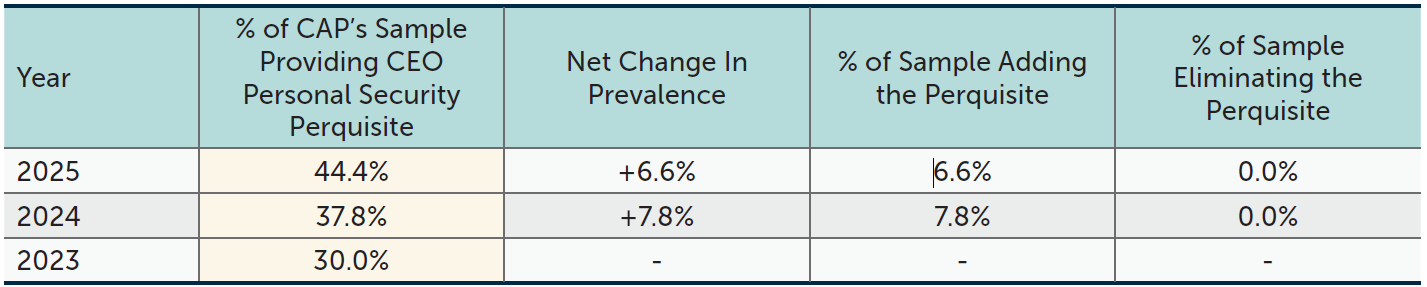
Prevalence of CEO Personal Security Perquisites: The study indicates a consistent upward trajectory in the provision of personal security perquisites for CEOs. By 2025, a substantial 44.4% of companies in CAP’s sample reported offering such benefits. This represents a steady increase over the preceding three fiscal years.
-
The Irreversibility of Security Perks: A particularly noteworthy observation is that the observed increases in prevalence exclusively reflect the addition of CEO security perks. Critically, no companies in the reviewed period reported eliminating these benefits. This stands in stark contrast to other executive perquisites, such as the personal use of corporate aircraft, where companies frequently both introduce and discontinue benefits over time, often linked to executive transitions. The absence of eliminations for security perks suggests that once implemented, they are widely perceived as essential, ongoing risk-mitigation measures rather than discretionary perks that can be easily retracted.
-
Post-Incident Influence: The approximately seven-percentage-point increase in the prevalence of security perks for 2025 suggests that a portion of companies may have indeed initiated or expanded their security programs in direct response to the UnitedHealthcare incident. However, it is important to note that only one company within CAP’s sample, an industry peer of UnitedHealthcare, explicitly referenced the event in its proxy disclosure. This suggests a more generalized, albeit palpable, shift in corporate risk assessment and preparedness.
-
Varied Forms of Security: The disclosed CEO security perks vary considerably in their scope and specific provisions. However, they generally encompass a combination of the following elements, often integrated into formalized executive security programs that are informed by internal or external risk assessments:
- Residential Security Enhancements: This can include the installation and ongoing maintenance of advanced security systems at the executive’s home, such as surveillance cameras, alarm systems, and secure perimeter fencing.
- Personal Security Personnel: The provision of trained security guards or bodyguards for the executive and their family, both during business hours and for personal time.
- Secure Transportation: This encompasses chauffeured vehicles, armored cars, and specialized security protocols for daily commutes and travel.
- Travel Security: This may involve pre-trip threat assessments, security escorts during business travel, and secure accommodation arrangements.
- Executive Protection Training: Providing executives with training on personal security awareness, threat recognition, and emergency response protocols.
Despite companies often viewing these provisions as critical for risk mitigation, U.S. Securities and Exchange Commission (SEC) disclosure rules generally mandate their reporting as executive perquisites if they provide a direct or indirect personal benefit to the executive. This regulatory framework necessitates transparency regarding the financial implications of these security measures.
The Financial Dimension: Costs and Trends
Among the companies that provided a quantifiable value for their CEO personal security perquisites, the reported costs exhibited considerable variation, directly correlating with the comprehensiveness of the security programs in place. While the median value of these perks saw a year-over-year decline, a significant majority of companies (72.0%) reported an increase in their CEO security perk value. Concurrently, the average value of these perks also increased, underscoring a discernible upward trend across the broader sample.
The average CEO security perk value stands notably above the 75th percentile, largely influenced by a subset of companies with exceptionally high costs, often indicative of more extensive and sophisticated executive security programs. Approximately 12.1% of companies disclosing a value for 2025 reported costs exceeding $1 million. It is crucial to note that year-over-year fluctuations in reported values may also reflect the episodic nature of certain security expenditures. For instance, the initial installation of a comprehensive residential security system can incur a substantial upfront cost, followed by lower ongoing costs for monitoring and maintenance in subsequent years. Therefore, changes in reported monetary value do not always equate to a direct change in the level of security being provided.
Personal Use of Corporate Aircraft: A Synergistic Benefit
The personal use of corporate aircraft continues to be one of the most prevalent executive perquisites and is frequently intertwined with executive security initiatives. In CAP’s sample, the prevalence of CEO aircraft perks experienced a modest increase over the past three years, reaching 44.4% for the 2025 fiscal year.
A significant observation is that 100% of the companies that introduced a CEO aircraft perk in 2025 cited security-related considerations in their proxy disclosures as the primary driver. Conversely, in instances where an aircraft perk was eliminated, it was invariably linked to a CEO transition, with the departing executive receiving the benefit and the incoming executive not being granted the same provision.

Further analysis of companies that provided CEO aircraft perks in both 2024 and 2025 revealed instances of enhanced benefit scope. For example, in 2024, 29% of these companies disclosed a dollar-value cap on their CEO’s aircraft usage, with a median cap of $225,000. For the 2025 fiscal year, more than one-third of these companies either eliminated this cap entirely (27.3%) or increased it (9.1%), with no instances of reduction.
The valuation of CEO aircraft perks is typically calculated based on incremental costs, such as fuel, crew, and landing fees. These costs can fluctuate meaningfully from year to year, depending on the frequency and duration of usage. Similar to the trends observed in security perk values, while the median value of aircraft perks declined year-over-year, a majority of companies (60.0%) reported increases in their reported values, and the average value also rose, indicating an overall upward trend.
Governance and Disclosure: Navigating Regulatory Waters
Security-related perquisites, like other executive benefits, are subject to the SEC’s stringent executive compensation disclosure rules. These regulations stipulate that companies must disclose perquisites when:
- The aggregate value of all perquisites and other personal benefits for an individual executive exceeds $10,000.
- The company cannot otherwise determine the full amount of the perquisite or personal benefit.
The complexities surrounding the disclosure of executive perquisites, particularly those related to security, were a subject of discussion at the SEC’s June 2025 Executive Compensation Roundtable. Regulators and market participants convened to consider whether the current disclosure framework adequately captures the nuances of benefits such as executive security programs.
Some commentators have advocated for a reclassification of security-related perquisites, suggesting they should be viewed as essential business expenses necessary for executive safety, rather than discretionary executive benefits. However, until such changes are officially implemented in disclosure rules, companies remain obligated to evaluate and disclose security arrangements under the existing perquisite framework. This often leads to a dichotomy where a benefit is perceived internally as a security necessity but is reported externally as a personal perquisite due to regulatory definitions.

Looking Ahead: A Persistent Focus on Executive Safety
The fatal shooting of Brian Thompson has undeniably amplified corporate awareness of executive security risks and has prompted numerous boards to meticulously reassess their strategies for protecting senior leaders. The preliminary evidence gleaned from off-cycle filers suggests that the trend towards more prevalent security-related perks was already gaining momentum prior to this tragic event and continues to expand.
The full ramifications of the UnitedHealthcare incident on executive security practices are likely to become more apparent during the 2026 proxy season. This period will see calendar-year companies filing their disclosures, encompassing a complete fiscal year that includes the aftermath of the event. CAP is committed to ongoing monitoring of proxy disclosures and market developments to meticulously assess the evolving landscape of executive security practices and the associated perquisites.
A confluence of factors – including escalating geopolitical tensions, deepening social and political polarization, and the increasing public visibility of senior executives – is poised to further influence how companies approach executive security. As the threat landscape continues to evolve, it is imperative for companies to consistently re-evaluate the scope, structure, and efficacy of their security-related perquisites to ensure the enduring safety and well-being of their most critical leadership assets. This proactive approach is not merely a matter of compliance but a fundamental aspect of responsible corporate stewardship in an increasingly complex world.
