

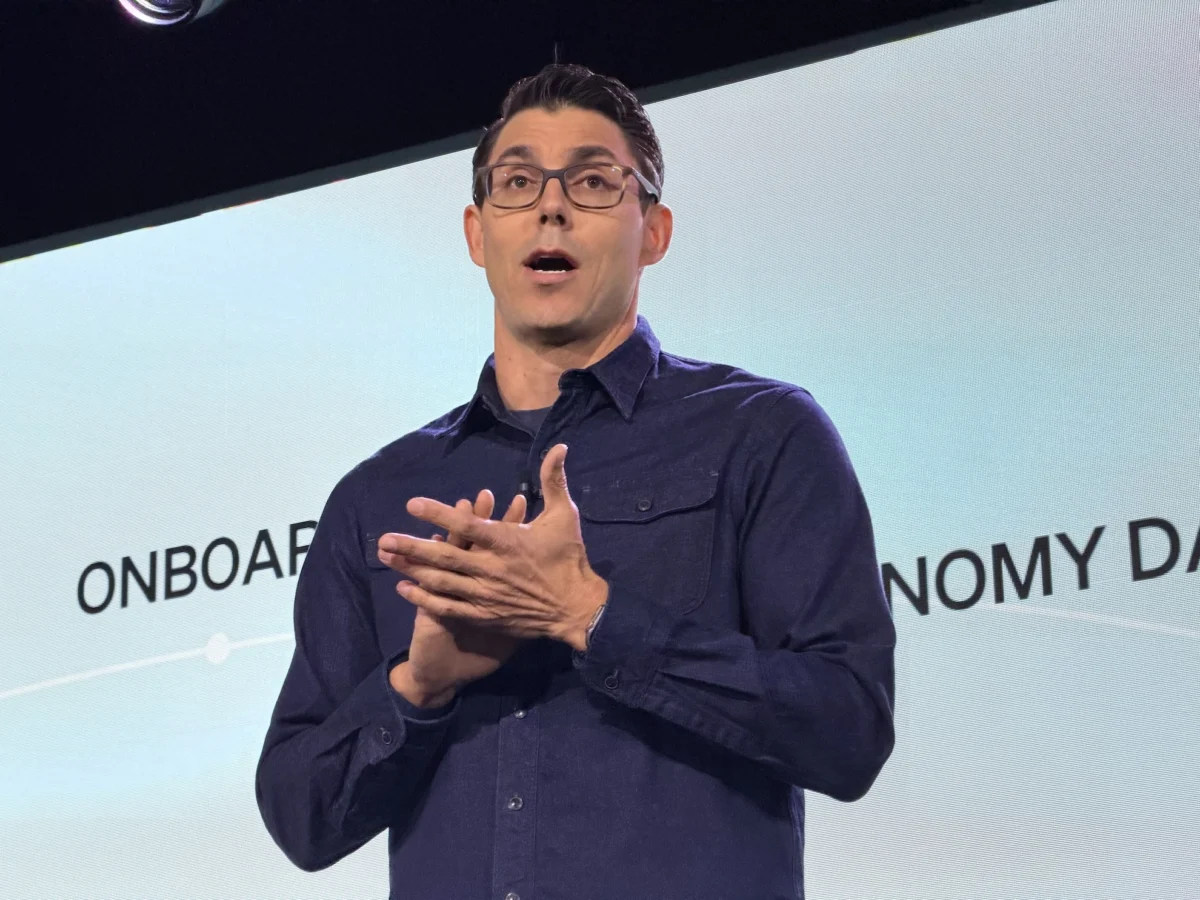
In the high-stakes world of venture capital and industrial manufacturing, few figures have demonstrated a more consistent ability to command the attention—and the checkbooks—of global investors than RJ Scaringe. In less than a decade, the MIT-educated engineer and serial entrepreneur has orchestrated a fundraising masterclass, securing more than $12.3 billion in capital for a trio of interconnected startups. While his flagship company, the electric vehicle manufacturer Rivian, accounts for the lion’s share of this figure, his newer ventures, Also and Mind Robotics, are already following an aggressive trajectory of capital accumulation that defies current market trends in the tech and automotive sectors.
The most recent indicator of Scaringe’s enduring appeal came this week with a $400 million funding round for Mind Robotics, his industrial AI and robotics firm. This latest injection of capital brings the total raised for his two newest ventures to over $1.3 billion in just over a year of operation. Such outsized raises for nascent startups have become increasingly rare in a post-zero-interest-rate environment, where investors have generally tightened their belts. When massive seed and Series A rounds do occur, they are typically reserved for "buzzy" defense technology firms or artificial intelligence laboratories founded by alumni of industry titans like OpenAI or Anthropic. Scaringe, however, has managed to secure these sums for sectors that are traditionally considered capital-intensive and "niche," such as electric micromobility and industrial automation.
The Architect of the Electric Adventure: A Chronology of Rivian
To understand the confidence investors place in Scaringe today, one must look back at the unconventional path of Rivian Automotive. Founded in 2009 as Mainstream Motors, the company spent nearly a decade in a state of self-imposed exile from the public eye. While other EV startups were making loud, often unfulfilled promises, Scaringe’s team worked quietly in suburban Michigan and later California, refining the "skateboard" platform that would eventually underpin their vehicles.
The company’s breakout moment arrived in late 2018 at the Los Angeles Auto Show. The unveiling of the R1T electric pickup truck and the R1S SUV was a watershed moment for the industry, signaling that a credible challenger to Tesla had arrived—one focused on the "utility and adventure" segment rather than luxury sedans. The response from the institutional and strategic investment community was immediate and overwhelming.
In early 2019, just months after the LA reveal, Rivian secured a $700 million round led by Amazon. This was followed by a $500 million investment from Ford Motor Company and a $350 million contribution from Cox Automotive. By the end of 2019, Rivian had closed a fourth round of $1.3 billion, led by funds advised by T. Rowe Price. The momentum continued through the pandemic; in 2020 and early 2021, the company raised an additional $5.15 billion across two rounds.
This culminated in November 2021 with one of the most successful Initial Public Offerings (IPOs) in American history. Rivian raised nearly $12 billion in gross proceeds, with its market capitalization briefly soaring past $100 billion. Although the company’s valuation has since corrected to approximately $18.2 billion—reflecting broader headwinds in the EV sector including high interest rates and supply chain complexities—the sheer volume of capital Scaringe attracted during this period remains a benchmark for the industry.
The Secret Sauce: Engineering Credibility and Storytelling
What separates Scaringe from other high-profile founders is a rare synthesis of technical depth and communicative art. Jiten Behl, a partner at Eclipse and former Chief Growth Officer at Rivian, suggests that Scaringe’s "superpower" lies in his ability to articulate a complex vision without falling into the trap of hyperbole. Behl, who joined Rivian when it was a skeleton crew, notes that Scaringe has a unique ability to communicate issues and opportunities so effectively that they become immediately credible to sophisticated investors.
Joe Fath, another partner at Eclipse who previously managed investments at T. Rowe Price, echoes this sentiment. Fath points to Scaringe’s dual identity as a "truly great engineer" and a "product design visionary." This combination allows him to operate at a high technical level while understanding the emotional resonance a product must have for both consumers and commercial buyers. Unlike many founders who lean heavily on one side of the brain, Scaringe’s involvement in the minutiae of suspension geometry or battery chemistry is balanced by a keen eye for aesthetic branding and user experience.
Furthermore, insiders note a distinct difference between Scaringe and other celebrity CEOs like Elon Musk. While Musk often centers his companies around his own persona, Scaringe is described as having an enthusiasm for the product that is "completely external." He is able to separate the selling of a revolutionary idea from the selling of himself, a trait that investors find refreshing and stabilizing in a sector often prone to "founder-worship" volatility.
Diversification into Also and Mind Robotics
While Rivian remains his most prominent achievement, Scaringe’s more recent ventures, Also and Mind Robotics, demonstrate his intent to build a broader ecosystem of autonomous and robotic technologies.
Founded in 2025, Also is focused on the electric micromobility market—specifically autonomous delivery vehicles. Despite the "niche" label often applied to this sector, Scaringe raised $105 million for the company in its first year. That figure has since ballooned to over $300 million, with DoorDash joining the roster of backers. The strategic logic is clear: as urban centers look to decarbonize, the "last mile" of delivery represents a massive, underserved market that requires the same battery and sensor expertise found in Rivian’s full-sized vehicles.
Mind Robotics, founded concurrently with Also, targets the industrial AI and automation space. This venture has moved with even greater velocity, raising $115 million in its first year, $500 million in March 2026, and an additional $400 million this week. Mind Robotics aims to apply the machine learning and computer vision technologies developed for autonomous driving to the broader manufacturing and logistics sectors. By diversifying into industrial AI, Scaringe is positioning his empire to capitalize on the global push for automated supply chains, a move that provides a hedge against the cyclical nature of the consumer automotive market.
Strategic Partnerships and the Path Forward
Scaringe’s ability to maintain investor confidence is also bolstered by high-profile strategic partnerships that provide both capital and operational validation. A recent $5.8 billion joint venture with Volkswagen Group has provided Rivian with a significant cash infusion and a massive partner for software and electrical architecture development. Additionally, a robotaxi partnership with Uber, valued at up to $1.25 billion, positions Rivian to be a key player in the future of autonomous ride-hailing.
However, the road ahead is not without significant challenges. Scaringe is currently managing three distinct, capital-intensive companies while overseeing the expansion of Rivian’s manufacturing footprint. This includes the existing plant in Normal, Illinois, and a massive new facility slated for Georgia. The logistical strain of traveling between Palo Alto, Irvine, Illinois, and Georgia—all while maintaining a hands-on approach to engineering—is immense.
The broader economic environment also remains a factor. The EV sector is currently navigating a period of slower-than-expected growth, and the competition in industrial AI is becoming increasingly crowded with well-funded incumbents. Critics often wonder if Scaringe is reaching his operational limit. Yet, according to those close to him, Scaringe views these challenges not as barriers, but as necessary components of a larger mission to create a multi-layered impact on how goods and people move.
Implications for the Tech and Industrial Landscape
The "Scaringe Phenomenon" serves as a case study for the modern industrial entrepreneur. It suggests that despite the "tech winter" and the cooling of the EV market, there is still an immense appetite for founders who can combine heavy-industry manufacturing with cutting-edge software and AI.
His success highlights a shift in venture capital priorities. Investors are increasingly looking for "hard tech" solutions—real-world hardware backed by sophisticated digital infrastructure. By successfully raising $12.3 billion across three ventures, Scaringe has proven that the "stealth and scale" model—operating quietly to build a technical foundation before launching with massive capital support—is a viable alternative to the "move fast and break things" ethos of Silicon Valley.
As Mind Robotics and Also continue to scale, the industry will be watching closely to see if Scaringe can replicate the cultural impact of Rivian in the fields of logistics and automation. If his fundraising track record is any indication, the market has already placed its bet: RJ Scaringe is not just building cars; he is building the foundational infrastructure for an autonomous, electric future. For now, the "Master of the Raise" shows no signs of slowing down, continuing to attract the billions necessary to turn his expansive engineering visions into industrial reality.
