

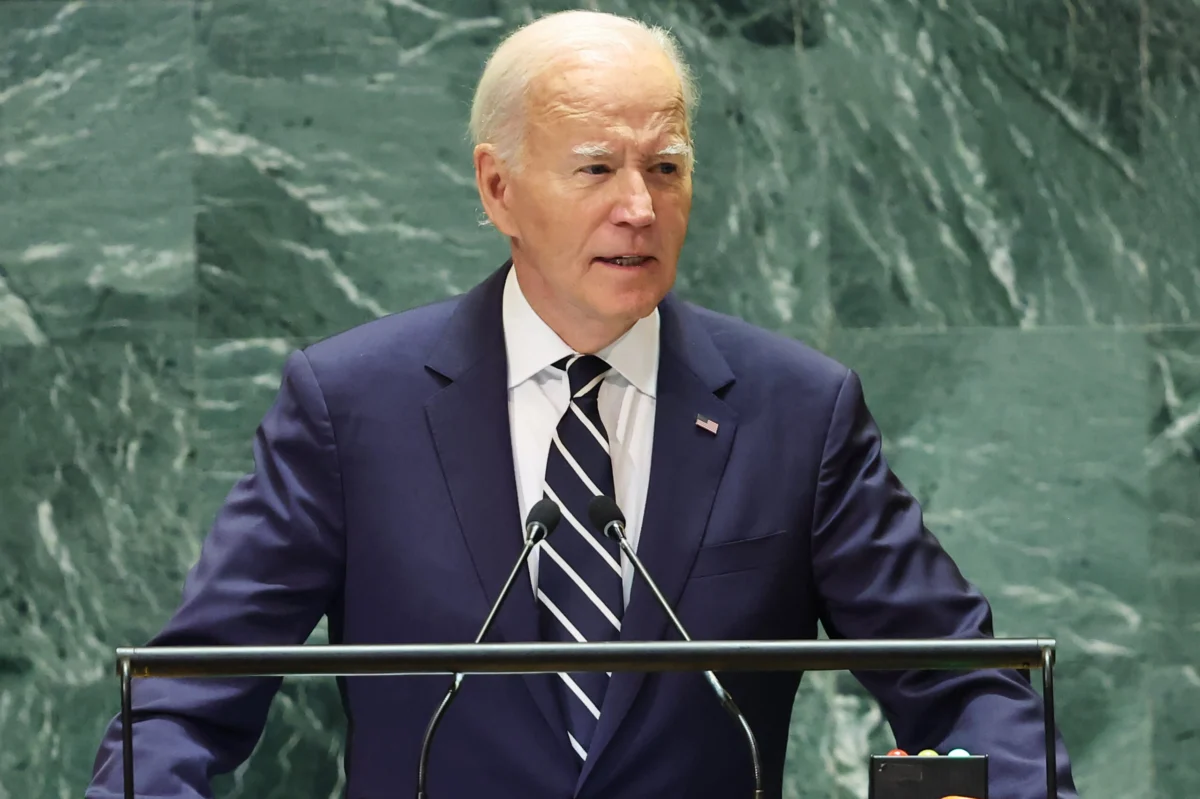
President Joe Biden stood before the United Nations General Assembly on Tuesday for the final time of his presidency, attempting to reconcile a half-century of diplomatic service with a global landscape currently fractured by devastating wars in the Middle East, Eastern Europe, and Northeast Africa. Addressing an audience of world leaders in New York, Biden sought to define his "foreign policy for the middle class" and his commitment to international alliances, even as the "rules-based order" he has championed for decades faces its most significant challenges since the end of the Cold War.
The speech served as both a valedictory address and a call to action. Biden, who took office in 2021 promising that "America is back," used the platform to argue that despite the current atmosphere of "despair," progress remains possible through collective action. However, the President’s optimistic rhetoric was frequently punctuated by the grim realities of the geopolitical backdrop, specifically the escalating conflict between Israel and Hezbollah, the protracted war of attrition in Ukraine, and the catastrophic humanitarian collapse in Sudan.
A Legacy Defined by Crisis and Continuity
Biden’s address was delivered at a critical juncture in his presidency, coming just four months before he is set to vacate the Oval Office. Throughout his remarks, he touched upon what the White House considers its hallmark foreign policy achievements: the revitalization of NATO, the strengthening of Indo-Pacific alliances like the Quad and AUKUS, and the establishment of global norms for emerging technologies such as artificial intelligence.
"I know many look at the world today and see difficulties and react with despair," Biden said, acknowledging the prevailing sentiment in a room filled with diplomats grappling with multiple simultaneous crises. "But maybe because of all I’ve seen and all we have done together over the decades, I have hope."
The President’s career has spanned the height of the Cold War, the post-9/11 era of interventionism, and the current shift toward great-power competition with China and Russia. In his final UNGA address, he sought to position his administration’s actions not as isolated responses to crises, but as part of a coherent strategy to uphold the U.N. Charter and prevent the world from sliding back into an era of unchecked aggression.
The Middle East: A Region on the Brink
Perhaps the most pressing challenge facing the Biden administration in its final months is the volatile situation in the Middle East. Since Biden’s 2023 address to the General Assembly, the region has been transformed by the October 7 attacks by Hamas on Israel and the subsequent military campaign in the Gaza Strip.
Biden used his speech to reiterate the necessity of a ceasefire and hostage deal, an objective that has remained elusive despite months of intensive mediation by the United States, Egypt, and Qatar. "Now is the time for the parties to finalize its terms, bring the hostages home, to secure security for Israel and Gaza free from Hamas’ grip, ease the suffering in Gaza, and end this war," Biden stated.
However, the conflict has already expanded beyond the borders of Gaza. In the days leading up to the General Assembly, Israel launched significant airstrikes against Hezbollah positions in Lebanon, following months of cross-border fire. This escalation has raised fears of an all-out regional war that could draw in Iran and further destabilize the global economy. Biden addressed these fears by calling for a diplomatic resolution along the Blue Line, the border between Israel and Lebanon, and emphasizing the need for a two-state solution as the only long-term path to stability.
The humanitarian data underscores the urgency of his plea. According to the Gaza Health Ministry, the death toll in the enclave has exceeded 41,000, while the United Nations reports that nearly the entire population of 2.3 million has been displaced. On the Israeli side, over 100 hostages remain in captivity, and tens of thousands of civilians have been displaced from northern communities due to Hezbollah’s rocket fire.
Ukraine and the Defense of Sovereignty
A cornerstone of the Biden presidency has been the mobilization of a global coalition to support Ukraine following Russia’s full-scale invasion in February 2022. Biden’s speech was a firm reminder to the international community that the defense of Ukraine is synonymous with the defense of the U.N. Charter’s principles of sovereignty and territorial integrity.
"We could have stood by and merely protested," Biden said, reflecting on the early days of the invasion. "But Vice President [Kamala] Harris and I understood that that was an assault on everything this institution was supposed to stand for. And so, with my direction, America stepped into the breach, providing massive security and economic and humanitarian assistance."
The President highlighted the expansion of NATO, which saw the addition of Finland and Sweden during his term, as a strategic failure for Russian President Vladimir Putin. However, he warned that the coalition must not succumb to "fatigue." This remark was directed as much toward the leaders in the room as it was toward domestic critics in the United States. In the U.S. Congress, a vocal minority of Republicans has grown increasingly skeptical of continued funding for Ukraine, despite the Biden administration authorizing over $175 billion in total aid since the war began.
Biden’s message was unequivocal: "You cannot grow weary. You cannot look away. We will not let up on our support for Ukraine, not until Ukraine wins a just and durable peace."

Addressing the "Forgotten War" in Sudan and Global AI Governance
While Ukraine and Gaza have dominated headlines, Biden also brought attention to the civil war in Sudan, often referred to by humanitarian organizations as the "forgotten war." Since April 2023, the conflict between the Sudanese Armed Forces (SAF) and the Rapid Support Forces (RSF) has created the world’s largest displacement crisis.
The President called on global powers to stop arming the rival generals and to prioritize the delivery of aid to millions of Sudanese facing famine. Current data from the International Organization for Migration (IOM) indicates that over 10 million people have been internally displaced or have fled Sudan, with experts warning that the death toll—currently estimated in the tens of thousands—could skyrocket if humanitarian corridors are not secured.
Beyond traditional warfare, Biden focused on the future of global governance in the digital age. He outlined the administration’s efforts to establish international principles for artificial intelligence, emphasizing that the technology must be developed and deployed in ways that protect human rights and prevent the spread of misinformation. Earlier this year, the U.N. General Assembly adopted a U.S.-led resolution on AI, the first of its kind, which Biden cited as a blueprint for managing the risks of the "next industrial revolution."
The Transition of Power and the 2024 Election
In a poignant moment of the address, Biden turned his focus inward to the state of American democracy and his personal decision to withdraw from the 2024 presidential race. In July, following concerns over his age and a difficult debate performance, Biden announced he would not seek re-election, endorsing Vice President Kamala Harris as the Democratic nominee.
"As much as I love the job, I love my country more," Biden told the General Assembly. "I decided, after 50 years of public service, it’s time for a new generation of leadership to take my nation forward. My fellow leaders, let us never forget: Some things are more important than staying in power."
This statement was viewed by analysts as a subtle critique of authoritarian leaders who cling to power, as well as a reaffirmation of the democratic process in the United States. The 2024 election looms large over the United Nations this week, as foreign diplomats attempt to gauge whether the U.S. will maintain its current internationalist trajectory under a potential Harris administration or return to the "America First" isolationism associated with former President Donald Trump.
A Marathon of Diplomacy: Meetings on the Sidelines
The General Assembly serves as a platform for more than just speeches; it is a hub for high-stakes "sideline diplomacy." Biden’s schedule for the week reflects a frantic effort to solidify his foreign policy legacy through bilateral and multilateral engagements.
On the Saturday preceding the assembly, Biden hosted the "Quad" summit in Wilmington, Delaware, meeting with the leaders of Australia, India, and Japan to discuss maritime security in the South China Sea and competition with China. On Monday, he met with United Arab Emirates President Mohamed bin Zayed Al Nahyan to discuss regional stability and economic cooperation.
The week’s diplomatic activities also include a meeting with Vietnamese President Tô Lâm to follow up on the comprehensive strategic partnership established last year. Most notably, Biden is scheduled to host Ukrainian President Volodymyr Zelenskyy at the White House on Thursday. Zelenskyy is expected to present a "victory plan" to both Biden and the two leading presidential candidates, Harris and Trump.
The dual nature of American politics was on full display in New York, as foreign leaders sought meetings with both the current administration and the potential successors. While Harris held her own sit-down with the UAE president, Donald Trump’s campaign confirmed he is expected to meet with Zelenskyy, Indian Prime Minister Narendra Modi, and Polish President Andrzej Duda.
Implications for the "Biden Doctrine"
As Joe Biden prepares to exit the world stage, the "Biden Doctrine"—characterized by the revitalization of alliances, the prioritization of democratic values over autocratic interests, and a cautious but firm approach to military intervention—faces an uncertain future.
The President’s final UNGA speech was an attempt to prove that the international system he helped build and defend for five decades is still capable of functioning in an era of extreme polarization and violent conflict. While he leaves office with NATO stronger and U.S. alliances in Asia more integrated than ever, the unresolved wars in Ukraine and the Middle East remain significant shadows over his record.
Ultimately, Biden’s address was a plea for the continuity of the American role as a "global stabilizer." Whether his successor will share this vision, or whether the world will move toward a more fragmented, multipolar reality, remains the central question facing the diplomats and heads of state who watched the 46th President deliver his final message to the world.
