

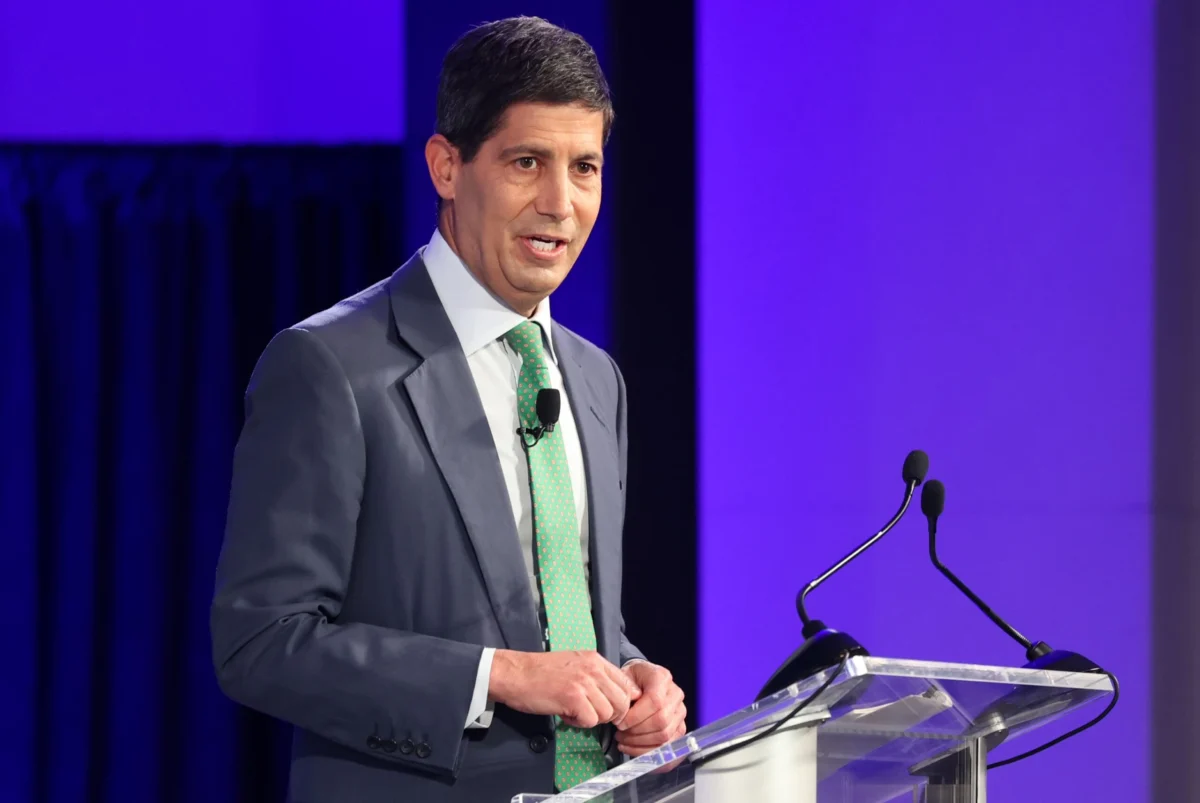
Kevin Warsh, a former Federal Reserve governor, stands at the precipice of potentially leading the world’s most influential central bank, but his ambitious agenda for a fundamental "regime change" faces a formidable array of challenges even before a confirmation hearing is formally scheduled. As oil prices surge, inflation forecasts climb, and futures markets increasingly signal the likelihood of a rate hike from the Federal Reserve, Warsh’s stated desire—and an explicit directive from President Donald Trump—to cut interest rates immediately collides with current economic realities and entrenched institutional norms.
The Contender and His Mandate
Kevin Warsh, 55, brings a unique blend of experience from his prior tenure as a Fed governor from 2006 to 2011, serving during the tumultuous global financial crisis, and more recently, a decade and a half in the private sector working alongside legendary investor Stanley Druckenmiller. This background, his supporters argue, has sharpened his market perspective and instilled a deep conviction that the Federal Reserve has strayed from its core mandate, making a series of long-running policy errors. His candidacy is heavily backed by President Trump, who has consistently advocated for lower interest rates, often publicly criticizing the current Fed Chair, Jerome Powell, for what he views as overly tight monetary policy. Warsh’s vision, often articulated as an overhaul of the central bank’s "operating system," aligns closely with Trump’s desire for a more accommodative monetary stance.
However, the economic landscape into which Warsh might step is fraught with complexities. The global economy is currently grappling with elevated energy prices, with crude oil recently nearing $100 a barrel, a level historically associated with inflationary pressures. This surge comes at a time when aggregate inflation forecasts are already on an upward trajectory, diverging significantly from the Fed’s own estimates. For instance, a prominent global forecasting group recently projected U.S. inflation at 4.2% this year, notably higher than the Fed’s more sanguine outlook. These conditions fundamentally challenge Warsh’s primary policy objective: to sharply reduce interest rates.
A Vision for Radical Reform: Deconstructing Warsh’s Agenda
Warsh’s proposed "regime change" at the Fed is multifaceted, touching upon interest rate policy, the central bank’s balance sheet, its communication strategy, and even its internal culture. Each facet, while driven by a desire for greater efficacy and credibility, presents distinct implementation hurdles.
Interest Rate Philosophy and Economic Headwinds:
At the core of Warsh’s policy agenda is a belief that interest rates are currently too high, impeding economic growth. He champions a view that advancements in artificial intelligence will rapidly boost productivity, allowing for faster economic growth without generating inflationary pressures. This perspective, however, finds skeptics even within the Federal Open Market Committee (FOMC). Chicago Fed President Austan Goolsbee, for example, publicly cautioned in February against relying too heavily on productivity gains to temper price pressures. "You want to be extremely careful," Goolsbee stated, "You can overheat the economy easily. Let’s be a little bit careful, circumspect."
Market expectations underscore the immediate disconnect between Warsh’s aspirations and current realities. Futures markets, which reflect investor sentiment on future interest rate movements, are currently pricing in a 35-40% chance of a rate hike by December, with no rate cuts anticipated for at least the next 16 months. The yield on the 2-year Treasury note, a sensitive indicator of short-term interest rate expectations, trades near 4%, signaling that markets expect the federal funds rate to hold steady at best, or even rise, for an extended period. Prior to recent geopolitical events, markets had only priced in a modest 50 basis points of cuts through 2026, falling short of Trump’s more aggressive demands for deeper rate reductions beyond the long-run neutral rate, typically estimated around 3%. This market judgment poses a direct challenge to Warsh’s economic argument regarding AI-driven disinflation.
Balance Sheet Overhaul and Its Risks:
Another cornerstone of Warsh’s agenda is a significant reduction of the Fed’s colossal balance sheet, which expanded dramatically during the 2008 financial crisis and again during the COVID-19 pandemic, peaking at over $8.9 trillion in mid-2022 and currently standing around $6.7 trillion. Warsh contends that the Fed’s large holdings effectively keep interest rates artificially high, troubling consumers, and that such an expansive role encroaches on fiscal policy, traditionally the domain of elected government. As he articulated in a November essay in The Wall Street Journal, "Money on Wall Street is too easy, and credit on Main Street is too tight. The Fed’s bloated balance sheet, designed to support the biggest firms in a bygone crisis era, can be reduced significantly."
His plan envisions a smaller balance sheet freeing up funds for greater lending into the real economy, with banks trading reserves more actively, providing the Fed with a clearer, more organic signal of market conditions and potentially earlier signs of systemic stress. However, history offers cautionary tales. In 2013, then-Fed Chair Ben Bernanke merely hinted at reducing asset purchases, triggering the "taper tantrum" that sent bond yields soaring globally. More recently, in 2019, Chair Powell’s efforts to shrink reserves led to a liquidity crunch in the repo market, forcing the Fed to inject funds to stabilize short-term rates. While Warsh has acknowledged the risks, stating that "regime change in policy shouldn’t be done overnight," any significant unwinding of the balance sheet, particularly the Fed’s roughly $2 trillion in mortgage-backed securities, could exert upward pressure on mortgage rates. This could create a direct conflict with President Trump’s previous directives to entities like Fannie Mae and Freddie Mac to buy mortgages to support the housing market.
Even within the Fed, there are nuanced views. Governor Chris Waller, a potential ally of Warsh, expressed support for reducing reserves only if banks’ demand for reserves also falls, perhaps through regulatory adjustments. "Reducing the balance sheet, holding reserve demand constant and moving to scarce reserves, to me, that’s just idiotic," Waller stated in a recent CNBC interview, highlighting the complexities and risks involved in such a maneuver.
Revamping Communication and Culture:
Warsh also promises highly visible changes to how the Fed communicates with the public and markets. He has indicated a disinclination to contribute to the Fed’s "dot plot," the anonymized projections of individual FOMC members for the future path of interest rates. He dismissed their importance for policy conduct at a financial-sector conference, arguing they "don’t matter that much." While the dot plot is controversial and often misinterpreted as a concrete plan rather than a collection of individual forecasts, it is a mainstay for Wall Street analysts who meticulously dissect it for clues about the Fed’s collective thinking.
More broadly, Warsh believes the Fed "overshares" and is overly reliant on "forward guidance," the practice of strongly promising easy policy in the future, which was heavily utilized during the Great Recession. In his view, this created a significant problem for Chair Powell and his colleagues in 2021 when inflation began to climb. The Fed, having committed to waiting, delayed raising rates even as price pressures persisted, costing the institution credibility. "They were sort of tortured because they had told you what they would do. You gotta get out of that. Spend less time predicting the future and more time shaping it," Warsh argued on a Hoover Institution podcast last year. A Fed that curtails its communication could be jarring for markets and the public, accustomed to parsing every word from officials. This shift would likely face resistance from officials themselves, who frequently engage with media and participate in conferences.

Internal Resistance and "Breaking Heads":
Beyond specific policy shifts, Warsh’s "regime change" also hints at a cultural overhaul. He famously told Fox News in July that the Fed might need "breaking some heads… because the way they’ve been doing business is not working." This suggests potential staff changes, bringing in new personnel, and adjustments to the economic models used for forecasting and policy analysis. Such a move would almost certainly encounter institutional resistance from long-serving Fed staff, who are fiercely protective of their expertise and the methodologies developed over decades. Similarly, existing Fed governors and district bank presidents, accustomed to established practices, may push back against radical departures from the status quo. Markets, generally averse to uncertainty, could also react negatively to such internal turbulence, perceiving it as a threat to the Fed’s traditional stability and predictability.
Navigating the Confirmation Gauntlet
Even securing the chair’s seat presents its own set of immediate political challenges. Warsh’s confirmation hearings have already been delayed by Senator Thom Tillis (R-N.C.), who has expressed discontent over an ongoing criminal investigation into current Fed Chair Jerome Powell. Tillis has vowed to hold up a Senate vote on Warsh’s nomination unless the Justice Department drops the probe, injecting partisan political maneuvering directly into the Fed’s leadership transition process. This incident underscores the increasing politicization of the central bank’s appointments and the delicate balance required to maintain its perceived independence.
The Philosophical Underpinnings: Warsh’s Critique of Past Fed Errors
Underpinning Warsh’s entire agenda is his deep-seated conviction that the Fed has made a series of profound policy errors, particularly since the 2008 financial crisis. He argues that the central bank maintained an excessively large balance sheet for too long, well beyond the emergency period, and subsequently missed the initial surge of inflation following the pandemic. For Warsh, these are not isolated missteps but rather systemic failures rooted in the institution’s very fiber, stemming from a lack of robust debate and an overreliance on "groupthink." His pursuit is not merely to install a new leader but to fundamentally reorient the institution. "What the Fed needs is more robust discussion of ideas, less groupthink. I don’t like it that everyone’s following the same models," Warsh told CNBC last year. For him, "Fed credibility is everything," and his proposed changes are designed to restore it.
Power Dynamics and Potential Allies
Despite the formidable obstacles, Warsh, if confirmed, would not be powerless. The Fed Chair, while only one vote on the 12-member FOMC, wields immense authority. The Chair sets the agenda for committee meetings, directs the organization’s influential research staff, and significantly shapes the public discourse around monetary policy. A Chair who wants specific data or analytical frameworks considered will almost certainly get their wish.
Warsh also has potential allies on the seven-member Board of Governors. Two current board members, Chris Waller and Michelle Bowman, were appointed by President Trump and could align with Warsh on several policy areas, particularly concerning balance sheet reduction and regulatory matters. The possibility of further Trump appointments to the Board, including potentially replacing Powell if he were to resign as governor after being replaced as chair, or other governors whose terms expire, could further solidify Warsh’s position. Furthermore, the Chair plays a crucial role in directing the 12 district Federal Reserve Banks regarding nominations for their presidents when vacancies arise, extending his influence across the system.
Implications and The Road Ahead
Warsh’s persuasive personality, rooted in the confidence of his convictions that the Fed has erred and he possesses the correct solutions, could be a powerful tool in navigating these challenges. He exudes a self-assuredness that contrasts sharply with the traditional cautious language of economists, a quality that likely appealed to President Trump.
The potential upsides of Warsh’s "regime change" could be significant: lower interest rates fostering economic growth, reduced market volatility around Fed pronouncements, and enhanced central bank independence as its smaller economic footprint minimizes its exposure to political scrutiny. Such a shift could fundamentally reshape the relationship between monetary policy and the broader economy, potentially unlocking new avenues for growth.
However, the downsides present considerable risks. A rocky transition process, marked by internal dissent and external market apprehension, could lead to increased market volatility and, paradoxically, push interest rates higher due to uncertainty. The abrupt abandonment of established communication tools could leave investors and the public scrambling to interpret the Fed’s intentions, potentially leading to mispricing of assets and economic instability. To avert such an outcome, Warsh would need to skillfully persuade his colleagues and the markets that his plan to overhaul the Fed is not only well-conceived but also implementable without causing undue disruption.
Ultimately, the success of Kevin Warsh’s potential tenure as Fed Chair hinges on the correctness of his analysis of the Fed’s past shortcomings and the efficacy of his prescriptions for its future. In an increasingly complex and interconnected global economy, the stakes for getting it right are transcendently high.
