

The transition from fossil-fuel-dependent housing to energy-efficient, climate-resilient homes is often hindered by a singular, formidable obstacle: the high upfront cost of retrofitting. For Kim Hodgkinson, a resident of Colchester, Nova Scotia, this barrier was a daily reality. Living in a bungalow that relied on an aging oil furnace and a failing heat pump, Hodgkinson faced the dual challenge of a drafty home and a fixed budget as a single mother. Despite the proximity of her home to her children’s school and her parents, the house lacked the fundamental necessity of reliable, affordable warmth. The financial burden of replacing doors that didn’t seal and an inefficient heating system seemed insurmountable until she encountered a municipal initiative that would fundamentally change her home’s energy profile.
Through a radio advertisement, Hodgkinson discovered "Cozy Colchester," a program designed to remove the financial friction associated with home energy upgrades. The program allowed her to finance critical improvements with repayments made directly to the municipality. This initiative is part of a growing movement across Canada utilizing the Property Assessed Clean Energy (PACE) financing model. By decoupling the cost of retrofits from a homeowner’s immediate savings and attaching the debt to the property itself, municipalities are unlocking a massive market for energy efficiency that was previously inaccessible to the average citizen.
The Mechanics of Property Assessed Clean Energy Financing
The PACE model is a deceptively simple financial innovation that addresses the primary reason homeowners hesitate to invest in green technology. Traditional bank loans for home improvements often come with high interest rates, short repayment terms, and personal credit requirements that can be restrictive. In contrast, PACE financing treats energy retrofits as a public good, similar to a sewer line or a sidewalk. The municipality provides the capital for the upgrades—ranging from insulation and window replacements to heat pumps and solar arrays—and the homeowner pays it back over a long period, often 10 to 20 years, through an assessment on their property tax bill.
One of the most significant advantages of this model is that the loan is tied to the property, not the individual. If the homeowner sells the property, the remaining balance and the benefits of the upgrades transfer to the new owner. This structure provides a level of security that has proven highly effective; a survey of program participants in Toronto indicated that nearly 80% of respondents would not have undertaken their retrofits without the availability of such a program. Furthermore, because the loans are secured by the property tax system, the rate of default is historically low, making these programs highly attractive to private investors and reducing the long-term risk for municipal governments.
A Chronology of Municipal Climate Action in Canada
The evolution of PACE financing in Canada has been a multi-decade journey of policy testing and scaling. The foundation was laid 26 years ago when the federal government, in partnership with the Federation of Canadian Municipalities (FCM), established the Green Municipal Fund (GMF). Initially intended as a mechanism for sustainable infrastructure, the GMF has evolved into a sophisticated delivery platform for climate solutions.
In 2013, the Halifax Regional Municipality took a pioneering step by launching "Solar City," the first major PACE-style program in the country. This initiative focused specifically on solar thermal and solar photovoltaic installations, providing over $27 million in financing and demonstrating that there was a significant appetite among residents for municipal-led energy financing.
The momentum shifted significantly in 2020. Leveraging a $300-million investment from the federal government, the FCM’s Green Municipal Fund launched the Community Efficiency Financing (CEF) initiative. This program was designed to help communities of all sizes—from rural townships to major urban centers—establish their own retrofit financing programs. Prior to this federal injection, only a handful of PACE programs existed in Canada. Today, the landscape has transformed into a network of more than 40 programs operating across eight provinces.
Economic Multipliers and Environmental Targets
The scale of the CEF initiative has produced measurable impacts on both the Canadian economy and the nation’s carbon footprint. According to data from the FCM, the programs currently active are expected to result in the retrofitting of approximately 16,000 homes. These projects are not merely environmental wins; they are economic engines. The initiative is projected to create 3,800 local jobs in the construction and green energy sectors and add an estimated $380 million to the national Gross Domestic Product (GDP).
From an environmental perspective, the urgency of these programs cannot be overstated. In Canada, buildings are responsible for approximately 18% of total greenhouse gas emissions, primarily through lighting, heating, and cooling. In May 2023, the federal government published a national electricity strategy that pledged to facilitate energy-saving retrofits for up to one million households. To reach this ambitious target, the PACE model serves as a critical bridge. By moving away from wood and oil heating—common in rural areas like Colchester—and toward high-efficiency electric heat pumps and solar power, these programs are directly contributing to the decarbonization of the residential sector.

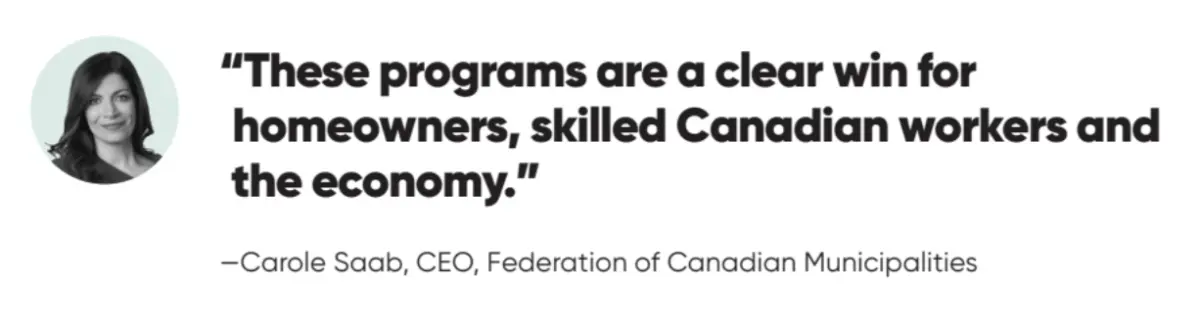
Carole Saab, CEO of the Federation of Canadian Municipalities, emphasizes that these local programs are the bedrock of a larger market transformation. Saab notes that strong communities are the foundation of a strong economy and that PACE works because it gives municipalities a practical way to deliver climate solutions at scale while simultaneously addressing the issue of affordability for residents.
Regional Success Stories and Private Sector Integration
The success of Cozy Colchester is mirrored in various forms across the country. In Alberta, the Clean Energy Improvement Program (CEIP) has successfully built a network of over 500 skilled workers to deliver projects, effectively smoothing the "boom-and-bust" cycles that often plague the construction industry. Justin Smale, manager of Calgary’s CEIP, highlights that the program injects capital into the local economy that would otherwise remain sidelined due to high interest rates or consumer hesitation.
In Ontario, programs like "Better Homes Kingston" and Guelph’s "Greener Homes" have adopted similar frameworks, tailoring them to the specific needs of their urban populations. These programs often go beyond simple financing by providing energy consultants and vetted lists of contractors. This support is essential for homeowners who may feel overwhelmed by the technical complexities of a deep energy retrofit.
The financial stability of the PACE model has also begun to attract significant private interest. To date, approximately $70 million in commitments has been secured from private lenders to augment public funds. This "blended finance" approach allows municipal programs to stretch their public dollars further, reaching more households without increasing the burden on the taxpayer.
From Efficiency to Resilience: Adapting to Extreme Weather
As climate change accelerates, the focus of municipal financing is expanding from simple energy efficiency to "residential resilience." This shift is a response to the increasing frequency and severity of extreme weather events, such as wildfires, floods, and heatwaves. The 2022 impact of Hurricane Fiona in Atlantic Canada served as a pivotal moment for this policy evolution. With $800 million in damages, Fiona was the most costly extreme-weather event in the region’s history.
Christina Lycan, another Colchester resident, experienced the necessity of resilience firsthand during the storm. After losing power and water for nearly a week while caring for a two-week-old baby, Lycan utilized the Cozy Colchester program to install a backup battery system and solar panels alongside her heat pumps. When a severe storm struck the area again in December, knocking out power for 48 hours, Lycan’s home remained fully functional.
Recognizing this need, the FCM is expanding the PACE framework through its Residential Resilience Financing offer. This initiative encourages homeowners to invest in measures that protect their properties from climate disasters, such as HVAC air purifiers for wildfire smoke, water-resistant basement materials for flooding, and backup power systems. By integrating resilience into the financing model, municipalities can help safeguard long-term property values and support the insurability of homes in high-risk areas.
Broader Implications and Future Outlook
The trajectory of PACE financing in Canada suggests a permanent shift in how municipal governments view their role in climate mitigation. By acting as a financial intermediary, cities and towns are filling a gap that neither the federal government nor the private banking sector has been able to close effectively on its own.
The success of these programs demonstrates that when the barrier of upfront cost is removed, the public is willing and eager to participate in the green transition. The low default rates and high satisfaction levels among participants like Hodgkinson and Lycan provide a blueprint for further expansion. The next phase of this evolution is likely to see the PACE model applied to commercial and multi-residential buildings, which represent another significant portion of urban emissions.
The Federation of Canadian Municipalities and the Green Municipal Fund continue to play a central role in this transformation. By using seed funding from a stable endowment and recycling interest and repayments from municipal loans, the GMF ensures a self-sustaining cycle of investment. As the federal government looks toward its goal of retrofitting one million homes, the infrastructure provided by the CEF initiative stands as the most viable platform for achieving national climate targets while fostering local economic prosperity and individual household security. Learn more about these initiatives at greenmunicipalfund.ca/invest.
