

Vanguard, Inc., a global leader in investment management, has reported significant and accelerating growth in its Investor Choice program, a groundbreaking initiative that empowers individual investors, financial advisors, and retirement and 529 plan sponsors to direct how their portion of eligible funds’ shares are voted at company shareholder meetings. The program, detailed in a recent Vanguard report authored by John Galloway, Global Head of Investor Engagement, reflects the company’s enduring commitment to democratizing financial participation and extending its investor-centric philosophy to the realm of corporate governance.

A New Era of Investor Empowerment in Proxy Voting
At its core, Vanguard Investor Choice represents a fundamental shift in how index fund investors engage with the companies they collectively own. Historically, index funds, by their nature, have voted on behalf of their shareholders according to pre-established voting policies. However, as index investing has become more accessible and mainstream, a growing number of investors have expressed a desire to have a more direct say in matters affecting the companies within their portfolios. Investor Choice addresses this demand by providing a simple, accessible, and free mechanism for investors to exercise their proxy voting rights.
"Vanguard Investor Choice extends that philosophy to proxy voting by making participation simple, accessible, and free," the report states. This initiative allows investors to make a single policy selection that influences their voting power across thousands of individual ballot items for companies held within eligible Vanguard equity index funds. Clients can choose from a curated menu of distinct policy options, designed to align with a diverse range of investment preferences and values.

Exponential Growth and Expanding Reach
The evolution of Vanguard Investor Choice has been marked by substantial and rapid expansion, demonstrating a strong resonance with the investing public. A 2026 survey conducted by Vanguard, involving nearly 1,000 investors, revealed that 85% of respondents believe it is important for asset managers to consider their voting preferences. Furthermore, over half (55%) expressed a keen interest in participating in such programs, underscoring the latent demand for greater investor agency in proxy voting.
This sentiment is clearly reflected in the program’s participation statistics. Between July 2025 and July 2026 alone, the number of participating fund shareholders surged from 82,000, representing $9 billion in assets under management, to an impressive 507,000, managing $151.3 billion. This represents a staggering 17-fold increase in assets of participating funds with a policy selection and a six-fold increase in participating fund shareholders over a single year. The report highlights that during the U.S. proxy voting season, instances of over 1,000 fund shareholders choosing a voting policy in a single day on Vanguard’s retail brokerage platform became common, with one day seeing more than 5,000 shareholders make their selections.

Technological Innovations Driving Accessibility and Engagement
Vanguard’s commitment to making Investor Choice accessible has been further bolstered by significant technological enhancements throughout 2026. These innovations have streamlined the process, allowing hundreds of thousands of investors to engage with the program through familiar digital channels.
A key development was the expanded partnership with Broadridge Financial Solutions, announced in March 2026. By integrating Investor Choice into Broadridge’s widely used ProxyVote digital platform (ProxyVote.com), investors holding Vanguard funds through third-party brokerage platforms gained seamless access. This integration made Investor Choice the inaugural index fund proxy voting program available on ProxyVote.com, a platform already familiar to millions who use it for voting on individual securities.

Further innovation came through a new pass-through voting solution developed by BetaNXT in collaboration with stewardship technology firm Tumelo. This solution leverages advanced technology to manage the end-to-end collection and application of investor voting policy choices, thereby broadening participation to an even wider array of eligible investors.
In an effort to embrace cutting-edge user interfaces, Vanguard also introduced a voice-activated pathway to access Investor Choice in early 2026 through an integration with Amazon’s Alexa. By simply saying, "Alexa, take me to Vanguard Investor Choice," users could receive an overview of the program, learn about its functionality, and obtain a direct link to enroll. This initiative, aligning with the ethos of empowering investors to "use their voice to have a voice," marked a novel approach to investor engagement.
Global Expansion and Retirement Plan Integration
The success of Investor Choice is not confined to the U.S. In 2026, Vanguard initiated a pilot program for eligible professional investors in the United Kingdom, allowing them to express preferences on shareholder voting decisions in select Vanguard U.K.-based index equity funds. As of June 2026, this U.K. pilot had already garnered $3 billion in policy elections from early participants, prompting Vanguard to explore further expansion opportunities outside the U.S.
The program’s accessibility for retirement plans has also seen significant advancements. Building on enhancements made in 2025 that broadened the availability of eligible mutual funds, ETFs, and collective investment trusts, participation among retirement plan clients has surged. As of July 31, 2026, nearly 80 retirement plan clients had opted into Investor Choice, collectively representing $120 billion in assets under management and encompassing over one million underlying plan participants.
Future Outlook and Broader Impact on Corporate Governance
Vanguard’s strategy for Investor Choice is focused on seamless integration and continuous expansion. The program is designed to automatically apply client policy elections as more Vanguard equity index products become eligible. Hundreds of thousands of clients have already pre-selected policy options for future eligible products, ensuring that their voting intentions will be applied immediately as these funds join the program. As of July 31, 2026, total voting policy selections across Vanguard’s U.S. equity index lineup covered $270 billion in assets. Approximately $150 billion (60%) of this lineup currently applies client policy elections, with an additional $120 billion (40%) representing products with pre-filed policy selections ready for future program integration. Vanguard has committed to bringing all U.S. equity index funds holding U.S. securities into Investor Choice by 2027.
The implications of Investor Choice extend beyond individual investor empowerment; they contribute to a more robust and dynamic corporate governance ecosystem. By providing a spectrum of clearly defined proxy voting policies, Vanguard acknowledges that no single approach can fully capture the diverse range of investor perspectives on maximizing long-term shareholder returns. The program allows investors to select policies that best align with their preferences on critical corporate governance issues.

Diverse Policy Preferences and Demographic Insights
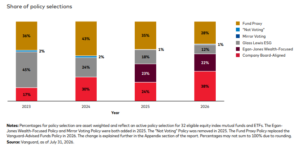
Analysis of policy selections reveals a broad dispersion of investor preferences. In 2026, no single policy was chosen by more than 38% of eligible equity index fund and ETF holders. This contrasts with the preferences of participating retirement plan sponsors, who predominantly favored the "Fund Proxy Policy" option. Overall, over 70% of voting policy selections among eligible mutual fund and ETF holders were for policies other than the Fund Proxy Policy as of July 31, 2026.
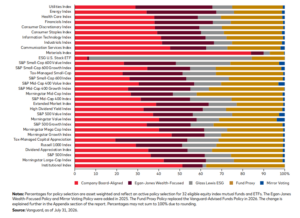
Examining trends over time, the "Company Board Aligned Policy" saw increased selection in 2026 compared to prior years, while the "Fund Proxy Policy" and "Glass Lewis ESG Policy" experienced a decrease in selection rates. Vanguard attributes this shift to the evolving investment objectives and shareholder bases of funds being added to the program, rather than a fundamental change in investor preferences. For instance, the consistent high selection rate of the Glass Lewis ESG policy among holders of the ESG U.S. Stock ETF, hovering around 73% in 2023 and 78% in 2026, supports this view.

Deep Dive into Investor Brokerage Client Behavior
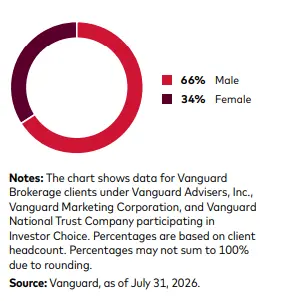
Vanguard’s retail brokerage platform provides a rich dataset for understanding how individual investors engage with Investor Choice. As of July 2026, participating brokerage clients demonstrated strong interest in influencing how their funds vote on key company decisions. The participating assets on this platform grew by 7.5 times from July 2025 to July 2026, reaching $45 billion, with 225,000 participating Vanguard Brokerage fund shareholders.
Demographic analysis of these clients offers further insights:
-
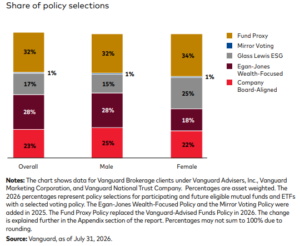
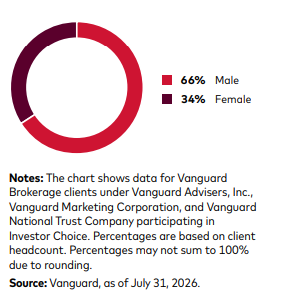
Gender: Distinct differences emerged in the selection of the Glass Lewis ESG Policy and the Egan-Jones Wealth Focused Policy. Female fund shareholders opted for the Glass Lewis ESG Policy at nearly double the rate of their male counterparts (25% versus 15%). While the "Mirror Voting Policy" saw increased selection among both genders, it remained a niche choice, accounting for only 1% of all policy selections. Notably, males participated in the program at twice the rate of females.
-
Age: Participating brokerage clients who made a policy selection had a median age of 66, significantly higher than the 45 median age of nonparticipating clients. Younger investors (ages 31-45) showed a slightly higher preference for the Mirror Voting Policy. The preference for the Glass Lewis ESG Policy generally decreased with age, while the Company Board Aligned Policy saw a rise in preference among older age groups. Nearly 60% of participating Vanguard Brokerage clients are over the age of 62, indicating a strong engagement from more established investors.
-
Investable Assets: A clear correlation exists between account balances and policy preferences. The selection rates for the Company Board Aligned Policy and the Egan-Jones Wealth Focused Policy increased with higher account balances, whereas the preference for the Glass Lewis ESG Policy declined as investable assets rose. Nearly half of participating clients possess $1 million or more in investable assets.
Conclusion: A Future of Enhanced Investor Voice
Vanguard Investor Choice represents a significant stride towards a more inclusive and participatory corporate governance landscape. By leveraging technology and a deep understanding of investor needs, Vanguard has successfully democratized proxy voting, empowering millions to have a tangible voice in the companies they invest in. The program’s exponential growth, coupled with ongoing technological enhancements and a commitment to global expansion, signals a robust future for investor engagement in the proxy voting ecosystem. The detailed insights into policy preferences across various demographics further underscore the program’s success in catering to a diverse investor base, solidifying Vanguard’s position as a leader in investor advocacy and innovation.

The full Vanguard report can be accessed here: https://corporate.vanguard.com/content/dam/corp/about-our-funds/pdf/investor-choice/how_investors_vote_september_2026.pdf
