


The middle market, a crucial engine of economic growth and innovation, continues to navigate a complex landscape shaped by geopolitical shifts, evolving consumer demands, and fluctuating capital markets. In its latest recurring market update, Intrepid Investment Bankers, a leading M&A advisory firm, provides critical insights into the transaction activity, valuation trends, and capital markets developments that are impacting companies in this vital segment. The firm’s analysis, focusing on the period impacted by significant tariff implementations, reveals a nuanced picture of profitability and strategic positioning, particularly within the industrial sector. While overarching concerns about tariffs have loomed, Intrepid’s data suggests a more resilient profitability performance for many companies than initially anticipated, though a distinct divergence in success has emerged based on a company’s position within the value chain.
Market Pulse: Navigating the Tariff Headwinds
The implementation of tariffs, a significant policy shift that began to escalate in late 2018 and continued through subsequent periods, created a ripple of uncertainty across the global industrial economy. Businesses faced the immediate challenge of rising input costs and the potential for retaliatory measures from trading partners. However, Intrepid’s analysis, drawing on data from S&P Global Capital IQ and its own proprietary insights, indicates that many middle-market companies have demonstrated a surprising capacity to absorb and mitigate these cost pressures.
Beneath the surface of aggregate profitability, a clear dichotomy has emerged. Companies that supply critical materials, components, and subassemblies to other manufacturers have generally experienced a strengthening of their pricing power. This enhanced ability to dictate terms and pass on increased costs has, in turn, allowed them to expand their profit margins. Conversely, businesses focused on producing and selling finished products have encountered a more challenging environment. These companies have found it more difficult to translate rising costs into commensurate price increases for their end consumers, often facing greater competition and less leverage in their customer relationships.
Intrepid’s examination delves into how this value-chain positioning has influenced margin performance throughout the tariff period. The implications of these findings are significant for business owners considering strategic decisions, investors evaluating acquisition targets, and acquirers seeking to understand the underlying health and future potential of middle-market enterprises.
M&A Market Snapshot: The Value Chain Advantage
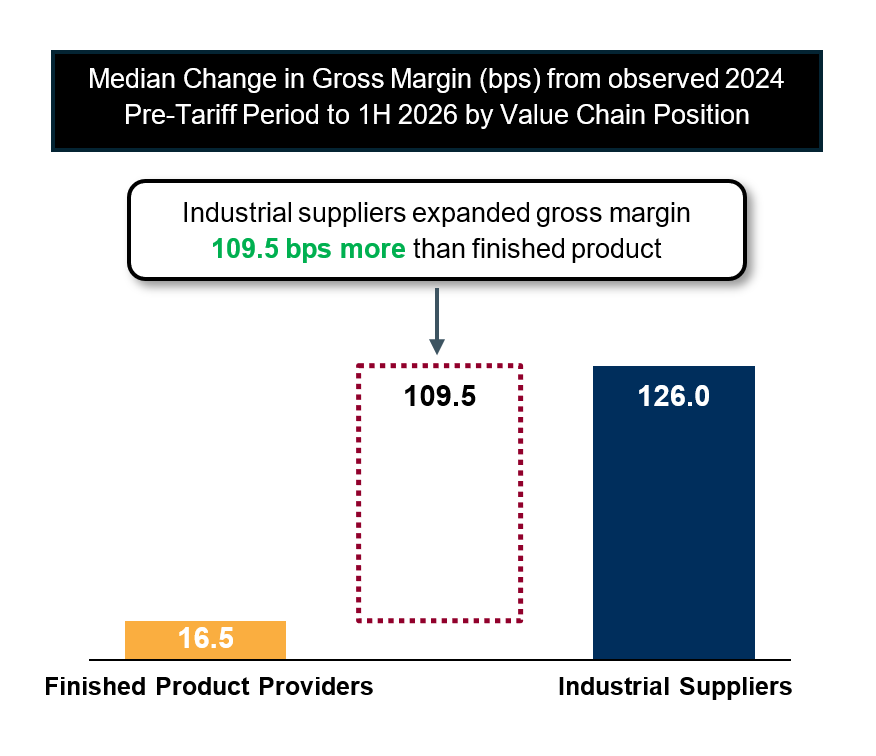
The data presented by Intrepid Investment Bankers paints a compelling picture of the differential impact of tariffs on industrial companies. The analysis, which compares performance from pre-tariff levels (specifically, Q3-Q4 2018) to the first half of 2026, reveals a notable outperformance by industrial suppliers of materials, components, and subassemblies relative to finished product providers.
During this period, the median gross margin for suppliers expanded by a significant 126.0 basis points. In stark contrast, finished product providers saw a more modest median gross margin expansion of only 16.5 basis points. This substantial difference highlights a key trend: the ability to control pricing and absorb cost increases is not uniformly distributed across the industrial spectrum.
The advantage for suppliers was also broad-based, indicating that this was not an isolated phenomenon. A robust 74.2% of supplier companies managed to improve their gross margins. This contrasts with the 53.2% of finished product providers that achieved similar margin improvements. While it is important to note that margins rose for both groups, suggesting that tariffs did not broadly compress industrial profitability across the board, the magnitude of the gains and the proportion of companies experiencing them clearly favor the upstream segments of the value chain.
The Mechanics of Margin Expansion: Pricing Power in Action
The fact that margins rose for both supplier and finished product groups indicates that, in many instances, pricing power outpaced the direct cost increases stemming from tariffs. However, the distribution of these gains is where the value-chain divergence becomes critical.
Suppliers, by their nature, often provide products that are integral to their customers’ manufacturing processes. These components and materials are frequently designed into specific customer specifications, making them difficult and time-consuming to replace with alternative suppliers. This inherent stickiness of their offerings provides suppliers with a strong foundation for negotiating price adjustments. Many suppliers were able to implement price increases effectively, often through surcharges or by leveraging index-linked contracts that automatically adjust for fluctuating commodity prices. This proactive approach allowed them to not only recover increased input costs but also to capture a portion of the value they provide.
Finished product providers, on the other hand, typically face a more direct and often more competitive marketplace. Their customers are the end consumers, who are more sensitive to price changes. Furthermore, finished product manufacturers are more likely to encounter direct competition from imported goods, which may not be subject to the same tariff structures or may have lower production costs. This intensified competitive pressure limits the extent to which finished product providers can pass on cost increases without risking a significant loss of market share. The visibility and contestability of pricing in the finished product segment make it a more challenging environment for margin expansion, especially when faced with escalating input expenses.

Implications for Owners, Investors, and Acquirers
The insights gleaned from Intrepid’s analysis carry significant weight for various stakeholders within the middle market. Understanding these dynamics is crucial for strategic decision-making, valuation assessments, and successful transaction execution.
Valuation Considerations: Durability of Gains
A primary concern for any buyer evaluating a middle-market company is the sustainability of its financial performance. In the context of recent tariff-driven margin improvements, buyers will be scrutinizing the durability of these gains. If a company’s increased profitability is largely attributable to temporary tariff surcharges, these gains are likely to reverse if tariff policies shift or are repealed. Conversely, margin improvements stemming from genuine, long-term pricing power, driven by product differentiation, strong customer relationships, or a dominant market position, are far more likely to be sustained.
Companies that can clearly articulate and demonstrate the underlying drivers of their margin expansion – differentiating between temporary surcharges and lasting competitive advantages – will command stronger valuations. This requires robust internal data and a clear strategic narrative that supports the sustainability of improved financial performance. For owners, this means preparing a compelling case that highlights enduring strengths rather than fleeting benefits. For acquirers, it underscores the importance of due diligence to ascertain the true nature of profitability enhancements.
Strategic Positioning: The Value of Indispensability
The analysis strongly reinforces the strategic value of being "hard to replace." Companies that supply essential components or services, and whose offerings are deeply integrated into their customers’ operations, possess a significant competitive advantage. This advantage translates into greater pricing power, improved margin stability, and enhanced resilience in the face of economic headwinds.
For finished product providers facing margin pressure, a strategic imperative may emerge to acquire or partner with critical component suppliers. This vertical integration or strategic alliance could serve multiple purposes: securing a more stable and cost-effective supply chain, gaining greater control over input costs, and potentially absorbing some of the pricing leverage previously held by their suppliers.
Investors are likely to favor supplier businesses with demonstrated pricing power as attractive acquisition platforms. These companies often represent more stable investment profiles and offer a clearer path to sustained profitability, making them ideal candidates for platform acquisitions aimed at building larger, more diversified businesses.
Transaction Timing: Seizing Opportunities
The current market conditions present distinct opportunities for different types of middle-market companies. Owners of supplier businesses that have experienced strong margin performance and demonstrated pricing power are in a particularly favorable position to explore strategic transactions. The timing is opportune to capitalize on this recent performance while it is fresh in the minds of potential buyers and investors. This could involve exploring a sale of the business, a recapitalization to extract liquidity, or other strategic initiatives that leverage their current strength.
For finished product providers that have been under margin pressure, the path to improving their competitive standing may lie in achieving greater scale. Through mergers and acquisitions, these companies can consolidate market share, achieve economies of scale in purchasing and operations, and potentially gain more leverage in their customer negotiations. Scale can be a powerful tool for recovering pricing leverage and improving overall profitability in a challenging market.
However, it is crucial to acknowledge that value-chain position is not an absolute guarantee of success. Intrepid’s analysis points out that approximately a quarter of suppliers did not experience margin expansion, indicating that even within advantageous segments, operational execution and strategic acumen remain paramount. The strongest companies, regardless of their position, will be those whose gains reflect lasting competitive advantages and robust operational strategies, rather than purely temporary benefits derived from shifting policy landscapes.
Broader Economic Context and Chronology
The period examined by Intrepid Investment Bankers coincides with a significant shift in global trade policy, primarily driven by the United States’ imposition of tariffs on goods from various countries, including China, and subsequent retaliatory measures from affected nations. This began in earnest in 2018, with ongoing adjustments and negotiations continuing through the subsequent years. The initial intention of these tariffs was often cited as a means to protect domestic industries and rebalance trade deficits.
However, the economic ramifications proved to be complex and far-reaching. For many manufacturing sectors, the immediate effect was an increase in the cost of imported raw materials, components, and finished goods. Businesses had to adapt by either absorbing these costs, passing them on to consumers, or seeking alternative, potentially more expensive, domestic suppliers. The uncertainty surrounding the duration and scope of these trade policies also created a hesitant investment climate for some businesses, as they grappled with predicting future cost structures and market access.
The period leading up to these tariff implementations, referred to as pre-tariff levels (Q3-Q4 2018), provides a critical baseline for understanding the impact. The subsequent analysis through H1 2026 allows for an evaluation of how different segments of the industrial economy adapted and performed amidst this evolving trade environment. This timeline is essential for grasping the long-term implications of policy decisions on business operations and profitability.
Official Responses and Expert Commentary
While this report is from Intrepid Investment Bankers, the broader economic discourse surrounding tariffs has involved numerous government officials, economists, and industry associations. Trade bodies, such as the National Association of Manufacturers (NAM) in the United States, have often voiced concerns about the impact of tariffs on their members, particularly regarding increased costs and supply chain disruptions. Conversely, some domestic producers have welcomed tariffs as a means to level the playing field against foreign competitors.
Economists have offered a range of perspectives, with some arguing that tariffs can protect nascent domestic industries and create jobs, while others contend that they ultimately lead to higher consumer prices, reduced trade volumes, and slower overall economic growth. The complexity of the global supply chain means that the impact of tariffs is rarely confined to bilateral trade relationships.
Intrepid’s analysis provides a data-driven perspective on how these broader policy shifts have translated into tangible outcomes for middle-market companies, offering a more granular view than broad economic pronouncements.
Conclusion: Strategic Acumen in a Dynamic Market
The middle market is characterized by its adaptability and resilience. As demonstrated by Intrepid Investment Bankers’ latest market update, companies that can strategically position themselves within the value chain, cultivate genuine pricing power, and proactively manage their cost structures are best equipped to thrive amidst evolving economic conditions. The insights into margin performance, valuation drivers, and transaction timing are invaluable for business leaders seeking to navigate the complexities of today’s M&A environment and capital markets. The ability to discern durable competitive advantages from transient benefits will be the hallmark of success for middle-market enterprises in the years to come.
About Intrepid Investment Bankers
Intrepid Investment Bankers is a premier middle-market investment bank dedicated to providing comprehensive M&A advisory, capital raising, and strategic consulting services. As an integral part of MUFG, one of the world’s largest and most respected financial institutions, Intrepid leverages deep industry expertise, senior-level execution capabilities, and extensive global resources. This unique combination empowers clients to achieve their most ambitious strategic objectives through tailored and effective financial solutions.
Connect with Intrepid
For those seeking to understand the intricate dynamics of current market conditions, explore valuation methodologies, assess capital raising options, or discuss transaction activity, Intrepid Investment Bankers offers a wealth of expertise. The firm’s dedicated team of professionals is readily available to engage in meaningful dialogue about the trends shaping the M&A landscape and to provide strategic guidance tailored to the specific needs and goals of your business.
