

The European Union stands at a critical juncture in its efforts to decarbonize the transport sector, yet the proposed EU Passenger Package currently risks falling short of the ambitious climate targets set out in the European Green Deal. While the package represents a significant leap forward in strengthening passenger rights and modernizing the fragmented European rail ticketing system, its current limitations in geographical scope and regulatory depth could stifle the very modal shift it seeks to promote. To truly challenge the dominance of short-haul aviation and road transport, the EU must ensure that rail travel is as seamless, reliable, and accessible as its more carbon-intensive counterparts.
The Climate Context and the Necessity of Modal Shift
Transport remains the most significant hurdle in the European Union’s quest for carbon neutrality. According to data from the European Environment Agency (EEA), transport is the only major sector in the EU where greenhouse gas emissions have continued to rise over the last three decades, increasing by nearly 33% since 1990. While other sectors have successfully decoupled growth from emissions, the mobility sector remains heavily reliant on fossil fuels. Road transport accounts for the vast majority—roughly 71%—of these emissions, while aviation is the fastest-growing source of transport-related pollution.
In contrast, rail transport is the greenest form of mass transit available, accounting for less than 1% of the EU’s transport emissions. Despite this efficiency, rail’s share of the passenger market remains disproportionately low, particularly for cross-border travel. The primary barriers are not merely infrastructure-related but are deeply rooted in the "stone age" of ticketing and the lack of integrated passenger rights. The EU Passenger Package was designed to address these administrative and digital hurdles, yet critics argue that without expanding its reach, it will fail to provide a viable alternative to flying for long-distance European travel.

The Hosting Obligation: Breaking the Monopoly of Incumbent Operators
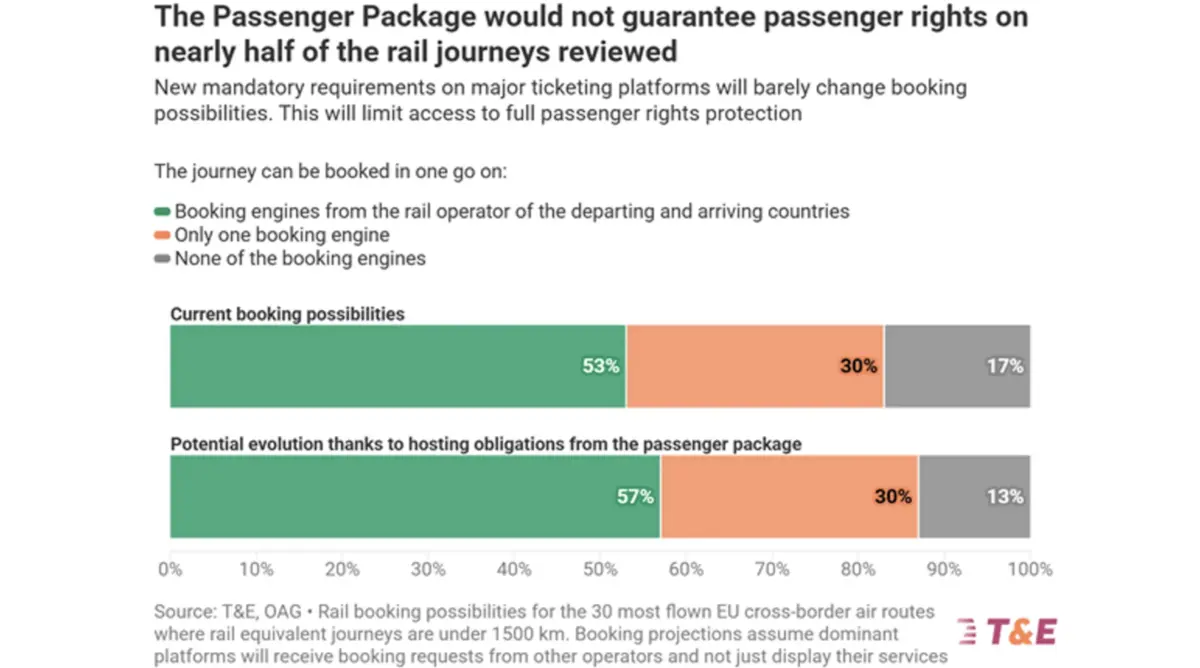
A central pillar of the current proposal is the "hosting obligation," which requires major rail operators to host and sell tickets for other operators on their booking platforms. This is a vital step toward a competitive and integrated market. Currently, the European rail landscape is dominated by national incumbents who often act as gatekeepers. In France, for example, the national operator SNCF’s digital platform, SNCF Connect, handles approximately 90% of all rail ticket sales in the country. New entrants and smaller operators often find themselves invisible to the majority of travelers because they are excluded from these dominant booking channels.
However, the current scope of the hosting obligation is largely restricted to domestic services and immediate neighboring countries. This limited geographic reach fails to address the reality of long-distance European travel. Research commissioned by Transport & Environment (T&E) indicates that many of the rail equivalents of the EU’s most-flown routes will remain unbookable as a single ticket under the current proposal. If a passenger cannot easily book a journey from Brussels to Madrid on a single platform with guaranteed rights, they are far more likely to choose a low-cost flight, which offers a simplified booking process despite its higher environmental cost.
To maximize the potential for a shift from air to rail, the hosting obligation must be extended to cover all major European capital cities within a 1,500-kilometer radius, provided the journey can be completed with a maximum of two changes. This would force major players like SNCF, SNCB, and Renfe to cooperate and display each other’s services for high-demand corridors, effectively creating a digital "Single European Rail Area."
Chronology of EU Rail Liberalization and Legislation
The EU Passenger Package is the latest in a long series of legislative efforts aimed at unifying the continent’s railways. Understanding its importance requires looking at the timeline of European rail reform:

- The First Railway Package (2001): Focused on the separation of infrastructure management from transport operations to encourage competition.
- The Second Railway Package (2004): Accelerated market opening for international freight services and established the European Union Agency for Railways (ERA).
- The Third Railway Package (2007): Introduced open access for international passenger services and established the first set of basic passenger rights.
- The Fourth Railway Package (2016): Aimed at completing the single market for rail services by removing remaining barriers and harmonizing safety certifications.
- The High-Speed Rail Plan (2021): A strategic vision to double high-speed rail traffic by 2030 and triple it by 2050.
- The EU Passenger Package (Current): Proposed to address the "missing link" of integrated ticketing and multi-modal rights.
Despite these decades of reform, the digital experience of booking a train across borders remains vastly inferior to booking a flight. The current package is seen as the final piece of the puzzle to make the Fourth Railway Package truly functional for the end consumer.
Addressing the Booking Horizon and Transactional Barriers
One of the most significant frustrations for rail travelers is the inconsistency of "booking horizons"—the window of time before a journey when tickets become available for purchase. For instance, an operator in Germany might release tickets six months in advance, while an operator in Spain might only release them two months before departure. Under the current EU proposal, a "single ticket" is often defined as being part of a "single transaction." This creates a paradox: if a traveler wants to book a multi-leg journey where the second leg is not yet available for sale, they cannot benefit from single-ticket protections.
To resolve this, the regulation should be revised to cover tickets purchased on a "single platform" rather than just a "single transaction." This would allow a passenger to book their first leg (e.g., Paris to Barcelona) and then add the second leg (e.g., Barcelona to Madrid) to their existing itinerary on the same platform once it becomes available. By maintaining the link between these bookings, the passenger would retain their rights to compensation and assistance if a delay on the first leg causes them to miss the second. Without this flexibility, the law creates a two-tier system where only those who book everything at once are protected, leaving early planners and long-distance travelers vulnerable.
The "Hop on Any Train" Principle for Journey Continuation
Reliability is the primary concern for long-distance rail passengers. When a connection is missed due to a delay, the current proposal suggests a system similar to the existing Agreement on Journey Continuation (AJC), which allows passengers to take the next available train from the same operator. However, in a competitive market, the "next available train" might be operated by a different company.

For example, if a traveler from Brussels to Milan misses their connection in Paris because their first train was late, they should not be forced to wait several hours for the next train from the original operator if a Trenitalia or SNCF train is departing sooner. Allowing passengers to "hop on" the next suitable train regardless of the railway undertaking would drastically improve the passenger experience. It would also reduce the financial burden on operators, who are currently required to pay for hotel accommodations and meals if a passenger is stranded overnight. A more flexible "next train" policy ensures passengers reach their destination faster and keeps the rail network moving efficiently.
Data-Driven Insights: Why Convenience Matters
The push for integrated ticketing is backed by compelling consumer data. A poll commissioned by T&E found that 61% of respondents were deterred from taking long-distance rail journeys at least once because the booking process was perceived as too complicated. In a digital-first economy, the "complexity tax" on rail travel is driving consumers toward aviation.
Furthermore, the environmental stakes are high. A single flight from London to Paris emits approximately 58kg of CO2 per passenger, whereas the same journey by Eurostar emits only 2kg. If the EU can successfully implement the Passenger Package with an expanded scope, it could catalyze a significant reduction in regional aviation emissions. However, if the package remains limited to neighboring countries, it will only address a fraction of the market, leaving the most carbon-intensive long-haul routes unchallenged.
Official Responses and Stakeholder Perspectives
The debate over the Passenger Package has highlighted a divide between consumer advocates and national incumbents. Organizations like Transport & Environment and various European passenger federations argue that the current draft is too timid. They contend that without mandatory data sharing and a wider geographical scope, the "single ticket" will remain a rarity rather than the norm.

On the other side, some national rail operators have expressed concerns regarding the technical and financial implications of the hosting obligation. They argue that integrating diverse booking systems is a massive IT undertaking and that being forced to sell competitors’ tickets could impact their own loyalty programs and revenue streams. However, the European Commission has signaled that the priority must be the "Single Market" and the "Green Deal," suggesting that the convenience of the passenger and the reduction of emissions must take precedence over the legacy structures of national operators.
Broader Impact and Future Implications
The success or failure of the EU Passenger Package will have ripples far beyond the rail sector. It serves as a litmus test for the EU’s ability to coordinate complex, cross-border infrastructure and digital policy. If the package is strengthened, it could provide a blueprint for multi-modal travel, eventually integrating buses, ferries, and urban transit into a single, seamless digital ecosystem.
Moreover, an effective Passenger Package is essential for the success of the EU’s High-Speed Rail Plan. Investing billions in new tracks and faster trains is of limited value if the digital infrastructure to sell those seats is broken. By harmonizing the Passenger Package with the High-Speed Rail Plan—specifically by extending protections to capital cities under 1,500km—the EU can ensure that its physical and legislative infrastructures are working in tandem.
As the European Parliament and Council continue their deliberations, the focus must remain on the traveler. A rail system that is as easy to use as a smartphone app is not just a luxury; it is a climate necessity. By expanding the geographical scope, redefining the single ticket, and ensuring the right to journey continuation across all operators, the EU can finally drag its rail sector into the modern era and provide a genuine, green alternative to the skies.
