

Stephen F. O’Byrne, President and Co-founder of Shareholder Value Advisors Inc., argues that the newly implemented U.S. Pay versus Performance (PvP) disclosures provide a critical and practical framework for investors to establish concrete quantitative guidelines for their Say on Pay (SOP) votes. This shift, O’Byrne contends, fundamentally enhances the efficacy of shareholder votes, enabling portfolio companies to proactively adjust their executive compensation designs to align with investor expectations and improve the likelihood of a positive SOP outcome.
For decades, the process of shareholder voting on executive compensation, commonly known as Say on Pay, has been a vital, albeit often imprecisely measured, tool for corporate governance. While shareholders have been granted the right to voice their opinions on executive pay packages, the lack of clear, quantifiable metrics has frequently rendered these votes more symbolic than substantive. Companies, in turn, have struggled to interpret the nuances of shareholder sentiment, often leading to compensation structures that may not genuinely reflect performance or shareholder value creation. The introduction of mandatory PvP disclosures by the Securities and Exchange Commission (SEC) marks a significant turning point, offering a data-rich environment for a more precise and actionable approach to executive compensation oversight.
The SEC’s PvP rules, mandated by the Dodd-Frank Wall Street Reform and Consumer Protection Act of 2010 and finalized in 2022, require public companies to disclose information that links executive compensation to their financial performance over a specified period. This disclosure aims to provide shareholders with a clearer understanding of how compensation decisions are tied to the company’s actual results and shareholder returns. Previously, proxy statements primarily reported "grant date fair value" of equity awards, which often failed to capture the actual economic value realized by executives due to vesting schedules and subsequent stock price fluctuations. The new PvP disclosures, however, focus on "realized and realizable" pay, offering a more accurate reflection of the incentives provided to top executives.
O’Byrne’s analysis posits that this new data set is not merely an incremental improvement but a transformative one, enabling investors to move beyond generalized pronouncements on compensation philosophy and embrace specific, measurable criteria. He outlines a methodology for utilizing PvP data to assess five key pay dimensions at the individual company level. By quantifying these dimensions, companies can gain assurance of a positive SOP vote if their compensation practices meet specific thresholds. These include:
- Alignment with Relative Total Shareholder Return (TSR): At least half of the variation in relative CEO pay must be explained by relative TSR. This ensures that a significant portion of executive compensation is directly attributable to the company’s performance relative to its peers.
- Statistical Significance of CEO Pay Leverage: The relationship between CEO pay and performance must be statistically significant at the conventional 5% level. This means that the observed link between pay and performance is unlikely to be due to random chance.
- Reasonable Relative CEO Pay Risk: The ratio of the variability in CEO pay to the variability in relative TSR (Relative Pay Risk) should be reasonable, with O’Byrne suggesting a threshold of approximately 2.0 or less as indicative of acceptable risk.
- Reasonable CEO Pay Premium Cost: The "cost" associated with above-median pay leverage, measured by the CEO pay premium, should also be reasonable, again suggesting a threshold of approximately 2.0 or less. This metric assesses the incremental cost of higher pay leverage.
The critical advantage of the PvP data, O’Byrne emphasizes, lies in its ability to provide "mark-to-market" pay. This captures the true incentive value derived from changes in the unvested equity held by executives. In contrast, the traditional "grant date pay" reporting, which has been the standard for decades, offered a static snapshot that did not reflect the dynamic economic realities of executive compensation. This inability of historical reporting methods to capture the full spectrum of executive pay incentives made it exceedingly difficult for investors to establish robust and actionable guidelines for their SOP votes.

The Inadequacy of General Guidelines and the Promise of Specificity
The current landscape of investor guidelines for SOP voting is often characterized by a lack of precision. O’Byrne points to prominent institutional investors like BlackRock and Vanguard, whose publicly available proxy voting guidelines, while expressing laudable principles, fall short of providing quantifiable metrics. For instance, BlackRock’s 2026 guidelines advocate for compensation policies that "encourage an appropriate risk appetite, and align the interests of shareholders and executives." However, they lack specific measures for assessing risk appetite or the degree of pay alignment. Similarly, Vanguard’s 2026 guidelines suggest that compensation plans "should align company executives’ pay outcomes with the company’s performance relative to its industry peers over multiple years," yet they offer no concrete methodology for quantifying this alignment.
This vagueness, O’Byrne argues, renders an investor’s SOP vote ineffective. Without clear, measurable benchmarks, companies lack the specific guidance needed to adjust their pay designs in a manner that would demonstrably improve their SOP vote outcomes. They can meet the general intent of the guidelines without making substantive changes that truly enhance pay-for-performance alignment. This disconnect leads to a situation where votes, though cast, may not drive the desired behavioral changes in corporate compensation practices, effectively making the vote a wasted effort.
Harnessing PvP Data for Measurable Pay Dimensions
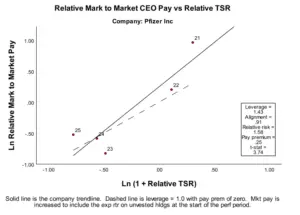
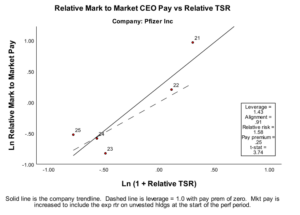
The core of O’Byrne’s proposal lies in the practical application of PvP data to measure five distinct pay dimensions. To illustrate this, he references figures that analyze the compensation of Pfizer CEO Albert Bourla and State Street CEO Ronald O’Hanley, based on their companies’ 2026 proxy statements and the accompanying five-year PvP disclosures.
The analytical framework involves plotting the natural logarithm of relative pay against the natural logarithm of 1 + relative TSR. The slope of the resulting trendline quantifies "pay leverage," indicating the percentage change in relative pay for every 1% change in relative shareholder wealth. The correlation coefficient, specifically the R-squared value, measures "pay alignment," signifying the proportion of variation in relative CEO pay explained by changes in relative TSR. When this correlation is negative, it signals a misalignment in the desired direction, and a negative sign is applied to the R-squared value to denote this adverse relationship.
Further metrics derived from this analysis include "relative pay risk," calculated as the ratio of pay leverage to the correlation, which gauges the variability of CEO pay relative to the variability of TSR. The intercept of the trendline represents the "pay premium at peer group average performance," a measure of performance-adjusted cost. Finally, the t-statistic for pay leverage indicates the statistical confidence that the observed relationship between pay and performance is not merely a product of chance. For a dataset with five observations, a t-statistic of 2.13 is required to achieve 95% confidence, a standard widely accepted in social science research.
Applying these metrics to Pfizer, O’Byrne finds that the company’s compensation practices meet the criteria for a positive SOP vote. With an R-squared of 83%, pay alignment significantly exceeds the 50% threshold. The pay leverage t-statistic of 3.74 is well above the 2.13 requirement for statistical significance. The relative pay risk of 1.58 is below the threshold that would indicate excessive risk. Furthermore, Pfizer’s compensation cost analysis, considering its pay leverage (1.43) and pay premium (0.25), demonstrates a favorable position relative to its peers. Its pay premium is only slightly below the median, while its pay leverage is significantly above it, resulting in a pay premium cost well within acceptable limits.
In stark contrast, State Street’s compensation practices, as analyzed by O’Byrne, warrant a negative SOP vote. The company exhibits negative pay alignment, a statistically insignificant pay leverage (indicated by a negative t-statistic), and excessive relative pay risk, all of which are red flags for shareholder advocates.
Implications for Proxy Advisor Reform and Corporate Governance
The adoption of these specific, quantitative guidelines by institutional investors has the potential to drive significant reform in the practices of proxy advisory firms. O’Byrne critiques the current methodologies employed by leading proxy advisors, such as Institutional Shareholder Services (ISS), arguing that their quantitative measures are often "unreasonable" and do not accurately reflect pay-for-performance alignment. For instance, ISS’s "Relative Degree of Alignment" metric, which compares a company’s TSR percentile to the CEO’s grant date pay percentile, is described as a proxy for grant-date pay cost rather than a true measure of the correlation between pay and performance. Similarly, the "Multiple of Median" metric, which compares CEO grant date pay to the peer group median, directly measures cost but fails to incorporate performance adjustments or pay leverage.
By implementing their own robust, data-driven quantitative guidelines, institutional investors can initiate a necessary debate on the adequacy of existing proxy advisor methodologies. This, in turn, could pressure firms like ISS to revise their models, addressing what O’Byrne characterizes as their "gross deficiencies." The expectation is that a greater emphasis on measurable, performance-linked executive compensation will lead to more responsible corporate governance and a stronger alignment of interests between company leadership and their shareholders.
The broader implications of this shift extend beyond individual company votes. A more standardized and transparent approach to assessing executive compensation can foster greater accountability throughout the corporate ecosystem. Companies will be incentivized to design compensation packages that demonstrably reward superior performance and shareholder value creation, moving away from potentially opaque or overly generous arrangements. This could lead to a more efficient allocation of capital and a stronger overall economy, as executive compensation becomes a more direct driver of long-term corporate success.
The transition to a PvP-informed SOP voting process represents a significant evolution in shareholder engagement. It promises to transform the Say on Pay vote from a qualitative expression of sentiment into a powerful, quantitative tool for driving meaningful change in executive compensation practices. As investors increasingly leverage the granular data provided by PvP disclosures, the expectation is that corporate boards and compensation committees will be compelled to adopt more transparent, performance-aligned, and shareholder-centric compensation strategies.
