

In the annals of 20th-century decorative arts, few moments are as pivotal as the 1949 Scandinavian tour undertaken by the French designer Jean Royère. Upon his return to Paris, Royère published a comprehensive report in the prestigious magazine Le Décor d’Aujourd’hui, detailing his observations of Nordic aesthetics. His visit to Stockholm proved particularly transformative, specifically his encounter with Svenskt Tenn, the legendary design emporium steered by the Austrian-Swedish architect Josef Frank. Royère described an immersive "jungle atmosphere" where the boundaries between the natural world and domestic interiors were intentionally blurred. He noted with fascination that customers had to "lift aside vines and branches" to reach simple household objects like candy dishes. This observation of "living rooms where ivy zigzags around paintings" and "dining rooms where Virginia creeper trails down into the chandeliers" would soon germinate into one of the most recognizable and coveted lighting series in the history of modern design: the Liane.
The Genesis of an Icon: From Stockholm to the Liane
The Liane—the French word for "vine"—was not merely a product of sudden inspiration but a sophisticated synthesis of Royère’s evolving style and the biophilic tendencies he witnessed in Sweden. Prior to this period, Royère had already begun experimenting with tubular steel, a material heavily associated with the functionalist rigor of the Bauhaus movement. However, where the Bauhaus sought industrial efficiency and geometric austerity, Royère sought whimsy and organic fluidity.
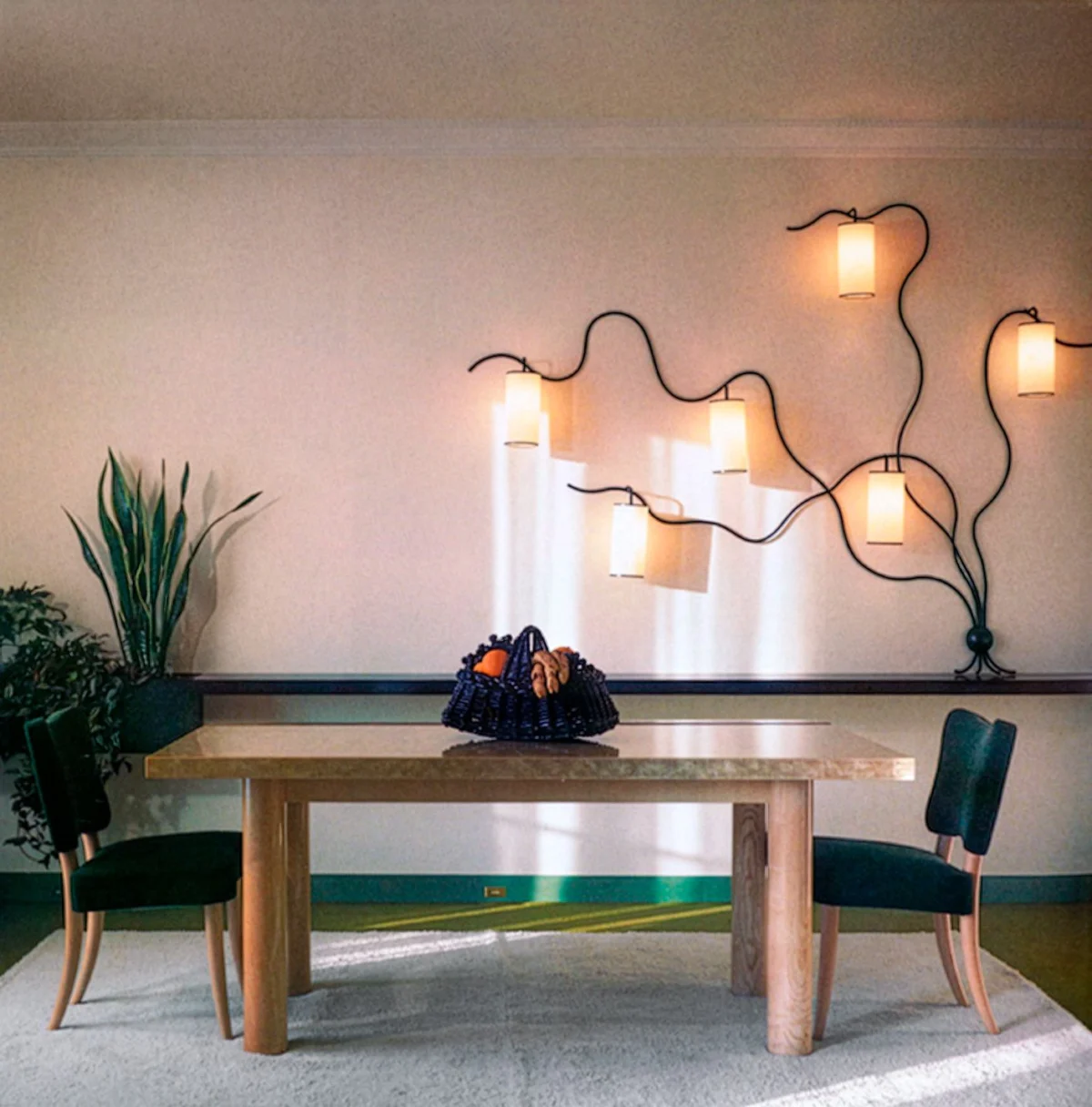
By the mid-1950s, the Liane collection had matured into a series of hand-forged tubular steel lamps that mimicked the erratic, searching growth of climbing plants. These fixtures were characterized by their "squiggly" silhouettes, appearing to crawl across walls and ceilings with a life of their own. The structural brilliance of the Liane lay in its base: a singular block that held the various steel "stems" in a gathered bouquet, from which they sprouted outward in asymmetrical, naturalistic patterns. These were often site-specific installations, designed to interact with the unique architecture of a client’s home, tracing the contours of mirrors, paintings, or cornices.

Technical Artistry and Material Evolution
The production of the Liane series reflected a meticulous attention to texture and color. The hand-forged steel was typically finished with layers of house paint in a specific palette—vibrant coral, deep blue, or matte black. This choice of medium was intentional; the house paint provided a unique, slightly aged texture that felt more artisanal than industrial. For more opulent commissions, Royère occasionally utilized gold leaf, though the painted versions remain the most emblematic of his playful spirit.
The illumination itself was diffused through cylindrical shades made of cellulose acetate, an early form of plastic that offered a soft, translucent glow. These shades were finished with color-matched paper trim, ensuring a cohesive aesthetic. Over the decades, the Liane evolved from simple wall-mounted sconces into complex, multi-armed chandeliers and even "tangled" floor lamps. Each piece was a testament to Royère’s philosophy that decorative elements should never be purely expressive; they must remain fundamentally structural. As Jonathan Wray, the current creative director at the revived Royère brand, notes, the fixtures feel like "wall drawings," where the line of the metal serves as both the art and the support.
A Chronology of Design Innovation: 1931–2018
To understand the significance of the Liane, one must view it within the broader timeline of Royère’s career and the subsequent revival of his legacy:
- 1931: Jean Royère begins his career in interior design after abandoning a more traditional path in the import-export business. He quickly gains a reputation for "Le Style Royère," characterized by comfort, color, and a rejection of rigid modernism.
- 1930s–1940s: Royère introduces controlled, undulating lines into his furniture, such as the "Croisillon" and "Ours Polaire" (Polar Bear) collections.
- 1949: The Scandinavian tour and the visit to Svenskt Tenn provide the catalyst for a more radical, organic approach to lighting.
- 1955: The Liane collection becomes a staple of Royère’s high-end commissions, featuring prominently in the homes of the Parisian elite and Middle Eastern royalty.
- 1981: Jean Royère passes away in Pennsylvania, having left a massive archive of sketches and plans to the Musée des Arts Décoratifs in Paris.
- 2018: The Royère brand is officially revived by Vladimir Markovic, the great-nephew of Royère’s longtime partner, Micha Djordjevic. This revival aims to produce authentic re-editions using the original archives.
The Contemporary Market and the Challenge of Authenticity
Today, the Liane light fixture is considered a "holy grail" for interior designers and collectors of mid-century French furniture. Because each original piece was essentially a custom "wall drawing," no two vintage Lianes are exactly alike. This bespoke nature has led to a surge in market value, with original 1950s fixtures frequently fetching hundreds of thousands of dollars at major auction houses such as Sotheby’s and Christie’s.

However, the high demand and high price points have also led to a proliferation of "shoddy look-alikes" and outright forgeries. Authenticating a vintage Liane requires a deep dive into provenance and an examination of the specific forging techniques used in the mid-20th century. The revived Royère brand protects this legacy by maintaining a strict catalog of the 35 original Liane varietals. While the modern versions utilize updated materials—such as powder-coated steel for durability and Japanese paper for the shades—they are produced with a reverence for the "expression of the hand" that defined Royère’s work. Notably, the brand does not allow for new bespoke versions; they exclusively produce the designs found within the historical archives to maintain the artistic integrity of the original oeuvre.
Supporting Data: The Value of "Le Style Royère"
The economic impact of Royère’s designs on the secondary market is substantial. Market data from the last decade shows a consistent upward trajectory for "organic" mid-century design. For instance:
- Auction Trends: In the early 2000s, a Liane wall lamp might have sold for $20,000 to $40,000. By the 2020s, prices for multi-arm wall lights have regularly exceeded $150,000, with rare chandeliers reaching even higher figures.
- Comparative Value: While contemporaries like Jean Prouvé or Charlotte Perriand focused on the "machine for living," Royère’s "fantasiste" approach appeals to a different segment of the market—those seeking "jewelry for the home."
- The "Ours Polaire" Effect: The record-breaking sales of Royère’s Polar Bear sofas (sometimes exceeding $600,000) have had a halo effect on his lighting designs, elevating the entire brand to the pinnacle of collectible design.
Broader Impact and Design Implications
The enduring relevance of the Liane collection speaks to a broader shift in interior design toward "biophilic" principles—the idea that humans have an innate tendency to seek connections with nature and other forms of life. Royère was decades ahead of his time in recognizing that the rigidity of urban living required a counter-balance of organic, almost chaotic, natural forms.
His work challenged the prevailing "International Style" of the mid-20th century, which often prioritized function to the point of sterility. By incorporating "climbing plants" made of steel, Royère proved that industrial materials could be imbued with warmth and wit. The Liane fixtures do not merely light a room; they inhabit it, interacting with the shadows and the architecture in a way that feels spontaneous rather than planned.

Furthermore, the revival of the Royère brand under Vladimir Markovic represents a growing trend in the luxury sector: the "heritage resurrection." By treating the furniture and lighting as works of art rather than mere commodities, the brand ensures that the "hand of the artist" remains visible. For contemporary architects and decorators, the Liane remains a versatile tool, capable of softening the sharp angles of modern glass-and-steel construction with its whimsical, leafy silhouettes.
Conclusion: A Legacy Rooted in Nature
Jean Royère’s Liane is more than a lighting fixture; it is a bridge between the industrial past and a more organic future. Born from a fascination with the "jungle" interiors of Stockholm, it transformed the cold utility of tubular steel into a poetic celebration of growth and movement. As the design world continues to grapple with the balance between technology and nature, the Liane stands as a definitive answer—a reminder that the most beautiful structures are often those that mimic the "zigzags" of the natural world. Whether as a vintage masterpiece in a Paris apartment or a meticulously crafted re-edition, the Liane continues to climb, zigzag, and illuminate the enduring genius of Jean Royère.
