

The 2026 proxy season has concluded, revealing a complex landscape of executive compensation where record-high CEO pay levels were met with remarkably strong shareholder support, a trend that defied historical patterns. This analysis, drawing from insights provided by Subodh Mishra, Global Head of Communications at ISS STOXX, and further detailed by Pranav Pradeep, Tim Sessing, and Chris Sayo from ISS-Corporate, highlights key takeaways from the fiscal years 2024 and 2025 compensation cycles, and anticipates potential shifts driven by upcoming regulatory changes.
Key Takeaways
The 2026 proxy season was characterized by record CEO pay levels and a resurgence of one-time equity awards, but remarkably shareholder support for executive compensation remained strong. Equity compensation continued to drive pay growth through both higher values and increased use of special equity grants. At the same time, companies increasingly relied on security-related perquisites, reflecting a broader focus on executive safety and risk management.
Economic uncertainties impacted compensation designs and decisions, and increased market volatility has led to a spike in discretionary pay adjustments to levels not seen since the pandemic. Despite the scrutiny these pay decisions often invite, investors appeared largely supportive: median say-on-pay support reached five-year highs across both the S&P 500 and Russell 3000, while the number of failed say-on-pay votes fell to multi-year lows. These results suggest that investors generally viewed compensation outcomes and board designs as being aligned with company performance and business objectives, even as pay levels and pay discretion continued to increase.
However, the executive compensation landscape may be approaching another period of significant change. Proposed Securities and Exchange Commission (SEC) amendments could fundamentally alter compensation disclosure and shareholder voting requirements for a substantial portion of public companies. If adopted, these changes could have far-reaching implications for compensation governance and shareholder rights in the years ahead, reshaping how companies communicate executive pay decisions to investors and how investors express their views.
Chief Executive Officer Pay Trends
S&P 500 CEO Pay Outpaced the Broader Market
A significant trend emerging from the 2026 proxy season is the widening gap in CEO compensation between the largest companies in the S&P 500 and the broader Russell 3000 index. Median CEO pay remained relatively consistent among Russell 3000 companies (excluding the S&P 500) over the past two fiscal years, holding steady at approximately $5.5 million in both FY2024 and FY2025. This indicates a period of measured compensation growth for the majority of publicly traded companies.
By stark contrast, median S&P 500 CEO pay continued its upward trajectory, reaching an estimated $17.5 million in FY2025. Since 2021, median pay for CEOs in the S&P 500 has risen by an impressive 20%, compared to a more modest 5% increase among the rest of the Russell 3000. This divergence suggests that the economic climate and market dynamics are impacting executive compensation differently across various company sizes and market capitalizations.
Industry-Level Compensation Growth Varied Significantly
The analysis also revealed a varied landscape of CEO pay increases across different industry sectors. Most sectors experienced growth in median CEO pay between FY2021 and FY2025, although the magnitude of these increases differed considerably. Telecommunications Services emerged as the leader, with a substantial 54% rise in median CEO pay, significantly outpacing the Russell 3000 median increase of 10%. This substantial growth in the telecommunications sector may be attributed to factors such as increased demand for digital infrastructure, the rollout of new technologies like 5G, and the competitive landscape within the industry.
Conversely, several sectors saw declines in median CEO pay over the same period. Real Estate Management & Development, Automobiles & Components, Banks, and Energy each reported decreases in median CEO pay. These declines could reflect sector-specific challenges, such as interest rate sensitivity in real estate and banking, supply chain disruptions and evolving consumer demand in the automotive sector, and commodity price volatility in energy.

Incentive Compensation Driving CEO Pay Increase
While all major compensation elements experienced an increase between FY2024 and FY2025, the pattern of growth varied across market segments, highlighting the differing compensation strategies employed by large-cap versus mid- and small-cap companies.
Among Russell 3000 companies outside of the S&P 500, short-term incentives recorded the largest percentage increase, rising by 19%. This suggests a greater reliance on annual performance metrics and bonuses for executives in these companies. This was followed closely by a 14% increase in "All Other Compensation," a broad category that can include various perks, benefits, and potentially other forms of discretionary awards.
For S&P 500 companies, the landscape of pay growth was different. Long-term incentives experienced the most significant increase at 8%. This indicates a continued emphasis on equity-based awards with extended vesting periods, aligning executive interests with long-term company value creation. Base salary and annual incentives, while also increasing, saw more modest growth of 3% each. This suggests a more stable base compensation structure for the largest corporations, with growth primarily fueled by equity performance.
Crucially, when measured in absolute dollar terms, equity compensation remained the primary driver of CEO pay increase across both segments. The median long-term incentive values increased by approximately $913,000 for S&P 500 CEOs and $121,000 for Russell 3000 CEOs outside the S&P 500. These figures substantially exceeded the absolute dollar increases in annual incentives and base salaries, underscoring the pivotal role of equity awards in overall CEO compensation growth during FY2025.
Resurgence of One-Time Equity Awards
A notable development in the 2026 proxy season was the resurgence of one-time equity awards, a practice that had become more prevalent during the pandemic era. Following the initial economic shockwaves of the pandemic, many companies turned to special equity grants as a strategic tool. These awards were often employed to address executive retention concerns, manage leadership transitions, and navigate unprecedented business uncertainty.
The ISS analysis indicates that the percentage of Russell 3000 companies granting a special equity award to at least one Named Executive Officer (NEO) saw a significant increase in FY2025, reaching 27.3%, up from 25.1% in FY2024. This marks the first year-over-year increase in the prevalence of these awards since the pandemic-era peak observed around 2021. While the overall usage remains below those extraordinary levels, the upward trend signifies a renewed reliance on these discretionary grants.
The value of these one-time awards also saw an increase. While grants valued below $1 million continued to represent the majority of awards, their share declined to 58.4% in FY2025, down from approximately 62% to 66% in the preceding four years. Concurrently, awards exceeding $20 million more than doubled, from 1.5% in FY2024 to 3.3% in FY2025. This dual trend—increased prevalence and higher values for special equity grants—contributed significantly to the overall growth in equity compensation observed during the fiscal year.
This resurgence suggests that boards are seeking greater flexibility in compensation design. In an environment marked by economic uncertainty, market volatility, and intense competition for executive talent, one-time equity awards offer a powerful tool to align executive interests with specific company objectives, retain critical leadership, and adapt to evolving business conditions.
Increased Focus on Executive Safety and Security
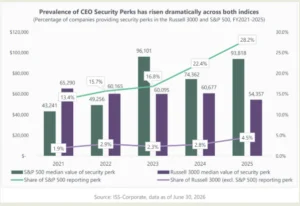
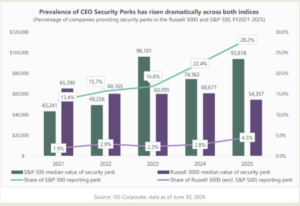
Beyond financial incentives, the 2026 proxy season also highlighted a growing emphasis on executive safety and risk management, reflected in the increased reliance on security-related perquisites. The analysis indicated an uptick in these benefits across both the S&P 500 and Russell 3000 indices.
This trend underscores a broader corporate governance focus on protecting top executives. While the specific nature of these benefits can vary, they often include enhanced personal security details, travel security measures, and potentially other risk mitigation strategies. This practice, though still relatively uncommon among smaller companies, has more than doubled in prevalence across the major indices since 2021. The value of these benefits peaked for S&P 500 companies in 2023, but the number of companies reporting such benefits has continued to rise. For the Russell 3000, the prevalence of security benefits saw a significant 61% increase from 2024, suggesting a widening adoption of these measures.
Say-on-Pay: Strong Investor Support Amidst Changing Practices
A particularly noteworthy aspect of the 2026 proxy season was the robust shareholder support for executive compensation proposals, often referred to as "Say-on-Pay" (SOP). Historically, spikes in one-time equity awards, significant increases in CEO pay, or sudden shifts in compensation strategy have often led to decreased SOP support and increased failure rates. However, this year’s proxy season bucked that trend.
Despite the resurgence of one-time equity awards and generally higher CEO pay levels, median SOP support for S&P 500 companies reached a five-year high of 93.3%, while Russell 3000 companies achieved an even more impressive 96%. Correspondingly, the number of failed SOP votes across both indices decreased significantly from 2025, reaching multi-year lows. This strong endorsement suggests that investors perceived a greater alignment between executive pay and company performance. Companies appear to have successfully demonstrated that these compensation practices, even with their increased levels and special awards, were tied to positive business outcomes and strategic objectives.
The ISS analysis suggests that investors viewed compensation outcomes and board designs as being aligned with company performance and business objectives. This broad investor endorsement underscores the effectiveness of thoughtful compensation design and robust disclosures in communicating the rationale behind executive pay decisions.
Regulatory Uncertainty on the Horizon: SEC Proposals
While companies are currently benefiting from strong shareholder backing on compensation matters, the executive compensation landscape is poised for potential disruption due to proposed rule changes from the U.S. Securities and Exchange Commission (SEC). These amendments could fundamentally alter compensation disclosure and shareholder voting requirements for a substantial portion of public companies.
The SEC’s proposed changes aim to simplify the reporting categories for public companies. Currently, companies are classified into five tiers, from Large Accelerated Filers to Emerging Growth Companies, with corresponding disclosure obligations. The proposed rules would consolidate these into just two categories: Large Accelerated Filers (LAF) and Non-Accelerated Filers (NAF). A company would be designated as an LAF if it has a public capital float of $2 billion or more and a consecutive reporting history of 60 months. All other companies would fall under the NAF designation.
Under these proposed rules, NAFs would be granted expanded exemptions and significantly reduced disclosure requirements. Notably, NAFs would be exempt from Say-on-Pay, Say-on-Frequency, and Golden Parachute votes. Furthermore, their disclosure obligations would be scaled back, requiring them to report on fewer NEOs and removing the mandate for compensation disclosure and analysis, certain compensation tables, and compensation committee interlocks disclosures. While companies could opt to maintain their current practices, these proposed changes could dramatically reshape the regulatory and shareholder engagement environment surrounding executive compensation.
The ultimate adoption and timeline of these SEC proposals remain uncertain. However, their potential implications are significant. For investors, a reduction in disclosure could make it more challenging to assess the alignment between executive incentives and shareholder interests. The removal of SOP votes could also diminish investor influence on executive pay decisions, potentially prompting them to explore alternative avenues for expressing their concerns. For companies, a simplified disclosure regime might reduce compliance burdens but could also lead to a disconnect between executive compensation strategies and investor expectations, potentially impacting dialogues and fostering further scrutiny.
Conclusion
The 2026 proxy season presented a fascinating duality: record CEO compensation levels coexisting with strong shareholder approval. The resurgence of one-time equity awards, coupled with a growing prevalence of security perquisites, signals a dynamic executive compensation environment shaped by economic conditions and evolving governance priorities. However, the proposed SEC rule changes loom large, potentially altering the established norms of disclosure and shareholder engagement. As companies navigate these currents, maintaining transparency and demonstrating clear alignment between pay and performance will remain paramount, regardless of future regulatory shifts. The fundamental principle that executive pay is a critical mechanism for accountability and aligning interests between management and shareholders is unlikely to diminish.
