

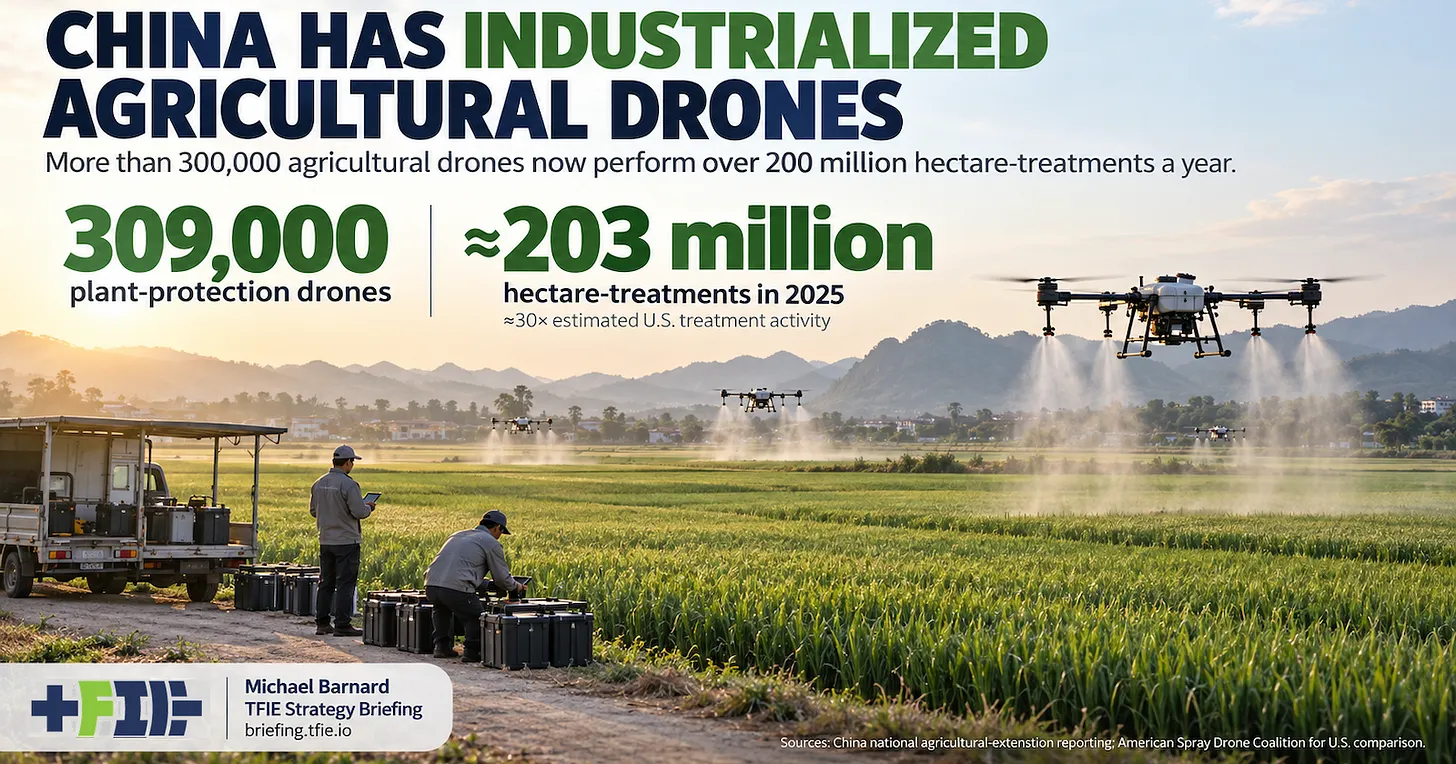
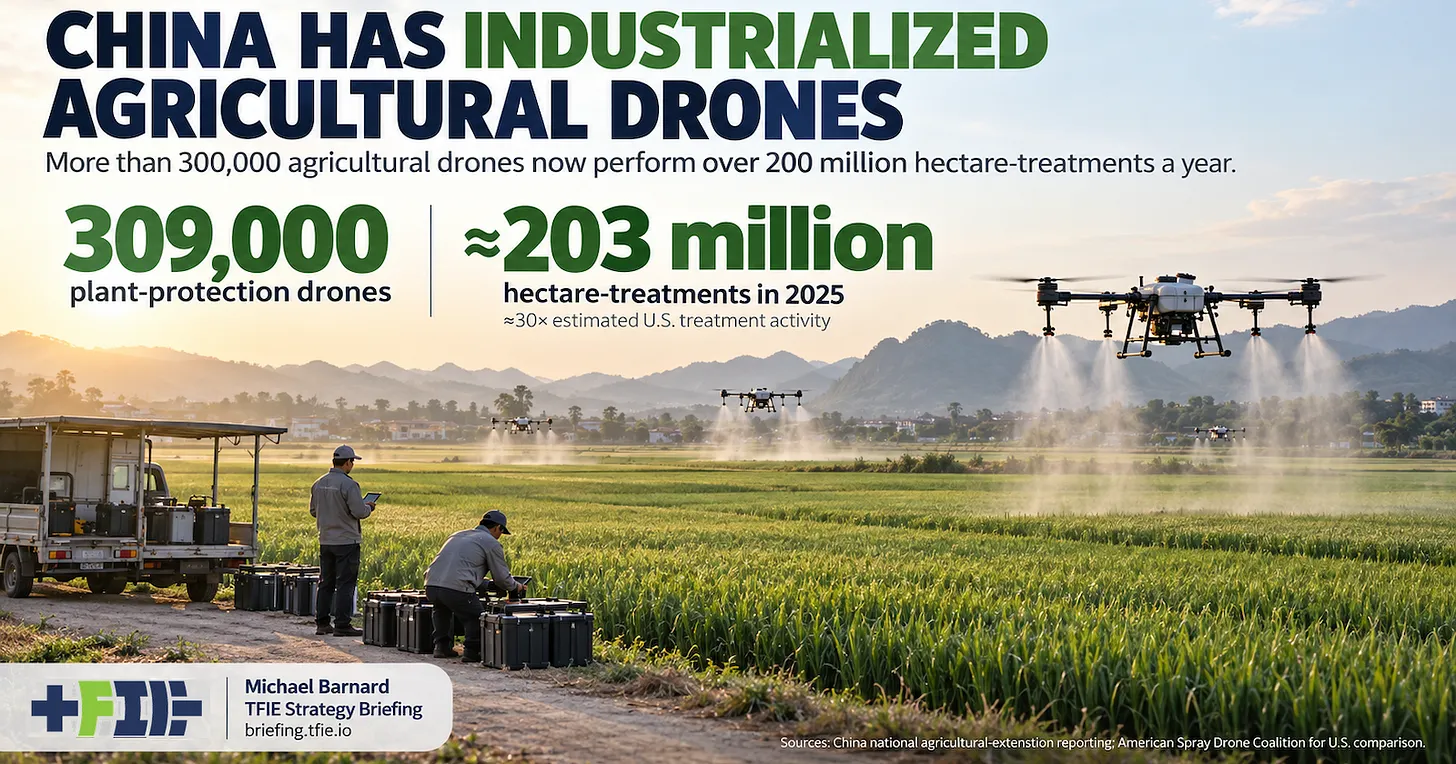
The landscape of global agriculture is undergoing a profound technological transformation, led by a surge in the deployment of unmanned aerial vehicles (UAVs) for crop protection and management. By the start of 2026, China has solidified its position as the undisputed world leader in this sector, boasting a fleet of approximately 309,000 plant-protection drones. These aircraft performed an estimated 203 million hectare-treatments during the 2025 calendar year, signaling that the technology has moved far beyond the experimental phase and has become a standardized component of the nation’s agricultural infrastructure. This scale of operation represents a significant leap from 2024, when the country reported 251,000 drones performing 178 million hectare-treatments.
The metric of "hectare-treatments" is critical to understanding the intensity of drone utilization. Rather than measuring the unique surface area of farmland, this figure accounts for the total work performed; for instance, a single hectare of rice treated three times for pests, fertilization, and blight over a season counts as three hectare-treatments. This method of accounting provides a clear picture of machinery utilization and the degree to which drone technology has been integrated into the daily rhythms of the farming cycle.
Comparative Scale: The Transpacific Gap
While the United States is witnessing its own rapid expansion in agricultural drone usage, the scale of operations remains vastly different from the Chinese model. According to the American Spray Drone Coalition’s 2025 industry survey, approved operators under the Federal Aviation Administration (FAA) Part 137 regulations performed approximately 16.4 million acres of treatments. When converted to hectares, this equates to roughly 6.64 million hectare-treatments.
The disparity is stark: China’s drone-based agricultural activity is approximately thirty times greater than that of the United States. This gap is particularly noteworthy because it cannot be attributed to a difference in available land. Both nations possess roughly comparable cultivated land bases—approximately 128 million hectares in China and 133 million hectares in the United States. The divergence suggests that the primary drivers of drone adoption in China are rooted in factors other than land availability, such as regulatory frameworks, labor costs, and the specific requirements of regional crop types.
Furthermore, while the American market is showing high percentage growth, the sheer volume of real activity added in China annually dwarfs the entire U.S. market. In 2025 alone, China added 25 million hectare-treatments of annual activity—nearly four times the total volume of the entire American spray-drone industry.
The Evolution of the Agricultural Drone Market
The transition of the Chinese market from "early adoption" to "industrial maturity" is perhaps the most significant development of the mid-2020s. In the early stages of the technology, the primary questions revolved around whether drones could effectively carry payloads and spray fields without crashing. Today, the Chinese market has moved into a secondary phase characterized by service, maintenance, renewal, and the establishment of rigorous operating standards.
As the installed fleet ages, a secondary market for used drones and specialized maintenance networks has emerged. Manufacturers like DJI and XAG have shifted focus from merely selling hardware to providing comprehensive "ag-tech" ecosystems. This includes multispectral imaging for precision application, automated charging stations, and sophisticated software that integrates with regional weather and soil data. The industry is now grappling with the challenges of a mature sector: optimizing the lifespan of the aircraft, improving the efficiency of battery cycles, and standardizing pilot certification to ensure safety across hundreds of thousands of daily flights.
Drivers of Chinese Industrialization
Several factors have contributed to China’s ability to industrialize agricultural drones at such a rapid pace. A primary driver is the "Low-Altitude Economy" initiative, a government-backed strategic push to utilize the lower atmosphere for logistics, transport, and agriculture. This policy environment has facilitated rapid regulatory approvals and provided subsidies for farmers and cooperatives to purchase advanced machinery.
Topography and land use also play a role, though perhaps less than previously assumed. While drones are indispensable for the terraced hills and small rice paddies of southern China—where traditional wheeled machinery cannot operate—their increasing use in the flatter, large-scale farming regions of northern China indicates that drones are competing directly with ground-based equipment. The labor shortage in rural China, driven by an aging population and urban migration, has also made autonomous or semi-autonomous drones an economic necessity rather than a luxury.
The American Context: Overcoming the "Big Iron" Tradition
In the United States, the adoption of spray drones faces a different set of challenges and opportunities. The U.S. agricultural sector is one of the most heavily mechanized in the world, relying on what is often called "big iron"—massive tractors and self-propelled sprayers that can cost upwards of $500,000. Additionally, a mature crewed agricultural aviation industry (crop dusters) has existed for decades.
Despite this, American contractors and farmers are increasingly turning to drones to solve specific operational problems. Drones are finding a niche in "late-season" applications where crops like corn are too tall for ground sprayers to enter without causing damage. They are also being deployed when fields are too wet for heavy machinery, which would otherwise cause soil compaction or become stuck.
The growth in the U.S. market proves that the utility of agricultural drones is not limited to small or irregular plots. Even in a system dominated by large-scale industrial machinery, drones offer a level of precision and flexibility that traditional equipment cannot match. They allow for "spot treatments" of specific pest outbreaks, reducing the total volume of chemicals used and lowering the environmental footprint of the farm.
The European Paradox: Hardware Without Infrastructure
Europe presents a unique case study in the global drone market. While Chinese-manufactured hardware is readily available across the European Union, the continent has not seen the same level of deployment as China or even the growth trajectory of the United States. This suggests that the availability of technology is only one part of the equation.

The lack of large-scale adoption in Europe is often attributed to a complex web of chemical regulations and strict aviation rules. Many pesticides approved for ground application in Europe are not yet certified for aerial dispersal via drone. Furthermore, the fragmented nature of European aviation regulation has made it difficult for operators to scale across borders. The European experience highlights that for an agricultural drone industry to flourish, it requires a supporting ecosystem of regulatory clarity, chemical certification, and localized maintenance infrastructure.
Environmental and Economic Implications
The shift toward drone-based crop protection has significant implications for environmental sustainability. Traditional ground sprayers often apply chemicals uniformly across a field, regardless of the actual need in specific areas. Drones, equipped with multispectral sensors, can identify areas of stress and apply treatments only where necessary. This "variable rate application" can reduce chemical usage by up to 30%, according to some industry estimates.
Moreover, drones eliminate the problem of soil compaction caused by heavy tractors. Compacted soil has reduced water infiltration and air porosity, which can lead to lower yields over time. By moving the application process into the air, farmers can maintain soil health and reduce the carbon emissions associated with operating heavy diesel machinery.
From an economic perspective, the "total cost of ownership" for drones is becoming increasingly attractive. While the initial investment in a high-end spray drone and its battery systems is significant, it is a fraction of the cost of a modern self-propelled sprayer. For small-to-mid-sized farms, or for agricultural service contractors, drones provide a high return on investment by allowing for more frequent, targeted, and timely interventions.
Future Outlook and Chronology of Growth
The timeline of agricultural drone development suggests that the next five years will be defined by the integration of Artificial Intelligence (AI) and the "swarm" capability.
- 2015–2018: The era of experimentation, characterized by modified hobbyist drones and limited payload capacities.
- 2019–2022: The rise of specialized manufacturers and the introduction of autonomous flight paths.
- 2023–2025: Rapid scaling in China and the emergence of professional regulatory frameworks in the U.S. (FAA Part 137).
- 2026 and Beyond: The shift toward "swarming," where a single operator manages multiple drones simultaneously, and the integration of AI for real-time pest identification and treatment.
As China enters this mature phase, the global market will be watching to see how the industry handles the replacement cycle of its massive fleet. The ability to maintain and upgrade hundreds of thousands of aircraft will determine the long-term viability of the drone-first agricultural model. Meanwhile, the United States is poised to continue its rapid growth as more farmers recognize the aircraft not as toys or gadgets, but as essential tools for modern precision agriculture.
The industrialization of agricultural drones in China is a milestone in the history of farming technology. It represents a shift from mechanical power to digital precision, providing a blueprint—and a challenge—for the rest of the world’s agricultural economies. The question is no longer whether drones have a place on the farm, but how quickly other nations can build the regulatory and service infrastructures necessary to match the scale currently seen in the Chinese fields.
