

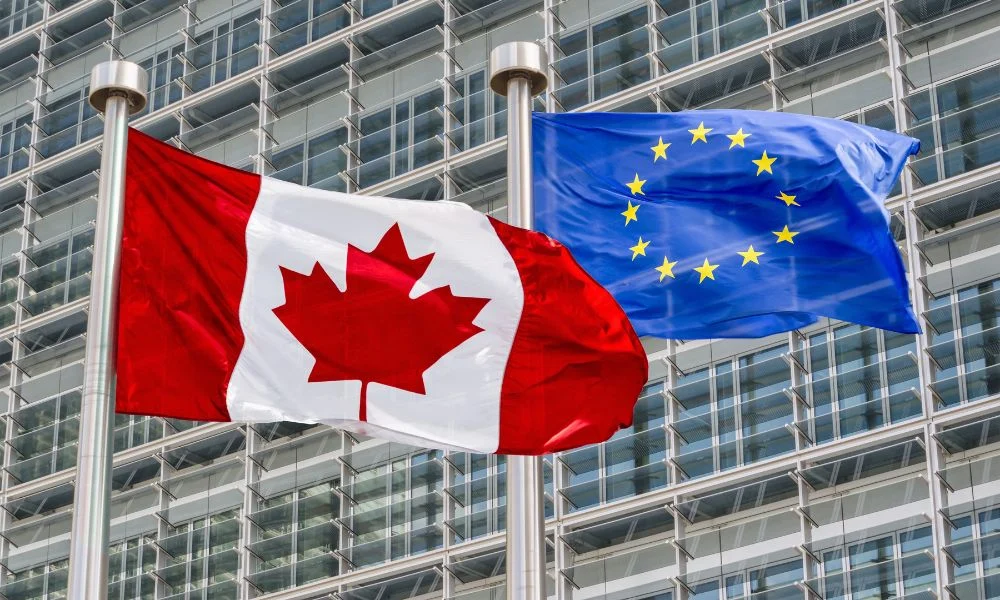
An expansive proposal for a new Canada-European Union alliance, spearheaded by Prime Minister Mark Carney, places the integration of financial services, particularly payment systems and capital access, at the forefront of potential collaboration. The vision, unveiled at the European Parliament in Strasbourg, France, suggests a future where Canada could become the European bloc’s inaugural associate member, a move that could profoundly reshape transatlantic economic and security landscapes.
The core of Carney’s proposition, as reported by CTV News, centers on creating a more seamless financial services market between Canada and the EU. This integration is envisioned as a catalyst for broadening consumer choice, reducing transaction costs, and significantly enhancing companies’ access to capital on both sides of the Atlantic. This ambitious financial integration is presented alongside a suite of other collaborative initiatives, including joint efforts in securing supply chains for critical minerals, developing robust and secure broadband infrastructure, ensuring sovereign compute capacity, establishing common artificial intelligence (AI) safety protocols and standards, and fostering reciprocal rights for citizens to live, work, and study across the partnered territories.
A Vision for Transatlantic Sovereignty and Economic Resilience
Prime Minister Mark Carney’s address to the European Parliament articulated a forward-looking perspective on sovereignty in the 21st century, emphasizing resilience and the capacity to withstand global shocks. In his remarks, he directly responded to European Commission President Ursula von der Leyen’s invitation the previous day for Canada to explore associate membership within the EU. Carney expressed his enthusiasm for the initiative, stating, "I welcome this ambition," and characterized the proposed alliance as "a unique, positive approach that we will define together."
Carney’s definition of modern sovereignty extended beyond traditional notions of territorial integrity to encompass secure access to a range of essential resources and technologies. He specifically highlighted payment systems as a critical component of national and economic sovereignty. His detailed outline of what constitutes sovereignty in the contemporary global arena included secure access to artificial intelligence, semiconductors, critical minerals, efficient payment systems, advanced clean energy technologies, vaccines, and space-based communication networks. This holistic view underscores the interconnectedness of economic strength, technological advancement, and national security in the current geopolitical climate.
The Genesis of the Associate Membership Proposal
The invitation for Canada to consider associate membership originated from European Commission President Ursula von der Leyen during her State of the Union address to the European Parliament on Wednesday, September 16. Prime Minister Carney was present in the chamber to witness this significant pronouncement. Von der Leyen explicitly stated her desire to "open the door" for Canada to become the EU’s first associate member, a move that would signal a new era of partnership.
According to CNBC, von der Leyen framed this potential relationship as an evolution from the existing Comprehensive Economic and Trade Agreement (CETA) to "an alliance for the future." The overarching objective of this alliance, as articulated by the Commission President, is to cultivate a shared space of common prosperity and economic security.
Navigating the Uncharted Territory of Associate Membership
The concept of "associate membership" as proposed by von der Leyen, however, does not currently possess a defined legal standing within the European Union’s framework. Tinatin Akhvlediani, head of EU enlargement at the Brussels-based think tank Center for European Policy Studies, informed CNN that "Associate membership does not exist."
Akhvlediani further elaborated that while countries like Ukraine, Moldova, and Georgia hold association agreements with the EU, these agreements necessitate a significant alignment with the bloc’s existing laws and regulations. Given Canada’s distinct legal and regulatory landscape, it is considered unlikely that Canada would pursue such a comprehensive legislative harmonization.
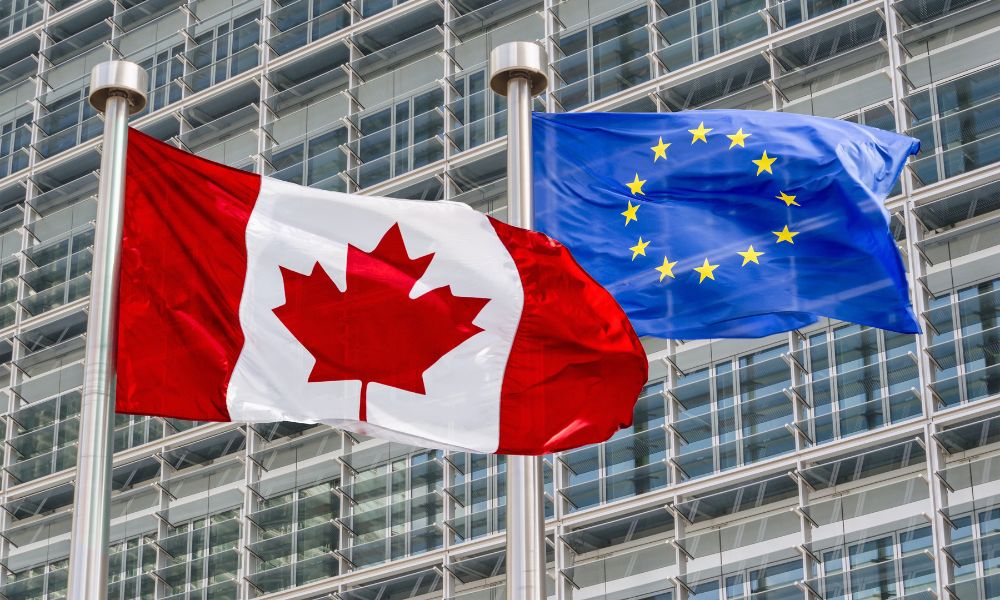
René Repasi, a German Member of the European Parliament, suggested to CBC’s As It Happens that the realization of a Canada-EU arrangement of the nature described would likely necessitate the creation of "a very comprehensive new international treaty." He pointed to the European Economic Area (EEA) as the closest existing model. The EEA, which includes Iceland, Norway, and Liechtenstein, represents a deep integration into the EU’s internal market, encompassing participation in EU legislative developments and adherence to the jurisprudence of the European Court of Justice.
Canada’s Parliamentary Process and International Reactions
Prime Minister Mark Carney indicated to reporters in Strasbourg that any future alliance would be subject to the democratic processes within Canada. He stated that Canadian lawmakers would ultimately determine the structure and scope of any such agreement, involving multiple parliamentary debates and a final vote. Carney emphasized that Canada is at "the start of a road" and is not pursuing full EU membership.
The proposal has elicited varied reactions on the international stage. US President Donald Trump, speaking on Wednesday, expressed skepticism and a willingness to impose tariffs if he perceived the initiative as detrimental to American interests. He stated, "If it’s a good intention, that’s fine. If it’s a bad intention, we’ll put very heavy tariffs on Europe, which is a possibility." In comments reported by CNBC, Trump, speaking in North Carolina, characterized Canada as a "terrible trade partner" and dismissed the associate membership talks as "laughable." On the same day, the White House announced that Trump had signed a presidential memorandum to identify and remove Canadian items from the US federal procurement system, claiming these items accounted for over $50 billion annually.
Economic Context and Bilateral Trade Dynamics
The timing of these discussions coincides with robust bilateral trade between Canada and the EU. According to European Commission figures cited by CNN, bilateral trade in goods and services between Canada and the EU reached €130.8 billion (US$151 billion) last year, representing an increase of over 80 percent in the preceding decade.
The EU-Canada Comprehensive Economic and Trade Agreement (CETA), which provisionally entered into force in 2017 and eliminated 99 percent of tariff lines, is still awaiting full ratification by ten EU member states, including key economies like France, Italy, and Poland. This ongoing ratification process highlights the complexities inherent in deepening economic ties within the EU.
Domestic Opposition and Public Opinion
Within Canada, the proposed alliance has faced opposition from some political quarters. Conservative Leader Pierre Poilievre has voiced his objections, stating at a Conservative caucus retreat that Conservatives oppose "EU taxes," "EU laws," and "EU open-border rules on immigration." He further questioned Prime Minister Carney’s stance, asking in a social media post how Canadians could trust him when he "says one thing in Canada and the opposite in Europe."
Despite these domestic concerns, public opinion polls suggest a general openness to closer cooperation with the EU. A survey conducted earlier this month by Canadian polling firm Abacus Data indicated that approximately 80 percent of Canadians favor deepening cooperation with the EU on foreign policy, defense, and economic priorities, a six-point increase since February. Furthermore, the survey revealed that 56 percent of Canadians believe Canada has more in common with EU countries than with the United States, and 49 percent would support Canada joining the EU, although Prime Minister Carney has explicitly stated that full membership is not on the table.
Future Prospects and Potential Developments
Further details regarding this nascent partnership could be elucidated at an EU-Canada investment summit scheduled to take place in Montreal next month, as reported by CNN. This summit will serve as a crucial platform for discussing potential investment opportunities and solidifying the framework for enhanced bilateral engagement. The discussions surrounding a potential associate membership and the creation of a unified financial services market represent a significant evolution in the Canada-EU relationship, moving beyond traditional trade agreements towards a more integrated strategic alliance. The path forward will undoubtedly involve complex negotiations, significant parliamentary scrutiny in Canada, and careful consideration of the legal and political implications for both parties. The ultimate shape of this alliance will depend on the ability of both Canada and the EU to navigate these challenges and forge a mutually beneficial framework for future collaboration.
