

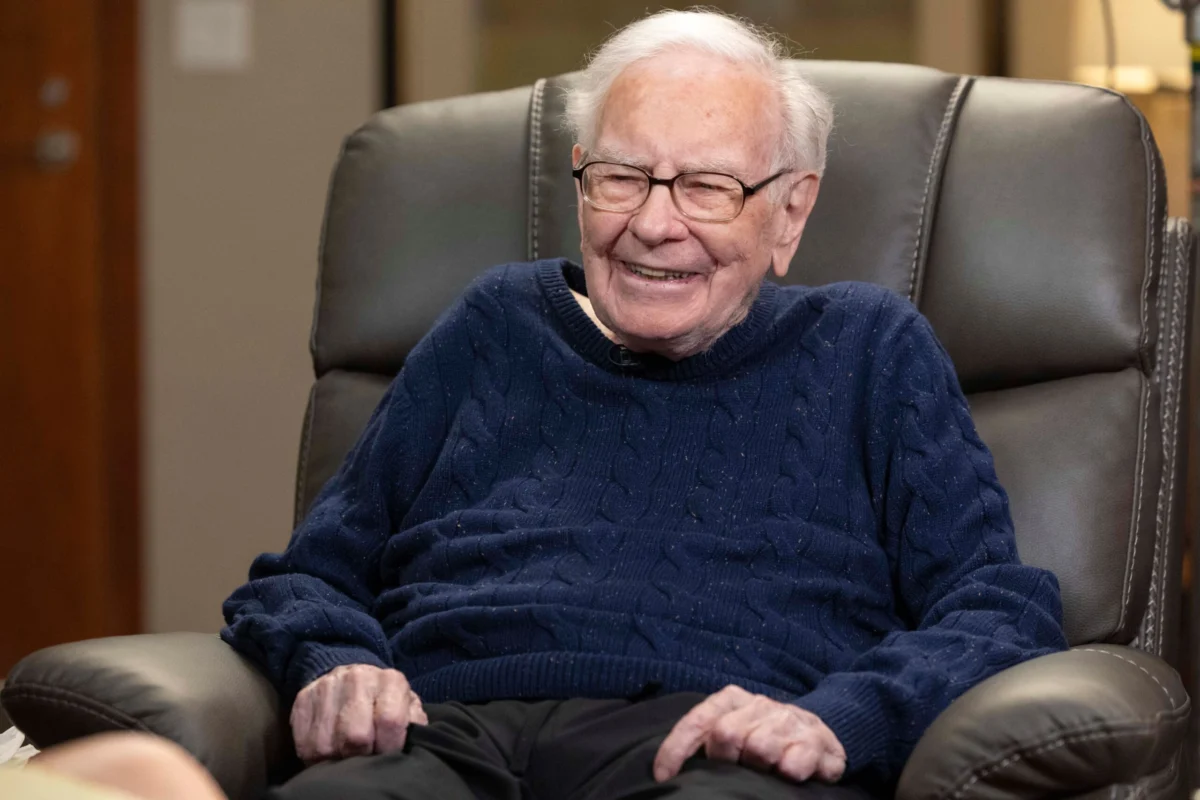
Warren Buffett, the revered nonagenarian investor who transformed a struggling textile mill into Berkshire Hathaway, a sprawling $1 trillion conglomerate, has announced his immediate resignation as chairman. The 96-year-old legendary figure, often dubbed the "Oracle of Omaha," revealed this pivotal decision in a letter to shareholders on Friday, marking the final formal step in his decades-long succession plan.
Effective immediately, Buffett will transition to the role of chairman emeritus, while retaining his seat on the board of directors. His son, Howard Buffett, is set to assume the chairmanship, a move long stipulated by Berkshire’s carefully crafted succession strategy. Susan Decker will continue in her capacity as lead independent director, providing continuity in governance.
In his characteristic candid style, Buffett addressed the inevitability of his departure, writing, "Father Time always wins. He has, however, been generous with me. He has given me the opportunity to see Berkshire reach a point where I am more confident than ever about what lies ahead." This poignant reflection underscores the magnitude of his journey and his enduring faith in the company’s future.
A Carefully Orchestrated Succession
This announcement arrives just over nine months after Greg Abel officially took the helm as CEO in late 2025, a transition that saw Buffett retain the chairmanship. The initial revelation of Abel’s ascension to CEO came during Berkshire’s annual meeting in May 2025, a moment that, despite Buffett’s advanced age, sent ripples of surprise through the thousands of attendees at the iconic "Woodstock for Capitalists" gathering.
The strategic division of roles has been meticulously planned to ensure a seamless leadership transition. As Buffett himself articulated, "Greg runs the company; Howard will guard its culture and values — both worth more than anything on our balance sheet. Think of Howard as a policy the shareholders own and hope never to claim against." This statement clearly delineates the responsibilities: operational leadership under Abel and the preservation of Berkshire’s unique ethos under Howard Buffett.
Greg Abel, acknowledging the weight of his inherited mantle, expressed his gratitude and commitment. "Warren described in his letter today how his role at Berkshire has been ‘the best job in the world.’ He gave me an extraordinary responsibility — the best job in American business — and then the latitude to lead in a manner consistent with Berkshire’s culture and values. I look forward to continuing to work alongside Warren, with Howard serving as Chairman and Sue as Lead Independent Director, and I am grateful for that opportunity."

The Unparalleled Legacy of the Oracle
Warren Buffett’s legacy in constructing Berkshire Hathaway is virtually unparalleled in the annals of American corporate history. In 1965, at the relatively young age of 34, he took control of a struggling New England textile mill, a relic of a bygone industrial era. Over the subsequent six decades, he meticulously transformed this faltering enterprise into a colossal financial and industrial powerhouse. Today, Berkshire Hathaway is a diversified conglomerate boasting an array of businesses spanning insurance (Geico), energy (Berkshire Hathaway Energy), manufacturing, retail, and transportation (BNSF Railway).
Under Buffett’s visionary leadership, Berkshire Hathaway has not only generated staggering wealth but has also become a beacon of a particular investment philosophy. His unwavering commitment to value investing, focusing on acquiring excellent businesses at fair prices and holding them for the long term, has consistently delivered superior returns. Last year, the company reported an impressive $44.5 billion in operating earnings and employed nearly 400,000 individuals across its vast portfolio.
A testament to his investment acumen, Berkshire Hathaway, under Buffett’s tenure, posted an astounding 19.7% compounded annual return to shareholders. This figure is nearly double the return achieved by the S&P 500 over the same period, underscoring the exceptional value creation he engineered. His annual letters to shareholders, replete with folksy wisdom, investment insights, and often self-deprecating humor, became mandatory reading for investors worldwide.
A Detailed Chronology of Transition
The journey towards this final leadership transition has been a gradual, yet deliberate, process:
- 1965: Warren Buffett assumes control of Berkshire Hathaway, then a textile manufacturing company, and begins its transformation into a diversified holding company.
- Early 2000s: Discussions around succession planning intensify as Buffett’s age becomes a more prominent factor. The board of directors begins formalizing plans for his eventual departure from daily operations.
- May 2021: Greg Abel, then vice chairman of non-insurance operations, is publicly identified by Buffett as the most likely successor for the CEO role, signaling a clear path forward.
- May 2025: At Berkshire Hathaway’s annual shareholders’ meeting, Buffett formally announces his intention to step down as CEO, naming Greg Abel as his successor. This move, while anticipated, still marks a significant milestone.
- Late 2025: Greg Abel officially takes over as CEO of Berkshire Hathaway. Buffett retains the chairman role, providing guidance and oversight during the initial phase of Abel’s leadership.
- March 2026: Greg Abel confirms in an interview with CNBC that Buffett remains actively involved, still coming into the Omaha office daily and frequently consulting with the new CEO. This highlights Buffett’s continued influence even after ceding the top executive role.
- May 2026: The annual "Woodstock for Capitalists" meeting is notably presided over by Greg Abel, marking the first time in decades that Buffett does not lead the entire proceedings. Buffett attends, making brief remarks and granting an interview to CNBC’s Becky Quick, demonstrating his support for the new leadership structure.
- June 2026: Berkshire Hathaway makes a significant $10 billion private stock purchase in Alphabet, the Google parent company.
- July 2026: Buffett reveals to CNBC that he was the driving force behind Berkshire’s substantial investment in Alphabet, showcasing his continued active role in key capital allocation decisions, even as chairman. In the same interview, he light-heartedly mentions having broken his leg a few weeks prior but assures recovery.
- August 2026: Berkshire Hathaway releases its Q2 earnings, revealing an increase in share repurchases to $4.5 billion, a move likely influenced by the leadership’s focus on capital deployment.
- Friday (Late 2026): Warren Buffett announces his resignation as chairman, effective immediately, transitioning to chairman emeritus. Howard Buffett is named his successor as chairman.
The Evolving Leadership Structure
With Buffett’s full relinquishment of formal leadership, the roles of Greg Abel, Howard Buffett, and Susan Decker become even more critical. Greg Abel, now fully at the helm, is tasked with navigating the vast and complex Berkshire empire. His track record as the head of Berkshire Hathaway Energy and other non-insurance operations, where he demonstrated strong operational acumen and growth strategies, positions him well for this challenge. He must now prove his ability to deploy Berkshire’s massive capital effectively, a skill for which Buffett was legendary.

Howard Buffett’s appointment as chairman is deeply symbolic and strategically important. As the guardian of Berkshire’s culture and values, his role transcends mere governance. He is expected to uphold the principles of integrity, long-term thinking, and shareholder-centricity that have defined Berkshire under his father’s stewardship. This "policy the shareholders own" ensures that the core philosophical underpinnings of the company remain intact, even as operational leadership evolves.
Susan Decker, as lead independent director, provides an essential layer of independent oversight and governance. Her continued presence ensures that the board operates with transparency and maintains accountability, crucial elements for a company of Berkshire’s size and public profile.
Berkshire’s Financial Health and Recent Performance
Berkshire Hathaway’s financial bedrock remains exceptionally strong. Beyond its impressive operating earnings, the company holds a substantial cash hoard, which stood at $365.5 billion in the second quarter of 2026. This immense liquidity presents both an opportunity and a challenge for the new leadership. Deploying such a vast sum wisely is critical for continued growth and shareholder value creation.
However, 2026 has presented some headwinds for Berkshire shares. The stock has seen a modest gain of just 1% year-to-date, trailing the S&P 500’s robust rally of over 11%. This underperformance can be attributed to several factors, including rising oil prices impacting some of Berkshire’s energy-intensive businesses and a broader market preference for higher-growth technology stocks over value-oriented conglomerates.
Investors are keenly watching how Abel will utilize Berkshire’s capital. The increase in share repurchases to $4.5 billion in the second quarter suggests a proactive approach to capital management, a move that is generally well-received by shareholders as it indicates confidence in the company’s intrinsic value and a commitment to returning capital.
Key Investment Decisions Under Transition
Even as his formal roles diminished, Buffett continued to influence Berkshire’s investment strategy. His direct involvement in the recent $10 billion private stock purchase of Alphabet highlights his enduring impact on the portfolio. Alphabet, the Google parent, now stands as Berkshire’s third-largest stock holding, behind perennial favorites Apple and American Express. These top holdings reflect Buffett’s long-standing preference for businesses with strong brands, durable competitive advantages, and predictable cash flows. The Alphabet investment, in particular, demonstrated Buffett’s adaptability and willingness to embrace technological giants, albeit selectively, when they meet his stringent valuation criteria.

Challenges and Opportunities for the New Era
The post-Buffett era, though carefully planned, will undoubtedly present unique challenges and opportunities for Berkshire Hathaway. The immediate challenge for Greg Abel is to demonstrate his ability to generate market-beating returns and effectively allocate capital on a scale comparable to his predecessor. The "Buffett premium" – the perceived extra value investors ascribe to Berkshire simply due to Buffett’s leadership – will gradually dissipate, requiring Abel to earn his own premium through consistent performance.
The opportunities are also immense. Berkshire’s diversified portfolio provides resilience against economic downturns, and its substantial cash reserves offer strategic flexibility for future acquisitions or investments. The strong foundation of businesses and the entrenched culture of prudence and long-term vision provide a stable platform for growth. Maintaining this culture, as entrusted to Howard Buffett, will be paramount.
Statements and Reaffirmations from Leadership
In his final letter, Buffett expressed profound confidence in the new leadership: "My expectations for him [Abel] were sky high from the start, and he has exceeded them." He concluded with a reassuring message to shareholders: "The company is in excellent hands, and I look forward to remaining a shareholder alongside you."
This comprehensive succession plan, meticulously executed over several years, aims to ensure that Berkshire Hathaway not only endures but thrives beyond the active leadership of its iconic founder. While the official end of Warren Buffett’s formal executive roles marks the close of an extraordinary chapter, the framework is now firmly in place for Berkshire Hathaway to continue its journey under a new generation of leadership, guided by the timeless principles established by the Oracle of Omaha.
