

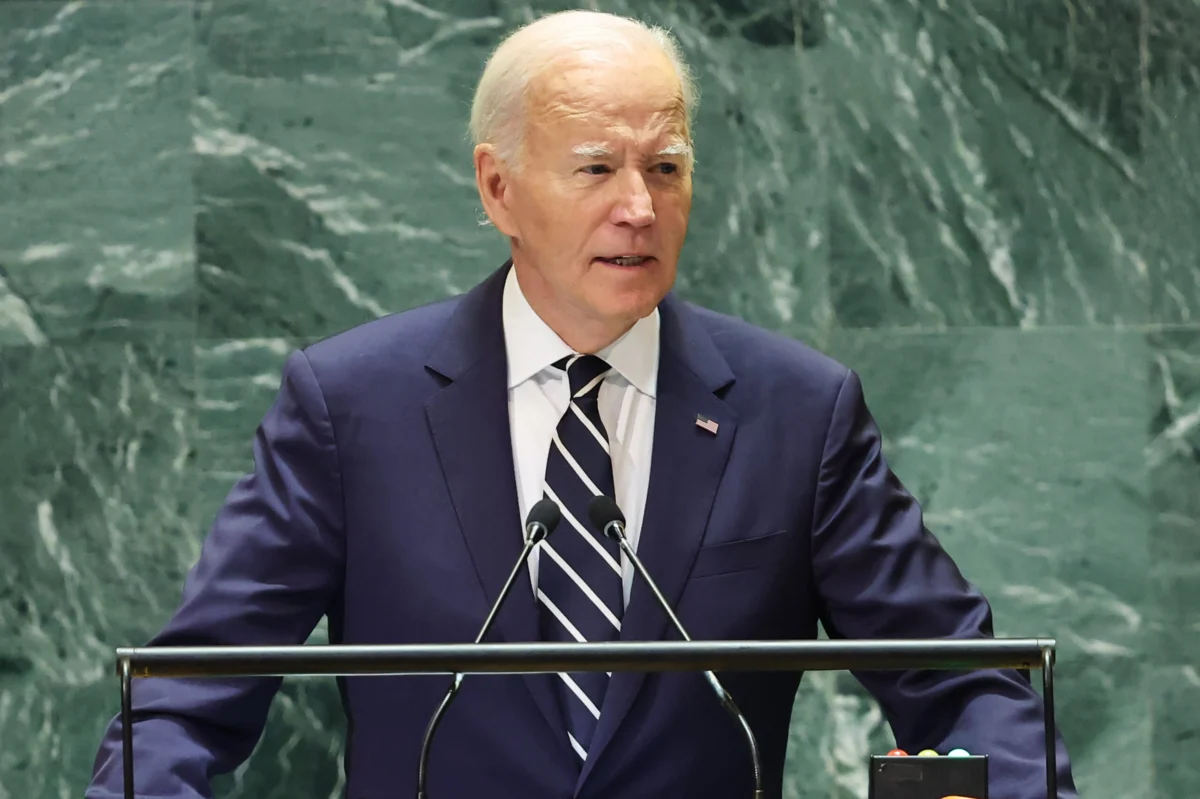
President Joe Biden delivered his final address to the United Nations General Assembly on Tuesday, standing before an audience of world leaders to reconcile the diplomatic ambitions of his half-century in public service with a world increasingly fractured by relentless conflict. Speaking at the 79th session of the assembly in New York, Biden sought to frame his foreign policy legacy as one of "hope over despair," even as the geopolitical landscape remains marred by the ongoing war in Ukraine, a humanitarian catastrophe in Sudan, and a Middle East teetering on the edge of a regional conflagration.
The address served as a capstone to a presidency that began with the promise of restoring American multilateralism following the isolationist "America First" era. Biden’s remarks were characterized by a poignant reflection on his decision to step down from the 2024 presidential race, a move he framed as a testament to democratic values. "As much as I love the job, I love my country more," Biden told the assembly. "Some things are more important than staying in power."
A World in Transition: The Backdrop of the 79th General Assembly
Biden’s appearance at the United Nations comes at a moment of profound uncertainty for the international order. When he took office in 2021, his primary message to the world was "America is back." Four years later, the message has shifted toward "America is transitioning," as the global community prepares for a potential shift in U.S. leadership following the November election.
The President’s speech touched on what his administration considers its pillar achievements: the revitalization of the NATO alliance, the formation of the "Quad" partnership in the Indo-Pacific (comprising the U.S., Japan, India, and Australia), and the establishment of global norms for artificial intelligence. However, these successes were balanced against the "grim reality" of current events. Since Biden’s 2023 UNGA address, the world has seen the Oct. 7 Hamas attacks on Israel, the subsequent and ongoing devastation in Gaza, and the escalation of hostilities between Israel and Hezbollah in Lebanon.
The Middle East: A Region on the Brink
The most immediate challenge facing the Biden administration is the spiraling violence in the Middle East. For months, the White House has been engaged in a delicate balancing act, supporting Israel’s right to defend itself while pushing for a cease-fire and hostage release deal that remains elusive.
"Now is the time for the parties to finalize its terms," Biden stated, referring to the cease-fire proposal supported by the U.S., Qatar, and Egypt. He emphasized that a deal would bring the hostages home, secure Israel’s safety, and "ease the suffering in Gaza." According to the Gaza Ministry of Health, the death toll in the enclave has exceeded 41,000 people since October 2023, with nearly the entire population of 2.3 million displaced.
Biden also used the platform to address the escalating violence in the West Bank and the broader need for a two-state solution. He argued that long-term stability can only be achieved if Palestinians live in "security, dignity, and self-determination in a state of their own," while Israel enjoys "full recognition and normalized relations with all its neighbors." This vision, however, faces significant hurdles, including the current Israeli government’s opposition to Palestinian statehood and the continued influence of militant groups.
Ukraine and the Defense of the UN Charter
A central theme of Biden’s presidency has been the defense of democratic sovereignty, most notably in the wake of Russia’s 2022 invasion of Ukraine. Biden reminded the assembly that when Russia invaded, many feared Ukraine would fall within weeks. Instead, 2.5 years later, Ukraine remains a sovereign nation, supported by a coalition of over 50 countries.
"We could have stood by and merely protested," Biden said. "But Vice President [Kamala] Harris and I understood that that was an assault on everything this institution was supposed to stand for."
The President’s call for continued support comes at a critical juncture. In Washington, a growing faction of the Republican Party has expressed skepticism or outright opposition to further military aid for Kyiv. Since the start of the war, the U.S. has committed more than $175 billion in total aid to Ukraine, including weaponry, economic support, and humanitarian assistance. Biden’s message to the UN was clear: "You cannot grow weary. You cannot look away."

The timing of the speech coincided with the arrival of Ukrainian President Volodymyr Zelenskyy in the United States. Zelenskyy is expected to present a "victory plan" to Biden and Vice President Harris in Washington later this week, as well as to former President Donald Trump.
Addressing the "Forgotten" Crisis in Sudan
While Ukraine and Gaza dominate the headlines, Biden made a point to highlight the civil war in Sudan, a conflict often described by humanitarian groups as the "forgotten war." The struggle for power between the Sudanese Armed Forces (SAF) and the Rapid Support Forces (RSF) has led to one of the world’s worst humanitarian disasters.
Data from the United Nations indicates that more than 10 million people have been displaced within Sudan, and another 2 million have fled to neighboring countries. Famine has been officially declared in parts of North Darfur, and the death toll is estimated in the tens of thousands. Biden called on the international community to stop the flow of weapons to the warring factions and to demand an end to the "senseless violence."
Managing Competition with China and Global Innovation
On the issue of China, Biden reiterated his administration’s policy of "de-risking, not de-coupling." He maintained that the U.S. seeks to manage competition responsibly to ensure it does not veer into conflict. This involves protecting sensitive technologies while maintaining trade relations that do not compromise national security.
The President also looked toward the future, outlining principles for the ethical development of artificial intelligence. The U.S. has been leading efforts at the UN to ensure that AI is used to bridge the digital divide and support sustainable development goals, rather than as a tool for surveillance or disinformation.
The Diplomatic Marathon: Side Events and High-Level Meetings
The General Assembly is as much about the speeches on the podium as it is about the meetings in the hallways. Biden’s schedule this week reflects a frantic effort to solidify partnerships before his term ends.
- The Quad: On September 21, Biden hosted the leaders of Australia, India, and Japan in Wilmington, Delaware, focusing on maritime security in the South China Sea.
- The UAE: On Monday, Biden met with United Arab Emirates President Mohamed bin Zayed Al Nahyan to discuss regional stability and economic investment.
- Vietnam: On Wednesday, he is scheduled to meet with President Tô Lâm, continuing the "Comprehensive Strategic Partnership" established last year.
- Synthetic Drugs: Biden will host a summit focused on the global fentanyl crisis, a major domestic and foreign policy priority aimed at disrupting international trafficking networks.
The Shadow of the 2024 Election
The presence of Vice President Kamala Harris and former President Donald Trump loomed large over the week’s proceedings. Foreign leaders are increasingly engaging with both candidates, recognizing the starkly different paths U.S. foreign policy could take after January 2025.
While Harris has largely aligned herself with Biden’s multilateral approach, Trump has signaled a potential return to a more transactional, "America First" strategy. Trump’s scheduled meetings with Zelenskyy, Indian Prime Minister Narendra Modi, and Polish President Andrzej Duda suggest he is already positioning himself as a shadow diplomat. This dual-track diplomacy creates a unique challenge for Biden as he attempts to project a sense of continuity and American reliability.
Conclusion: A Final Call to Action
In the closing moments of his address, President Biden returned to the theme of public service. By highlighting his decision to step aside for a "new generation of leadership," he aimed to provide a counter-narrative to the rise of authoritarianism globally. He urged his fellow leaders to remember that they are there to serve their people, not their own ambitions.
Biden’s final UNGA speech was an attempt to bridge the gap between the idealism of the UN Charter and the brutal realities of 21st-century warfare. While his administration has successfully revitalized traditional alliances, the "unfinished business" of Gaza, Ukraine, and Sudan ensures that his successor will inherit a world as volatile as the one Biden faced four years ago. As the President exited the stage, the message left behind was one of cautious optimism—a belief that despite the "difficulty and despair," the international community still possesses the tools to prevent a global catastrophe, provided it has the will to use them.
