

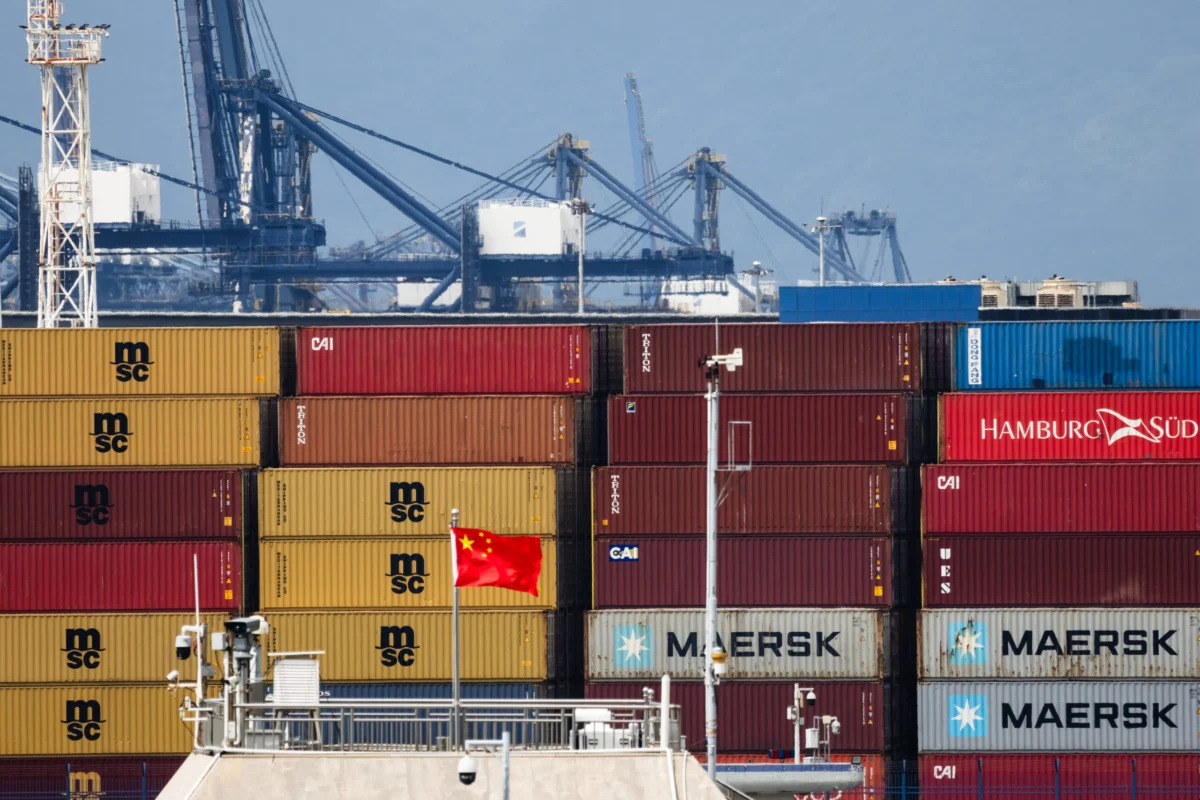
SHENZHEN, CHINA – May 1, 2026: The bustling Yantian Port in Shenzhen, Guangdong Province, China, serves as a critical artery for global commerce. On this day, the Chinese national flag stands tall against a backdrop of stacked shipping containers, emblazoned with the logos of international maritime giants like MSC (Mediterranean Shipping Company), Maersk, and Hamburg Süd. This imagery underscores China’s pivotal role in the world’s supply chains, a role that has recently seen a significant upswing in export performance, even as underlying domestic economic currents suggest a need for rebalancing.
Recent official customs data reveals that China’s trade growth experienced a notable acceleration in August. Exports, a key engine for the world’s second-largest economy, surged by 25% in U.S. dollar terms compared to the same period last year. This figure aligns precisely with the forecasts of analysts polled by Reuters and marks an improvement from the 23.9% increase observed in July. This robust export performance is a critical factor supporting China’s economic momentum amidst a complex global economic landscape characterized by geopolitical tensions and moderating domestic consumption.
However, the picture for imports presented a more nuanced scenario. Imports rose by a respectable 28.2% in August, demonstrating an increase from July’s 27.5% growth. Despite this upward trend, the figure fell short of economists’ expectations of a 30% rise in the Reuters poll. This shortfall in import growth is being interpreted by some as an indicator of tepid domestic demand, a persistent challenge for Beijing as it seeks to transition its economic model towards greater reliance on internal consumption.
The divergence between export and import growth resulted in a further expansion of China’s trade surplus. In August, the surplus swelled to $119.09 billion, an increase from the $112.5 billion recorded in July. This growing surplus, driven primarily by strong external demand for Chinese goods, has intensified global discussions around China’s trade practices and its impact on international trade balances.
Export Drivers and Global Demand
The surge in Chinese exports in August was particularly pronounced in key trade relationships. Shipments to the United States, a major trading partner, saw a significant jump of 34.4%, continuing a trend of double-digit gains that has been largely consistent throughout the year. Imports from the U.S. grew by 17.8%, according to CNBC’s calculations based on official data, indicating a continued robust flow of goods between the two economic powerhouses, albeit with a widening trade gap in China’s favor.
Trade with the European Union also demonstrated positive, albeit more modest, growth. Exports to the EU expanded by 6.6%, while imports from the bloc saw a marginal increase of 0.7%. The data also highlighted a remarkable performance in trade with South Korea, where China’s imports more than doubled, and exports jumped by nearly 50%, suggesting a strong recovery and increased demand for components and finished goods in that region.
Analysts attribute the sustained strength of Chinese exports to several converging factors. The global build-out of artificial intelligence (AI) infrastructure has created a significant demand for high-tech components and manufacturing capabilities, areas where China holds a dominant position. This demand has served as a crucial buffer, cushioning the negative impacts of geopolitical shocks, the ongoing moderation of domestic demand, and a general slump in investment within China. Essentially, exports have become the primary growth driver, stepping in to compensate for weaknesses elsewhere in the economy.
Mounting Pressure for Trade Rebalancing
The sustained export-led growth has not gone unnoticed on the international stage. Zhiwei Zhang, President and Chief Economist at Pinpoint Asset Management, commented on the situation, stating, "China continues to rely on exporters to support the economy as domestic demand remains subdued." He further highlighted the increasing global pushback against China’s trade imbalances, a sentiment echoed by governments worldwide.

The offshore yuan, China’s currency, showed minimal reaction to the trade data release on Tuesday, trading at approximately 6.7099 per U.S. dollar. This relative stability comes as the Chinese currency has outperformed many of its Asian peers this year, appreciating by 3.8% year-to-date against the greenback. This appreciation, while positive for China’s purchasing power, has also been a point of contention for some trading partners who argue that the yuan remains undervalued.
Calls for a Stronger Yuan and International Scrutiny
China’s substantial and persistent trade surplus has intensified calls from economists and foreign officials for Beijing to allow its currency, the yuan, to strengthen. The argument is that a deeply undervalued yuan contributes significantly to China’s export competitiveness, potentially creating unfair advantages in global markets. Last month, Brad Setser, a senior fellow at the Council on Foreign Relations, estimated that the Chinese currency is undervalued by as much as 20%.
The impressive performance of China’s exports has drawn considerable scrutiny from Western trading partners, who are increasingly urging Beijing to rebalance its trade structure and bolster its domestic demand. This pressure was palpable at the recent gathering of Group of 20 finance ministers in the United States. In a joint statement, the ministers criticized economies that rely heavily on exports for growth. Notably, China was the only dissenting member in this statement, signaling its discomfort with the international consensus on trade imbalances.
Beijing has consistently pushed back against these trade complaints, characterizing them as "an excuse to pressure and restrict China." During a speech at the G20 summit, People’s Bank of China Governor Pan Gongsheng asserted that China has "never actively pursued" a trade surplus and has not depreciated its currency to gain a trade advantage. He also reiterated China’s commitment to maintaining an open market for foreign businesses.
Despite these diplomatic exchanges, frustrations in Washington over the bilateral trade relationship are unlikely to derail an upcoming high-stakes visit by Chinese leader Xi Jinping to Washington D.C. later this month. According to analysts, this is partly due to the U.S.’s own narrowing deficit with China in certain sectors and its ongoing trade disputes with other global partners, which may temper its immediate focus on China’s surplus.
Beijing’s Fiscal Push to Stimulate Domestic Demand
In response to the economic headwinds, particularly the slowing domestic demand and investment, Beijing has been signaling a renewed focus on stimulating growth. Neo Wang, China strategist at Evercore ISI, expressed optimism about the second half of the year, citing "the sense of urgency and determination in Beijing’s recent policy communications" and stabilizing manufacturing activity in August.
China had set an ambitious GDP growth target range of 4.5%-5% for the current year. However, momentum has faltered after a strong start, with growth cooling to a more than three-year low of 4.3% in the second quarter. Data released in subsequent months indicated a further weakening of domestic demand and investment in July, with manufacturing activity contracting for a second consecutive month.
To counteract this trend, fiscal spending by the government has accelerated in recent weeks. This increased spending is aimed at arresting the decline in investment and restoring economic stability. A significant measure involves a planned $54 billion capital injection into several state-owned banks and insurers, a move designed to bolster the financial sector and support broader economic growth, especially at a time when stimulus options are somewhat constrained.
Economists are also looking at the possibility of further monetary easing by the People’s Bank of China (PBOC) before the end of the year. Shan Guo, a partner at China-focused Hutong Research, anticipates one or two interest-rate cuts. The timing and pace of these potential cuts are expected to be influenced by several key factors: the monetary policy decisions of the U.S. Federal Reserve, the issuance of bonds by the Ministry of Finance, and the trajectory of the yuan’s appreciation. Guo suggests that a stronger yuan could provide the PBOC with greater flexibility to implement interest rate cuts, even if the Federal Reserve continues its own tightening cycle.
The interplay between robust export performance and subdued domestic demand presents a complex challenge for China’s economic policymakers. While the nation’s manufacturing prowess continues to drive significant trade surpluses and support overall GDP growth, the long-term sustainability of this model hinges on Beijing’s ability to effectively rebalance its economy and foster stronger internal consumption. The coming months will be crucial in observing how these fiscal and monetary policy levers are utilized to navigate these competing economic forces and achieve a more balanced and resilient growth trajectory.
