

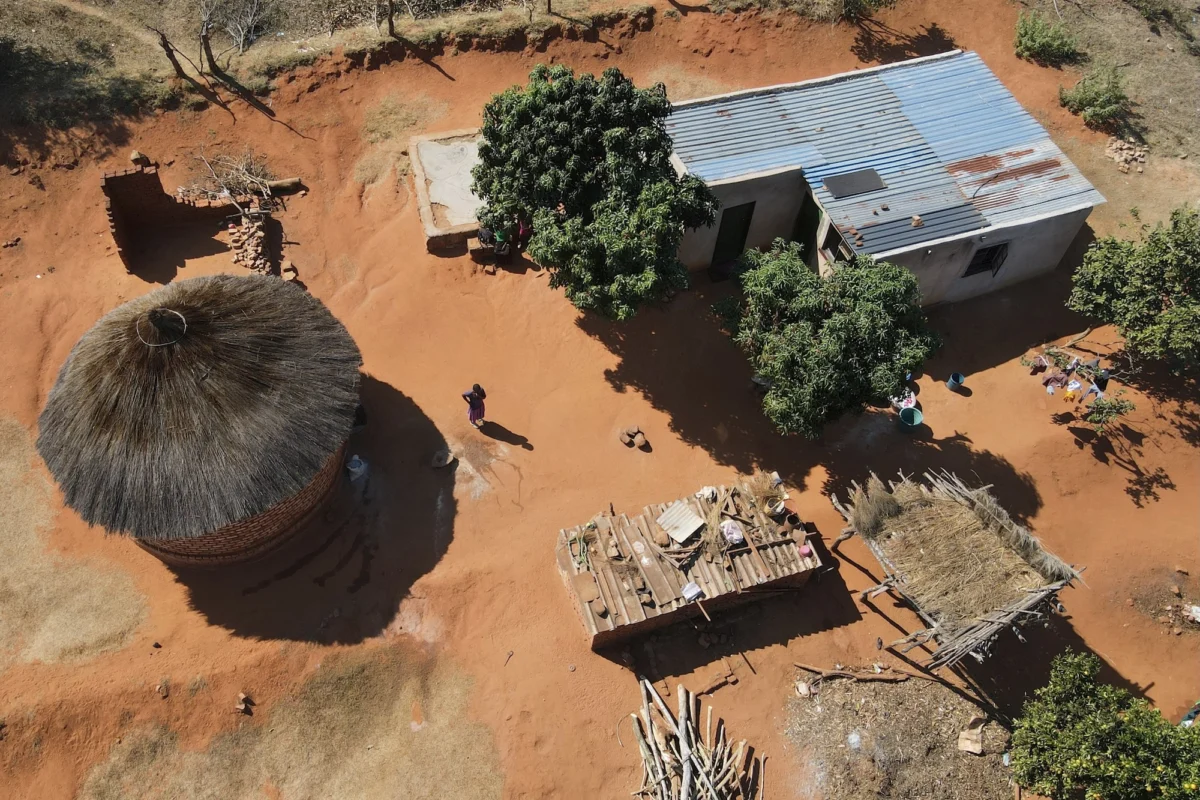
Esther Mwedzi sits on the front veranda of her home in eastern Zimbabwe, methodically separating her laundry as the afternoon sun glints off the corrugated metal roof. Her residence, a large, modern brick house, stands as a striking anomaly against the dusty, sun-scorched yard of Chitiyo village. For Mwedzi, a 38-year-old mother of three, the structure is more than just a shelter; it is a monument to financial ingenuity in a country where the formal banking sector has long remained out of reach for the average citizen. “I built this house with my hard work,” she says, gesturing to the four-bedroom home that took only 18 months to complete.
Mwedzi’s success was not facilitated by a commercial mortgage or a government grant. Instead, she is a member of Mutekwatekwa, an informal savings group operating near Mutare, the capital of Zimbabwe’s Manicaland province. In a region where access to traditional credit is virtually non-existent for those without formal employment, Mwedzi utilized low-interest loans from this community-driven collective to purchase bricks, cement, windows, and doors. This model of grassroots micro-financing, known locally in Shona as “mukando,” is currently transforming the landscape of rural Zimbabwe, providing a lifeline to thousands who exist outside the traditional financial system.
The Financial Divide: Why Formal Banking Fails the Rural Poor
The rise of informal savings groups is a direct response to the prohibitive barriers established by Zimbabwe’s formal financial institutions. For the majority of Zimbabweans, commercial banks are not a resource, but a gatekeeper. Lending requirements typically include formal payslips, letters of employment, and proof of residence—documents that are nearly impossible to produce in an economy where the informal sector accounts for an estimated 80 to 90 percent of all economic activity.

Furthermore, the cost of formal credit is astronomical. While the Mutekwatekwa savings group offers loans at a fixed 10 percent interest rate, commercial banks often charge annual rates as high as 46 percent or more, driven by the country’s volatile inflationary history. For a rural farmer or a small-scale livestock keeper, such rates are not just burdensome; they are predatory.
Rashweat Mukundu, a prominent social commentator, notes that the financial sector’s exclusivity has forced a return to communal roots. “The poor, urban, and rural communities mobilize whatever they have to support investment and to support food security,” Mukundu explains. “Formal banking is limited to the few who hold formal jobs and businesses, so savings groups are a long-standing method community members can use to support each other.”
The Mechanics of Mutekwatekwa: Trust as Collateral
The Mutekwatekwa savings group, established in early 2024, operates on a foundation of radical transparency and mutual accountability. The group consists of 50 members, subdivided into four smaller clusters of 12 to 13 people. Each member contributes a minimum of US$5 monthly to a shared pool. In a country where the average civil servant, such as a teacher or nurse, may earn a monthly salary equivalent to less than US$300, these five-dollar contributions represent a significant commitment to long-term stability.
The logic of the group is cyclical. The accumulated funds are lent back to members, who are required to repay the principal plus 10 percent interest within a month. At the end of the calendar year, the interest earned is distributed among the members, often resulting in a doubling of their initial savings.

Jeremiah Chitiyo, the chairperson of Mutekwatekwa, emphasizes that the group’s impact extends far beyond simple cash flow. “The initiative helps people access capital, acquire assets, and start up small businesses,” he says. “Small loans have enabled people in this community to build houses, buy cows and goats, pay school fees, and drill boreholes.”
To ensure members can meet their monthly obligations even during lean agricultural months, the group manages a community garden. Here, members grow a variety of fruits and vegetables, which serve the dual purpose of improving household nutrition and providing a surplus to sell in local markets. This integrated approach ensures that the "mukando" is not just a bank, but a holistic economic ecosystem.
A Chronology of Resilience: From Aid to Autonomy
The evolution of these savings groups in Manicaland is inextricably linked to international development efforts, though their current survival is a testament to local ownership.
- 2020–2024: CARE Zimbabwe, with funding from the United States Agency for International Development (USAID), begins implementing programs designed to reduce poverty and improve food security in rural districts. The focus is on "climate-smart" agriculture and the establishment of self-managed village savings and loan associations (VSLAs).
- January 2024: The Mutekwatekwa group is formally established in Chitiyo village. CARE Zimbabwe provides the initial training on constitution-building and financial management but provides no direct capital, ensuring the money in the box belongs solely to the villagers.
- Early 2025: A shift in U.S. foreign policy leads to significant USAID funding cuts. The program, originally slated to run until 2027, faces immediate disruption.
- 2025–Present: Despite the withdrawal of external financial backing, the savings groups continue to thrive. Because they were designed to be self-sustaining from day one, the groups maintain their operations, proving that local ownership is the ultimate hedge against geopolitical shifts.
Delilah Takawira, Country Director at CARE Zimbabwe, highlights this sustainability. “Our role is facilitator, not financier,” she says. “Savings groups do not require external funding to operate. They belong to their members.” As of 2025, CARE’s initiatives have supported over 47,000 members across 5,013 groups nationwide, circulating nearly US$2 million in internal loans.

Beyond Housing: Climate Resilience and Infrastructure
While the visual evidence of the groups’ success is often found in the new homes of members like Tsitsi Mahari—a 23-year-old mother who built a three-bedroom house complete with solar power and a smart television—the groups are also tackling infrastructure challenges that the state has failed to address.
In the arid regions of Manicaland, water scarcity is a constant threat to livelihoods. Senior Chitiyo, a relative of Jeremiah and a long-time participant in various "mukando" clubs, belongs to a specialized six-member group of smallholder farmers. Their goal is specific: irrigation.
Each member contributes $25 a month toward a fund used to drill boreholes, a project that costs approximately $2,000 per site—a figure far beyond the reach of an individual farmer. By pooling their resources, the group has already successfully drilled boreholes for three members. Senior Chitiyo is scheduled for her installation in August 2027. “I have used the proceeds from these clubs for more than a decade to build my house and feed and clothe my four children,” she says, standing in the small grocery shop she also funded through savings.
Risk Management in a Trust-Based Economy
The lack of legal recourse in informal lending is a double-edged sword. Without a judicial system to enforce repayments, the entire structure relies on social capital. Defaults can be devastating, and there is a constant risk of theft or fraud.

To mitigate these risks, the Mutekwatekwa group adheres to a strict internal constitution. Loans are generally restricted to members only, as chasing outsiders for repayment is difficult. Transparency is the primary defense against internal theft. “All transactions happen in front of the full membership,” Takawira explains. “The funds sit in a lockbox with three keys, held by three different members. The box can only be opened when all three are present during a general meeting.”
This "three-key" system has proven remarkably effective. Groups that lend exclusively within their known community report significantly lower rates of default and theft than those that attempt to expand into external micro-lending.
Analysis: The Future of Informal Finance in Zimbabwe
The success of the "mukando" system in Chitiyo village offers a blueprint for economic resilience in developing nations facing high inflation and state fragility. By decoupling financial growth from the national currency and the formal banking infrastructure, rural communities have insulated themselves from the broader economic shocks that frequently paralyze Zimbabwe’s urban centers.
However, challenges remain. The loans, while transformative on a household level, are still relatively small. For Esther Mwedzi, the next step is moving from subsistence and basic asset acquisition to larger-scale entrepreneurship. With her house complete, she plans to take a larger loan to launch a broiler chicken project, aiming to supply the larger markets in Mutare.

“I want to diversify my sources of income,” Mwedzi says. Her ambition reflects a broader trend: the transition of rural women from passive savers to active entrepreneurs.
The broader implication for Zimbabwe’s economy is profound. As these groups grow in capital and sophistication, they are effectively creating a parallel financial system that is more responsive, more stable, and more inclusive than the one sanctioned by the state. In the absence of a functional national economy, the people of Chitiyo village have built their own, one five-dollar contribution at a time. For Esther Mwedzi and her neighbors, the "mukando" is not just a way to save money—it is the foundation of their independence.
