

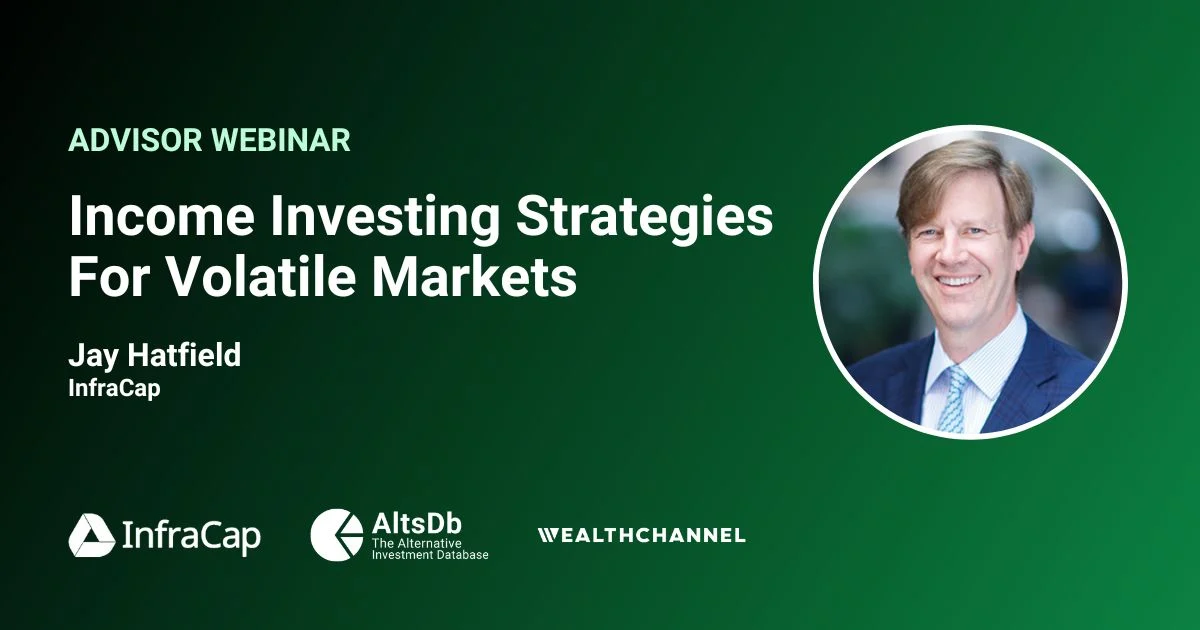
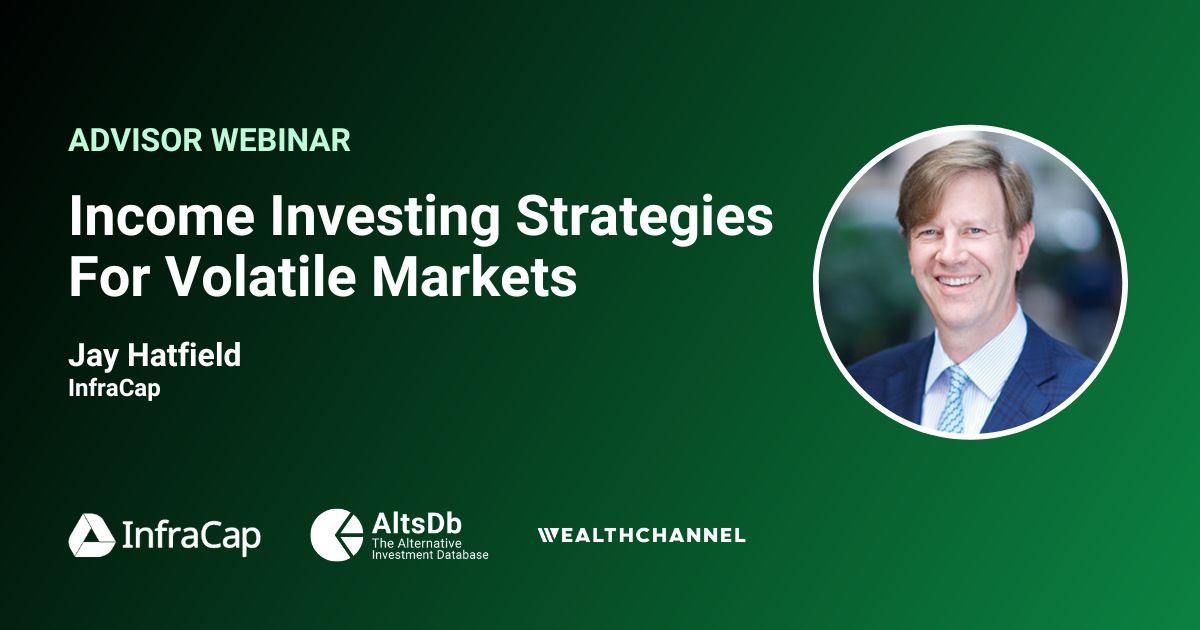
On February 8th, financial advisors had the opportunity to deepen their understanding of income investing strategies tailored for the current macroeconomic climate during a comprehensive one-hour webinar hosted by AltsDb co-founder Jimmy Atkinson. The event featured Jay Hatfield, founder and CEO of InfraCap, who shared his expertise and insights with a virtual audience of professionals. This educational session was notable for its acceptance by the CFP Board, granting attendees one hour of Continuing Education (CE) credit, underscoring its relevance and value to financial planning professionals.
The webinar, titled "Income Investing Strategies For Volatile Markets," addressed the critical need for advisors to navigate complex economic conditions that can significantly impact investment portfolios, particularly those focused on generating consistent income. In an environment characterized by fluctuating interest rates, persistent inflation, and geopolitical uncertainties, traditional income-generating assets may face unique challenges and opportunities. Hatfield’s presentation aimed to equip advisors with the knowledge and tools necessary to construct and manage portfolios that can withstand market turbulence while continuing to deliver reliable income streams to clients.
Context of the Webinar: Navigating a Shifting Economic Landscape
The timing of this webinar was particularly pertinent. As of early 2023, the global economy was grappling with a confluence of factors that had reshaped investment landscapes. Central banks worldwide had been engaged in aggressive interest rate hikes to combat inflation that had reached multi-decade highs in many developed nations. This policy shift had a direct impact on bond yields, making fixed-income investments more attractive but also introducing greater price volatility. Simultaneously, equity markets had experienced significant downturns in 2022, creating a more challenging environment for growth-oriented strategies and highlighting the importance of income-generating assets for portfolio stability and wealth preservation.
The macroeconomic environment of late 2022 and early 2023 was marked by:
- Elevated Inflation: Consumer Price Index (CPI) figures remained stubbornly high in many major economies, eroding the purchasing power of returns and prompting central banks to tighten monetary policy. For instance, in the United States, inflation peaked at over 9% year-over-year in mid-2022, a level not seen in decades.
- Rising Interest Rates: The U.S. Federal Reserve, the European Central Bank, and the Bank of England all embarked on significant interest rate hiking cycles. The Federal Reserve, for example, raised its benchmark interest rate from near zero to over 4% within a year, a rapid pace of tightening that historically can lead to economic slowdowns.
- Market Volatility: Equity markets experienced substantial drawdowns in 2022. The S&P 500, a key benchmark for U.S. stocks, fell over 19% for the year. This volatility underscored the need for defensive strategies and income-producing assets that can provide a cushion against market declines.
- Geopolitical Tensions: Ongoing conflicts and geopolitical shifts continued to add layers of uncertainty to global markets, impacting supply chains, commodity prices, and investor sentiment.
In this context, financial advisors face the dual challenge of managing client expectations and adapting their investment strategies. The webinar sought to address these challenges by focusing on income investing, a segment of the market that has historically played a crucial role in wealth management, particularly for clients nearing or in retirement.
Key Themes and Strategies Discussed
While the specific details of the strategies discussed are best captured by viewing the webinar or downloading the presentation deck, the overarching themes likely revolved around how to construct resilient income-generating portfolios in the face of prevailing economic headwinds. This would typically involve exploring a range of asset classes and investment approaches that can offer attractive yields without exposing clients to undue risk.
Potential topics covered during the session could have included:
- Diversification Across Income-Generating Asset Classes: Moving beyond traditional fixed income to explore alternative income sources. This might involve strategies in areas such as:
- Dividend-Paying Equities: Focusing on companies with a history of consistent dividend payments and strong balance sheets, which can offer both income and potential capital appreciation. Data from the S&P 500 has historically shown that dividend-paying stocks often outperform non-dividend payers over the long term, especially when reinvested.
- Real Estate Investment Trusts (REITs): These offer exposure to real estate income streams through a liquid, exchange-traded vehicle, and are legally required to distribute a significant portion of their taxable income to shareholders as dividends.
- Infrastructure Investments: Assets like toll roads, utilities, and renewable energy projects often provide stable, long-term cash flows that can be passed on to investors. InfraCap, as a firm specializing in alternative investments, likely brought a unique perspective on these less conventional income sources.
- Private Credit: Opportunities in direct lending, mezzanine debt, and other forms of private debt, which can offer higher yields than publicly traded bonds, though often with less liquidity.
- Preferred Stocks: A hybrid security that pays fixed dividends, offering a middle ground between stocks and bonds.
- Yield Enhancement Strategies: Methods for potentially boosting income without significantly increasing risk. This could involve:
- Option-Writing Strategies: Selling call or put options on income-producing assets to generate premium income.
- Covered Call Writing: A common strategy where an investor owns an underlying asset and sells call options on that asset, generating income from the option premiums.
- Cash-Secured Puts: Selling put options while holding enough cash to buy the underlying stock if it falls below the strike price, generating premium income.
- Risk Management in Income Portfolios: Strategies to mitigate risks associated with rising interest rates, inflation, and credit defaults. This includes:
- Duration Management: For fixed-income assets, managing the sensitivity of bond prices to interest rate changes.
- Credit Quality Assessment: Diligently analyzing the creditworthiness of bond issuers and other debt instruments.
- Inflation Hedging: Incorporating assets that tend to perform well during inflationary periods, such as real assets or inflation-linked bonds (e.g., Treasury Inflation-Protected Securities – TIPS).
- The Role of Alternative Investments: Given InfraCap’s specialization, the webinar likely delved into how alternative income strategies can complement traditional portfolios, offering diversification benefits and potentially enhanced risk-adjusted returns. Alternatives can include a broad range of assets beyond stocks and bonds, often characterized by lower correlation to traditional markets.
The Value Proposition for Financial Advisors
For financial advisors, staying abreast of evolving income investing strategies is paramount. Clients, particularly those in or nearing retirement, rely on their advisors to generate predictable income streams to cover living expenses, preserve capital, and maintain their lifestyle. The webinar offered a valuable opportunity for advisors to:
- Gain Actionable Insights: Learn about specific investment vehicles and strategies that can be implemented in client portfolios.
- Enhance Client Communication: Develop a deeper understanding of the current economic environment and how to articulate the rationale behind their investment recommendations to clients.
- Meet Continuing Education Requirements: Fulfill professional development obligations, demonstrating a commitment to ongoing learning and expertise. The CFP Board’s accreditation signifies that the content met rigorous standards for financial planning education.
- Network and Learn from Experts: Engage with industry leaders like Jay Hatfield and gain perspectives from a specialized firm like InfraCap.
Broader Implications for the Financial Advisory Industry
The focus on income investing in volatile markets reflects a broader trend in the financial advisory industry. As investors increasingly seek stability and predictable returns, particularly in uncertain economic times, advisors are compelled to expand their toolkit beyond traditional asset allocation models. The growing interest in alternative investments, as exemplified by InfraCap’s participation, suggests a shift towards more sophisticated and diversified approaches to portfolio construction.
The success of such webinars, indicated by their CFP Board accreditation, highlights the demand for practical, education-focused content that directly addresses the challenges faced by advisors in their daily practice. These events serve as crucial platforms for knowledge transfer, helping to ensure that financial professionals are equipped to guide their clients through complex economic landscapes.
Furthermore, the availability of the webinar presentation deck for download provides a lasting resource for attendees and others interested in the topic. This allows for further study and application of the discussed strategies. The presentation likely contained detailed charts, data, and case studies that would be invaluable for advisors seeking to implement these income-generating approaches.
Conclusion
The webinar hosted by AltsDb and featuring Jay Hatfield from InfraCap provided a timely and valuable educational experience for financial advisors. By focusing on income investing strategies tailored to the current macroeconomic environment, the session equipped professionals with critical knowledge to navigate market volatility and meet client income needs. The CFP Board’s recognition of the webinar underscores its significance and the ongoing importance of specialized education for financial advisors striving to deliver optimal outcomes for their clients in an ever-changing financial world. The event serves as a testament to the proactive efforts within the industry to adapt to economic realities and foster informed investment practices.
