

The telecommunications landscape in Zimbabwe is on the precipice of a transformative shift as the nation seeks to modernize its digital infrastructure through the integration of Low Earth Orbit (LEO) satellite constellations and high-capacity terrestrial fiber networks. This evolution marks the most significant technological leap since the country’s entry into the satellite era nearly four decades ago. To fully realize the potential of modern satellite technology, a comprehensive twelve-month strategic roadmap has been conceptualized, focusing on the establishment of domestic gateway teleports, the licensing of high-frequency Q/V bands, and the commissioning of a central Point of Presence (PoP) in Harare.
The Historical Context: From Mazowe to the LEO Era
Zimbabwe’s foray into satellite communications was born out of a strategic diplomatic engagement in the mid-1980s. Following an official state visit to Japan, the Zimbabwean government secured the technical partnership necessary to establish the country’s primary satellite hub at Mazowe in 1985. For decades, the Mazowe Earth Station served as the nation’s singular gateway to the world, utilizing Geostationary Earth Orbit (GEO) links to provide international telecommunications and broadcasting services.
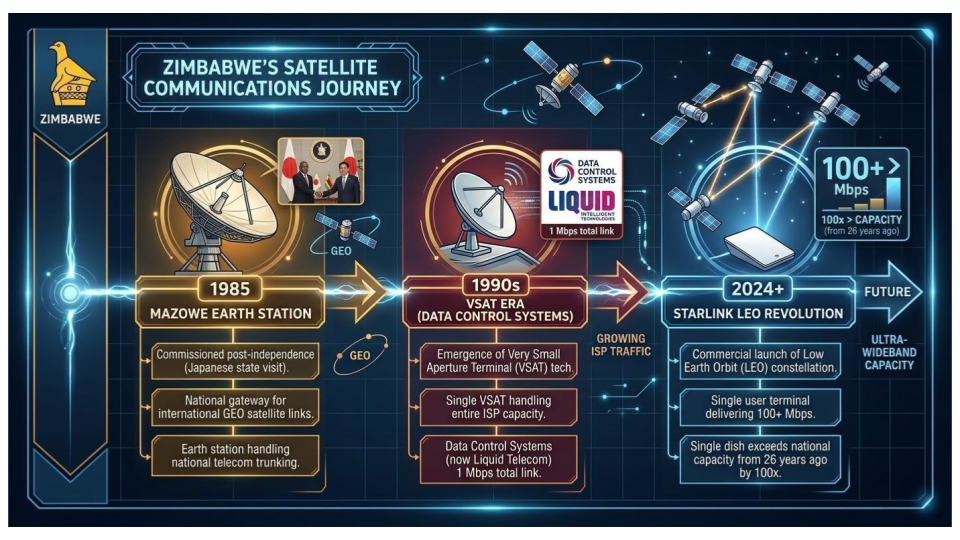
During the late 1990s and early 2000s, the demand for data began to outpace traditional voice services. This era saw the rise of Very Small Aperture Terminal (VSAT) technology. In its infancy, the nation’s commercial data load was handled by a single VSAT terminal operated by Data Control Systems—the precursor to what is now Liquid Intelligent Technologies. At that time, an aggregate trunk connection of just 1 Mbps was sufficient to support the country’s nascent internet requirements.
However, the digital divide and the exponential growth of the global internet have rendered these legacy systems insufficient. By the 2020s, individual enterprise users often required more bandwidth than the entire national capacity of the late 1990s. The introduction of LEO satellite constellations, most notably Starlink, has disrupted this paradigm. A single modern enterprise terminal now delivers throughput exceeding Zimbabwe’s total 1999 national bandwidth capacity by a factor of 100, necessitating a total overhaul of the country’s ground-based infrastructure to handle these massive data flows.
Performance Benchmarks and the Necessity of Local Infrastructure
Starlink officially commenced commercial operations in Zimbabwe on September 6, 2024. The initial phase of the rollout was characterized by exceptional performance, as the regional network load remained low. However, as adoption rates surged across Southern Africa, the limitations of relying on distant ground stations became apparent. By September 2026, substantial regional subscriber growth led to noticeable bandwidth throttling during peak hours.

Technical analysis indicates that while LEO satellites provide high-speed connectivity, the absence of local ground stations in Zimbabwe forces data to travel to teleports in neighboring countries or further afield before entering the global internet backbone. This "tromboning" effect increases latency and creates bottlenecks. To resolve these issues, the deployment of local ground station teleports and a domestic Point of Presence (PoP) in Harare is essential. Such infrastructure would stabilize speeds and maintain domestic latencies below the 20 ms threshold, providing a fiber-like experience via satellite.
Technical Engineering: The Q/V Band and Spectrum Allocation
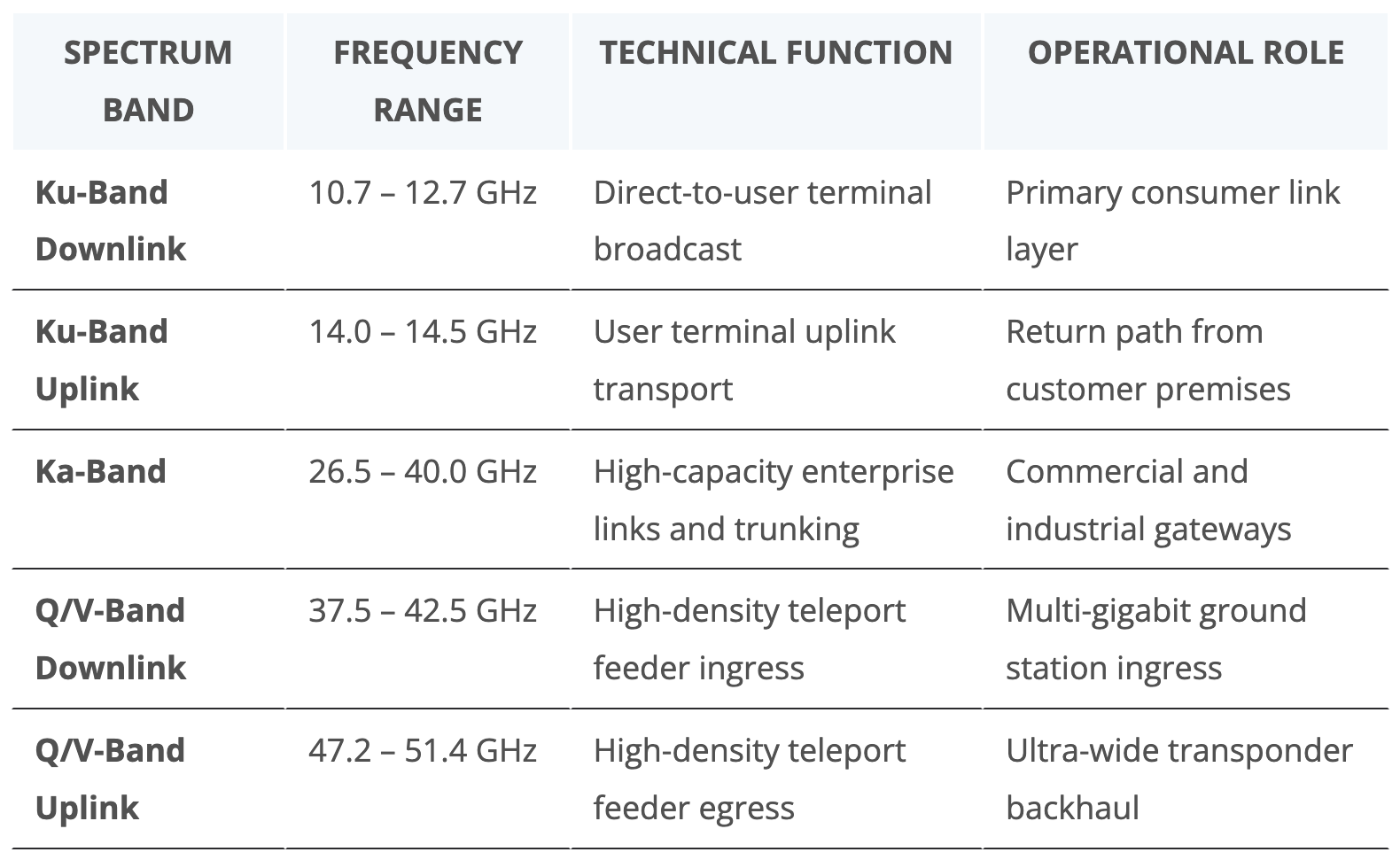
A critical component of the proposed roadmap is the licensing and utilization of the Q/V bands. While most consumer satellite services operate on Ku and Ka bands, the high-density requirements of a national gateway necessitate the use of higher-frequency feeder links.
The Q/V bands (ranging from 37.5 to 52.4 GHz) offer significant engineering advantages for satellite-to-ground communication. Firstly, they provide substantially more bandwidth than lower frequency bands, allowing for the massive data backhaul required by thousands of simultaneous users. Secondly, these bands are less congested, reducing the risk of signal interference with existing terrestrial microwave links.

For the Postal and Telecommunications Regulatory Authority of Zimbabwe (POTRAZ), the allocation of these spectrum bands represents a regulatory milestone. By creating a framework for Q/V band licensing, Zimbabwe can position itself as a regional leader in satellite technology, attracting further investment from global LEO operators.
National Fiber Infrastructure Synergy Matrix
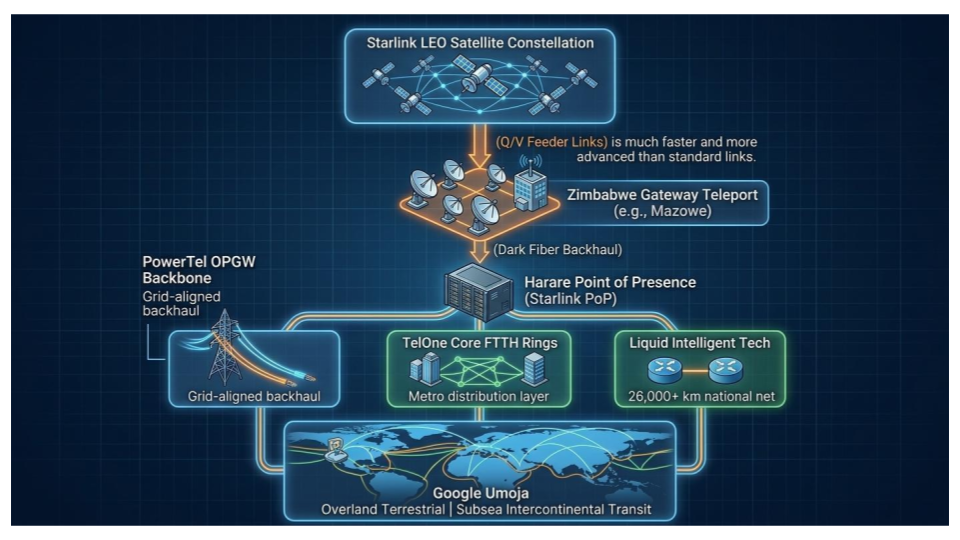
The success of a domestic Starlink gateway depends heavily on its integration with Zimbabwe’s existing terrestrial fiber-optic networks. The proposed Harare PoP will act as a bridge between the sky and the ground, leveraging several key infrastructure assets:
- Liquid Intelligent Technologies: With over 26,000 km of fiber across Zimbabwe, Liquid provides the core long-haul routing layer. Connecting a Starlink PoP to Liquid’s regional network ensures that satellite data can be distributed efficiently across Southern Africa.
- PowerTel and Paratus: A significant public-private partnership (PPP) between PowerTel and Paratus Zimbabwe has resulted in a high-capacity Dense Wavelength Division Multiplexing (DWDM) backhaul network. Starting with an 800 Gbps link between Plumtree and Bulawayo, this infrastructure is designed to scale up to 10 Tbps, linking Zimbabwe with Botswana and Zambia.
- TelOne: The state-owned provider continues to expand its backbone capacity along transit links to South Africa and Zambia, driven by the regional demand for 100G+ wavelengths.
- DFA Zimbabwe: In partnership with BCS Group and Dandemutande, DFA has constructed a 1,500 km open-access optical fiber backbone along national railway lines. This $18 million investment provides redundant, high-speed wholesale backhaul that is vital for national data resilience.
- Google Umoja Cable System: The Umoja cable, which provides an overland path from East Africa to Southern Africa and then across to global subsea landings, offers Zimbabwe a direct route to low-latency intercontinental cloud links. A local Starlink PoP connected to Umoja would significantly enhance the performance of cloud-based services for Zimbabwean businesses.
Global Benchmarks: Learning from Brazil and the USA
In conceptualizing this roadmap, Zimbabwe can look to global leaders in LEO satellite adoption. Brazil and the United States serve as primary benchmarks for ground station deployment. In Brazil, the rapid expansion of Starlink ground stations across the Amazon and rural regions has bridged the digital divide for millions, proving that LEO technology can overcome challenging geography when supported by local teleports.
In the United States, the density of ground stations ensures that users rarely experience the throttling seen in underserved regions. These case studies demonstrate that the quality of service is directly proportional to the proximity and capacity of the ground-based gateway infrastructure. For Zimbabwe, the lesson is clear: relying on international gateways is a temporary fix; long-term stability requires domestic investment.
The Strategic Twelve-Month Implementation Roadmap
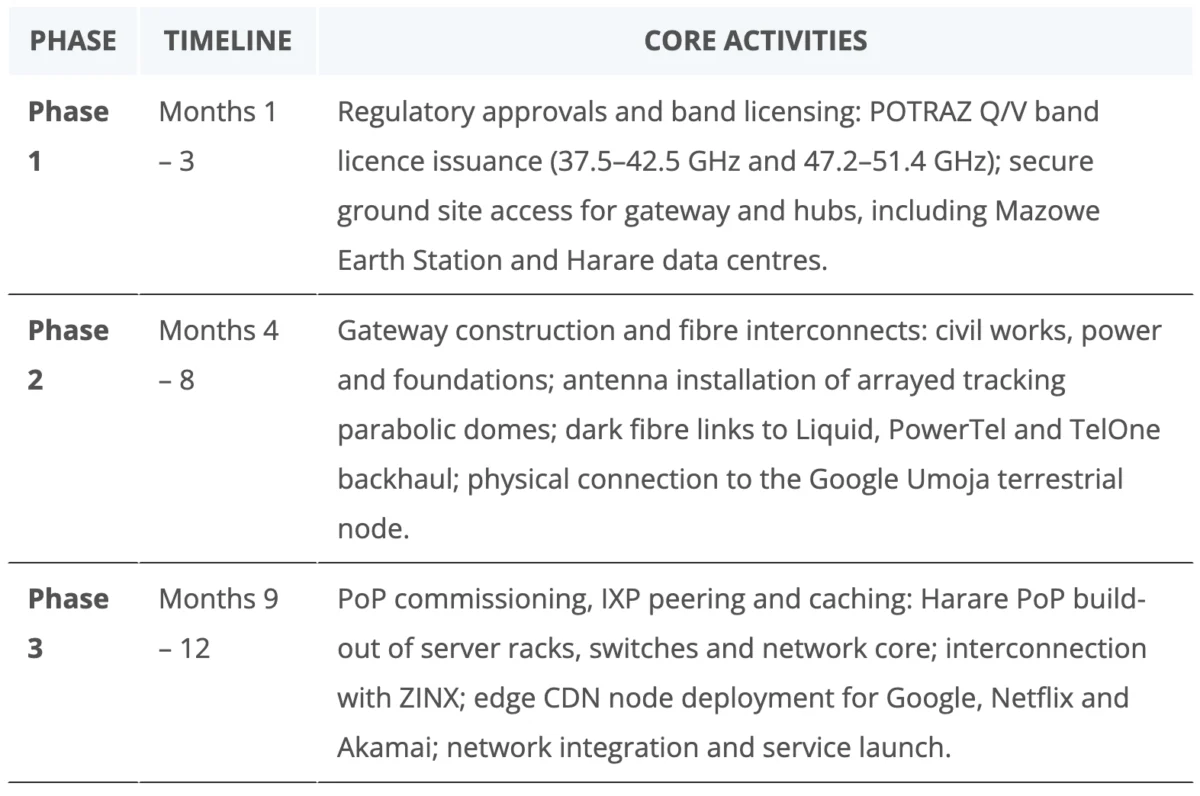
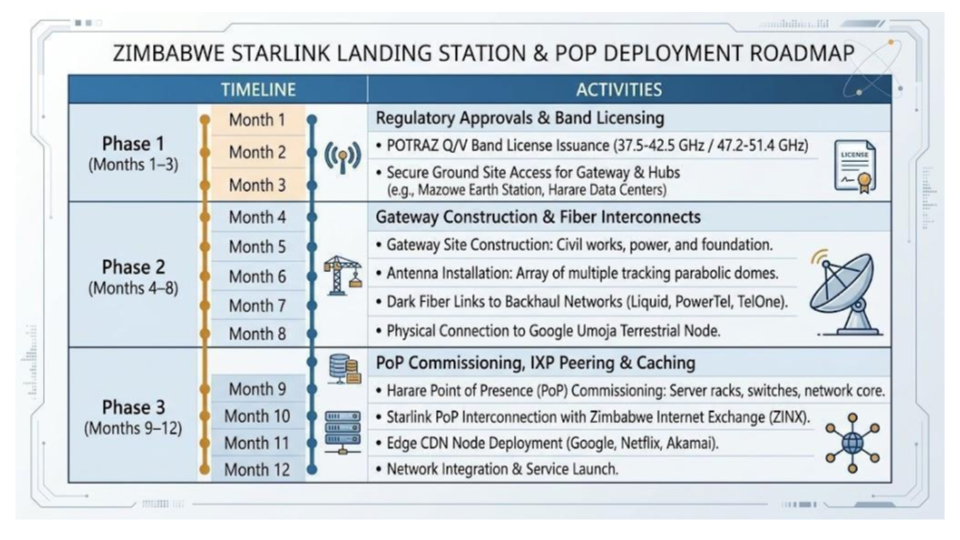
The proposed roadmap is divided into three distinct phases, designed to move from regulatory preparation to full operational status within one year.
Phase 1: Regulatory and Site Acquisition (Months 1–4)
The initial four months focus on the legal and logistical groundwork. This includes the formal application for Q/V band spectrum allocation with POTRAZ and the identification of suitable locations for teleport construction. These sites require proximity to high-capacity fiber nodes and a stable power supply, often necessitating the integration of renewable energy solutions like solar arrays to ensure 99.99% uptime.
Phase 2: Infrastructure Construction and Hardware Integration (Months 5–9)
Once permits are secured, the physical construction of the landing stations begins. This involves the installation of high-gain tracking antennas capable of communicating with multiple LEO satellites simultaneously. During this phase, the hardware for the Harare Point of Presence is procured and installed in Tier III or Tier IV data centers, ensuring the highest standards of security and reliability.
Phase 3: Network Optimization and Service Launch (Months 10–12)
The final quarter is dedicated to technical testing and peering. Engineers will work to integrate the satellite gateway with the terrestrial fiber networks of Liquid, PowerTel, and TelOne. This phase includes "stress testing" the network to ensure it can handle peak-hour loads without degradation. By the end of month twelve, the domestic PoP is commissioned, and subscribers transition to a localized routing path, resulting in an immediate and dramatic improvement in latency and throughput.
Broader Impact and Economic Implications
The establishment of a domestic satellite gateway and PoP in Harare has implications far beyond improved internet speeds. In an increasingly digital global economy, connectivity is a primary driver of Gross Domestic Product (GDP). For Zimbabwe, this infrastructure supports the goals of "Vision 2030," which aims to transform the nation into an upper-middle-income economy.
Reliable, low-latency internet is a prerequisite for modernizing the agricultural sector through IoT (Internet of Things) devices, enhancing distance learning for rural schools, and enabling the growth of a local tech ecosystem. Furthermore, by becoming a transit hub for satellite data, Zimbabwe can generate revenue through transit fees and become a central player in the Southern African Development Community (SADC) telecommunications market.
The transition from the legacy GEO systems of the 1980s to a sophisticated LEO-integrated network represents more than just a technical upgrade; it is a vital step toward national digital sovereignty. By executing this twelve-month roadmap, Zimbabwe can ensure that its citizens and businesses are no longer passengers on the digital highway, but active drivers of their own technological future.
