

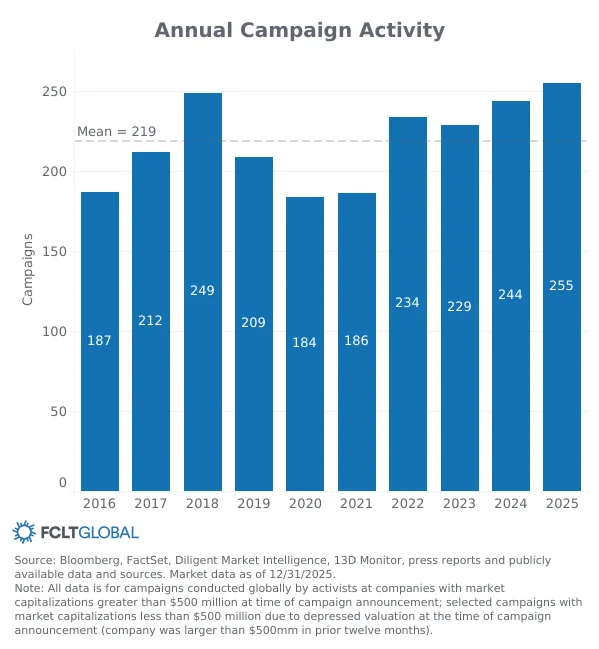
2025 marked an unprecedented surge in shareholder activism, with over 255 campaigns launched globally, a new record for the most prolific year to date. Activity in the United States saw a significant year-over-year increase of 28 percent, while Japan also reached its own historical benchmark with 56 new campaigns. This escalation in activist engagement is fueled by several converging factors, including increased accessibility to launching campaigns and, critically, identifiable strategic weaknesses within many corporations.
Victoria Tellez, Research Director at FCLTGlobal, highlighted in a recent memorandum that the landscape of activist investing has become considerably more accessible. In 2025, a notable 29 percent of campaigns were initiated by first-time activists, nearly matching the record set in the preceding year. The barrier to entry for a credible campaign has diminished, often requiring little more than an equity stake, a public announcement, and a well-defined investment thesis. This accessibility is further amplified by regulatory shifts. The implementation of the SEC’s universal proxy rules prior to 2025 substantially lowered the financial and logistical burden for activists seeking board representation. Previously, an activist aiming to replace directors had to fund an entirely separate proxy contest, involving the printing and mailing of their own ballots to all shareholders. Under the universal proxy system, however, the company itself incorporates the activist’s nominees onto its official ballot, significantly streamlining the process and reducing costs. This shift has had a tangible impact; in 2025, 32 U.S. CEOs resigned within a year of an activist campaign being launched, surpassing the previous record of 27 set in 2024.
Underlying Drivers of the Activism Surge
Beyond the enhanced accessibility, FCLTGlobal’s analysis sought to identify the underlying strategic issues that are prompting this recent spike in activist activity. To this end, the organization examined a sample of 100 activist campaigns across the United States, Japan, and Europe conducted in 2025. Each campaign’s primary demand was mapped against the behaviors outlined in the FCLT Gold Standard framework, a set of principles designed for long-term-oriented companies.
The FCLTGlobal study revealed two recurring patterns that were present in over half of the campaigns analyzed. Crucially, 71 percent of these campaigns targeted companies that were perceived to lack a credible long-term roadmap. In parallel, 55 percent of campaigns identified boards that were not dedicating sufficient time to strategic issues. The convergence of these two critical gaps was particularly striking: a combined 90 percent of companies within the sampled group faced an activist campaign where at least one of these deficiencies was evident. Furthermore, approximately one in five of these companies exhibited both weaknesses simultaneously, presenting a clear and exploitable vulnerability for activists.
The Critical Absence of a Credible Long-Term Roadmap
The finding that 71 percent of activist campaigns in 2025 were launched against companies lacking a credible long-term roadmap underscores a fundamental disconnect between corporate strategy and investor expectations. Research conducted by FCLTGlobal in 2019, as detailed in their report "Driving the Conversation: Long-Term Roadmaps for Long-Term Success," indicated that a significant majority, 86 percent, of investment decision-makers prefer companies to utilize a minimum three-year time horizon for their forward-looking targets.
A robust long-term roadmap is more than just a set of financial projections; it encompasses a comprehensive three-year outlook on growth and profit margins, a clearly defined capital allocation framework that outlines how the company prioritizes reinvestment, acquisitions, and capital returns, and a stated strategy for addressing the most pertinent disruptions facing the business. This document should present a unified vision of leadership’s trajectory for the company, integrating market assumptions, concrete targets, and directional indicators.
The strategic roadmap serves as the foundational document that grants a company the authority to make difficult short-term decisions in pursuit of long-term objectives. When a company can articulate these decisions in advance, demonstrate consistency with its stated plan, and hold itself accountable to published metrics, investors are generally more understanding of short-term earnings pressures, provided they are clearly linked to a credible long-term strategy.
In the absence of such a roadmap, an activist investor is empowered to construct their own narrative, often exploiting the perceived lack of direction. A notable example is the case of Honeywell. Following the disclosure of a significant stake by an activist investor, the firm advocated for a portfolio separation, arguing that the conglomerate structure obscured the true valuation of its distinct business units. Lacking a compelling counter-argument for the synergy of its combined operations, Honeywell ultimately announced a complete breakup into separate entities within months of the activist’s intervention.

Other campaigns highlighted a lack of a credible multi-year plan for a company’s core business. In certain instances, particularly within the Japanese market, the issue was the opacity surrounding capital allocation. Companies were observed holding substantial cash reserves and cross-shareholdings without a publicly articulated framework for how these assets would be strategically deployed. This lack of transparency can be a significant red flag for investors seeking clarity and predictability in capital management. Ultimately, while strong financial performance serves as the primary bulwark against activist intervention, a deficiency in a coherent strategic roadmap presents a readily exploitable weakness that activists can effectively leverage.
Boards Under Scrutiny: Insufficient Time for Strategic Deliberation
The second significant pattern identified by FCLTGlobal, affecting 55 percent of the analyzed campaigns, was the perception that corporate boards were not dedicating adequate time to strategic issues. The composition and engagement of a board are often the initial indicators of a company’s strategic rigor. FCLTGlobal’s 2019 report, "The Long-Term Habits of a Highly Effective Corporate Board," found that boards demonstrating a sustained long-term impact dedicate nearly twice as much time to strategy, business model analysis, and the creation of long-term value compared to their less effective counterparts.
An effective board that fosters long-term value creation typically includes directors with diverse experiences. This often involves individuals with deep capital markets knowledge, operational expertise gained from industries outside the company’s core sector, and a demonstrated willingness to introduce genuinely different perspectives and frameworks to strategic discussions. Such directors are better positioned to hold management accountable, challenge ingrained assumptions that insiders may have long overlooked, and ensure the company remains agile and forward-looking.
The implications of a board that is not sufficiently engaged in strategic oversight are profound. Without dedicated time and a diverse range of perspectives, boards may struggle to identify emerging threats, capitalize on nascent opportunities, or adequately challenge management’s strategic proposals. This can lead to a company becoming reactive rather than proactive, a characteristic that is particularly unattractive to long-term investors and a prime target for activist campaigns.
The Strategic Advantage of Long-Term Value Creation
The overarching conclusion from FCLTGlobal’s analysis is that a steadfast commitment to long-term value creation serves as the ultimate defense against activist pressure. Companies that prioritize both in-depth strategic deliberation and the transparent articulation of their strategic roadmaps tend to attract and retain long-term shareholders. This stable shareholder base acts as a significant structural asset when activist campaigns emerge.
Activist investors fundamentally rely on the support of long-term institutional investors to achieve their objectives. Consequently, a company whose long-term investors have confidence in its strategy and the efficacy of its board is considerably more resilient to external pressure. The academic and practitioner literature on shareholder activism consistently points to one core outcome: activist campaigns invariably garner attention and precipitate change, at least in the short to medium term.
Research conducted by McKinsey & Company published in 2023 indicated that activist campaigns often halt a company’s downward performance trajectory and are associated with excess total shareholder returns for a period of at least 36 months. However, a subsequent analysis by McKinsey in 2024, examining nearly 170 campaigns globally over a decade, revealed a more nuanced picture. After the activist investor exited their position, three-year excess shareholder returns turned negative in approximately 40 percent of the companies that had initially shown gains while the activist was involved. Only 23 percent continued to experience positive returns.
A plausible explanation for this trend, and one that aligns with the findings of the FCLTGlobal analysis, is that companies which respond to specific activist demands without addressing the underlying strategic gaps often see their initial gains erode. This suggests that superficial fixes are insufficient and that a deeper, strategic recalibration is necessary for sustained improvement.
The critical lesson for corporate boards and management teams is to proactively address these strategic vulnerabilities before they become points of contention for activists. This involves clearly articulating a credible multi-year roadmap, dedicating sufficient board time to the strategic questions that truly matter, and thereby earning the trust and confidence of long-term investors. By the time an activist campaign is launched, the company’s vulnerabilities are already exposed. An activist’s involvement is often a signal that the essential work of long-term value creation has been neglected. Therefore, the most durable and effective defense lies in undertaking that crucial work preemptively. By fostering a culture of strategic foresight and transparency, companies can build a robust foundation that not only withstands activist pressure but also drives sustainable, long-term growth.
