

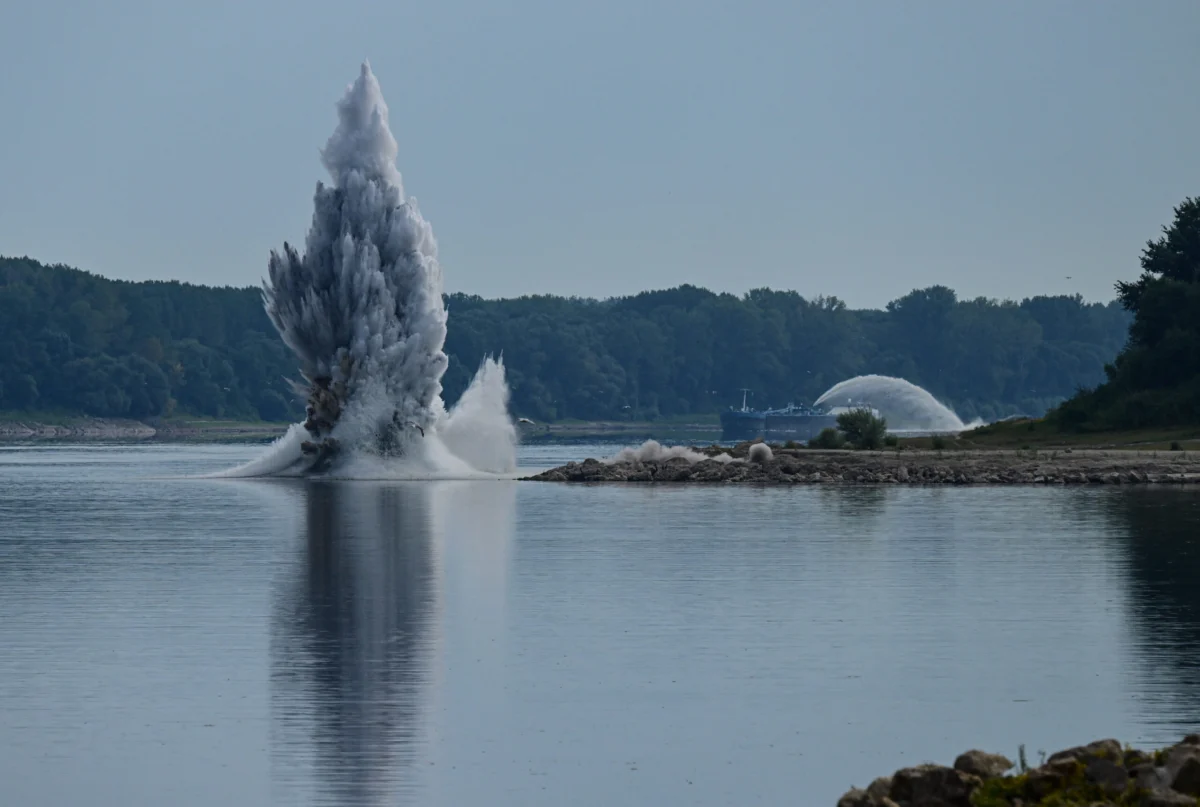
The drought gripping Europe has reached critical levels, jeopardizing economic growth across the continent and forcing nations to resort to drastic measures, including underwater detonations, to maintain vital infrastructure and trade routes. The Rhine and Danube rivers, arteries of European commerce, have fallen to historic lows, with profound implications for industry, energy, and supply chains.
The severity of the water crisis is starkly illustrated by the images emerging from Romania. In a bid to ensure sufficient cooling water for the Cernavoda Nuclear Power Plant, the sole operational nuclear facility in the country, the Romanian navy undertook a series of controlled underwater explosions in the Danube River near Izvoarele village on August 3, 2026. These detonations were designed to clear debris and deepen the riverbed, thereby increasing water flow towards the plant’s critical cooling systems. The Danube, a vital waterway for a significant portion of Europe, has experienced drastically reduced water levels throughout the summer, mirroring the plight of other major European rivers.
This extreme weather event has not been confined to Romania. Hungary’s Paks nuclear plant, responsible for approximately 40% of the nation’s electricity, has also faced imminent threats due to low water levels in the Danube. Similarly, Serbia has been compelled to curtail hydropower generation, a significant contributor to its energy mix, as its rivers struggle to sustain capacity. These actions underscore the cascading effects of water scarcity, extending from industrial operations to national energy security.
The Rhine River, often referred to as the economic backbone of Europe, is experiencing unprecedentedly low water levels, impacting Germany’s industrial heartland and further disrupting already strained global supply chains. The water level at Kaub, a critical bottleneck for shipping traffic destined for southern Germany and Switzerland, plummeted to a mere 24 centimeters on August 1st and 2nd, 2026. This figure represents the lowest level recorded since meteorological records began in 1880, with forecasts indicating even further declines in the immediate future, according to data compiled by ETH Zurich.
This dramatically reduced depth is well below the critical navigation threshold of 78 centimeters at the Kaub gauge. While shipping remains technically possible below this mark, cargo barges are forced to operate with significantly reduced loads. This limitation directly translates into substantially higher freight transportation costs, exacerbated by low-water surcharges that are rapidly accumulating.
"Major rivers like the Rhine and Danube are critical trade corridors and sources of water for industry and energy generation, so when water levels fall, the effects extend far beyond the waterways themselves," Liz Saccoccia, water security lead at the World Resources Institute, explained to CNBC via email. "We’re already seeing that happen. Nuclear plants in Hungary, Romania and France, along with hydropower facilities in Serbia, have already had to reduce electricity generation because there isn’t enough water for cooling or driving turbines, increasing the risk of blackouts and costly electricity imports," she added.
The repercussions extend beyond industrial output. Saccoccia highlighted the broader economic impact: "Along the Danube, low water levels have prevented farmers from shipping their crops and stopped cruise ships from reaching ports such as Budapest. These are early examples of how increasingly unreliable water supplies can ripple through the economy, affecting trade, energy security, supply chains and local businesses."
Economic Ramifications of a Drying Rhine
The precarious state of the Rhine River poses a significant threat to Germany’s economic output. Stefan Kooths, a professor of economics at the Kiel Institute for the World Economy (IfW), has projected that the low water levels on the Rhine could dampen German gross domestic product (GDP) by as much as 0.2% in the third quarter of 2026. This projection underscores the immense economic reliance on the smooth functioning of this vital waterway.

"Since water levels are unlikely to rise sharply back above the critical threshold in early August, transport capacity is likely to remain affected by the low water levels for some time in the coming month as well," Kooths stated in an email to CNBC. He further estimated the economic loss in value added to be in the range of 1 to 2 billion euros ($1.15 billion to $2.3 billion) for the third quarter alone.
This economic impact is particularly concerning given Germany’s modest growth trajectory. The German economy expanded by a mere 0.2% in the second quarter of 2026, following a revised 0.4% increase in the first quarter. Any significant disruption, such as that caused by the Rhine’s low levels, can disproportionately affect overall growth figures.
A Deeper Dive into Water Scarcity
The current crisis on the Rhine and Danube rivers is a stark manifestation of a larger, more critical environmental issue: water scarcity. This problem is especially acute in southern Europe, where approximately 30% of the population resides in areas classified as having permanent water stress – a condition where water demand consistently exceeds available supply, according to the European Environment Agency.
The persistent heatwaves and the resulting drought conditions have become a recurring challenge, suggesting that this is not an isolated incident but rather a symptom of a changing climate. Felix Schmidt, a senior economist at the private German bank Berenberg, noted that businesses in Germany, a traditional economic powerhouse, were likely not entirely caught off guard by the Rhine’s low water levels. He indicated that many companies had proactively implemented contingency measures, such as increasing inventory stockpiles or rerouting some freight transport via rail and road networks. However, he also cautioned that current freight rates have surged dramatically, "going through the roof," which in turn exacerbates existing inflationary pressures.
"Given that Germany is growing very little, obviously, if we grow 0.1 instead of 0.2 then this means we lose half of the growth, if you want to frame it like that," Schmidt commented during a phone interview with CNBC, illustrating the magnified impact of such disruptions on a low-growth economy.
Climate Change: The Underlying Driver of Europe’s Drought Risk
The recurring drying of major European rivers is increasingly being understood as a direct consequence of escalating climate change. The persistent heatwaves experienced across Northern Europe, for instance, have not only impacted industrial operations but have also demonstrably reduced overall productivity. Furthermore, extreme heat poses a threat to critical infrastructure, leading to potential damage and disruption.
Schmidt elaborated on the multifaceted nature of these climate-induced challenges: "Water levels are obviously one thing but we had this heat wave in Germany a couple of weeks back, impacting big parts of northern Europe, which brings down productivity. You have infrastructure which gets destroyed by the heat. You have energy supply, which is affected, like the nuclear plants being shut down in Hungary, France and Switzerland. You also have the catastrophic development like the fires sweeping now in southern Europe. So, it’s affecting the economy in many, many ways."
The escalating frequency and intensity of extreme weather events, from prolonged heatwaves to devastating wildfires, as witnessed in southern Europe, paint a grim picture of the challenges ahead. The current crisis on Europe’s rivers serves as a potent reminder of the interconnectedness of environmental stability, energy security, and economic prosperity. As climate change continues to alter weather patterns, a sustained and comprehensive approach to water management and climate adaptation will be crucial for mitigating future economic shocks and ensuring the long-term resilience of European economies. The extreme measures being taken today, such as underwater detonations, highlight the urgent need for proactive strategies to address the growing threat of water scarcity across the continent.
