

American CEOs entered August with a notably brighter view of the business environment, extending a steady recovery in confidence observed over recent months. This burgeoning optimism, detailed in Chief Executive‘s August CEO Confidence Index, reveals leaders increasingly self-assured about current economic conditions and projecting a stronger trajectory for the coming year, a sentiment largely driven by unexpectedly robust demand. The survey, conducted on August 4th and 5th among 285 U.S. CEOs, indicates a significant shift from a year ago, when projections were more cautious.
Current Conditions Exceed Expectations
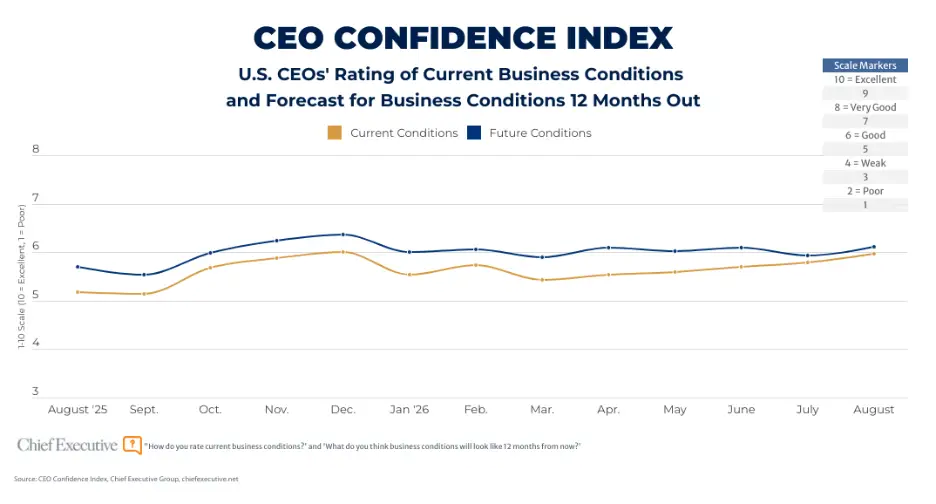
The August CEO Confidence Index registered a rating of 6 out of 10 for current business conditions, a 3 percent increase from July’s 5.8. This marks the first time since December 2025 that the index has entered "good" territory, and importantly, it surpasses the expectations CEOs themselves held just twelve months prior. In August 2025, business leaders had forecasted that conditions would reach approximately 5.7 by August 2026. The current reading of 6/10 therefore represents a 5 percent improvement over their year-ago projection, signaling that the economic landscape has proven more favorable than anticipated.
This positive sentiment is not merely backward-looking. The optimism extends into the near-term future, with CEOs anticipating business conditions to reach 6.1 out of 10 by this time next year. This projection is 2 percent higher than current levels and 3 percent above their July forecast, representing the strongest year-ahead reading since December 2025, when CEOs projected conditions would hit 6.4/10. This sustained upward trend in confidence suggests a growing belief in the economy’s ability to navigate ongoing challenges.
Demand as the Driving Force
When asked to identify the primary drivers shaping their outlook for the next twelve months, a significant 44 percent of CEOs cited demand, sales, or backlog as the most influential factors. This persistent strength in consumer and business spending has been a recurring theme in recent economic analyses, often defying earlier predictions of a slowdown.
Shathi Govender, CEO of Transworld Business Advisors Detroit South, commented on this phenomenon, stating, "Demand continues to be positive." However, she also highlighted a persistent challenge, noting that "labor remains challenging to execute on this demand." This sentiment underscores a common paradox in the current economy: robust demand is present, but the ability to meet it is constrained by workforce dynamics.
An anonymous CEO of a large international transportation company observed, "Demand is surprisingly resilient to price increases." This indicates that despite inflationary pressures and potential cost pass-throughs, consumers and businesses are continuing to purchase goods and services at a notable pace. This resilience could be attributed to a variety of factors, including pent-up savings from previous periods, a continued need for essential goods, or a stronger-than-expected underlying economic momentum.
Further elaborating on the potential for demand growth, David Chavez, CEO of business coaching firm Assured Strategy, expressed a forward-looking perspective: "When this Iran war ends, I think demand will go up quite a bit." This statement points to the significant impact of geopolitical events on economic sentiment and expectations, with the resolution of such conflicts potentially unlocking further consumer and business confidence, and consequently, demand.
Lingering Concerns and Counterbalancing Factors
Despite the prevailing optimism, certain headwinds continue to influence CEO perspectives. Approximately one-third of CEOs pointed to rising costs, inflation, or margin pressure as factors weighing on their outlook. These concerns are not new, but their continued presence highlights the ongoing struggle for businesses to maintain profitability in an environment of escalating expenses.
Geopolitical instability was another significant consideration, cited by 30 percent of respondents. The ongoing conflict in Iran, as well as other global tensions, creates an environment of uncertainty that can impact supply chains, energy prices, and international trade, all of which are crucial for business operations. Furthermore, 19 percent of CEOs identified government policy or regulation as a concern, indicating that the regulatory landscape remains a point of consideration for strategic planning.
Labor, while not a leading driver of the 12-month forecasts, repeatedly surfaced in comments regarding the current environment. CEOs highlighted tight labor markets, wage pressures, employee retention challenges, skill gaps, and the critical need for ongoing investment in training and leadership development. These issues are not new but remain a persistent operational hurdle for many businesses seeking to capitalize on growth opportunities. The August survey indicated that only 11 percent of respondents cited labor as a primary driver for their 12-month outlook, suggesting that while it remains a significant operational concern, it is not currently seen as a primary impediment to overall economic growth in the same way as demand or costs.
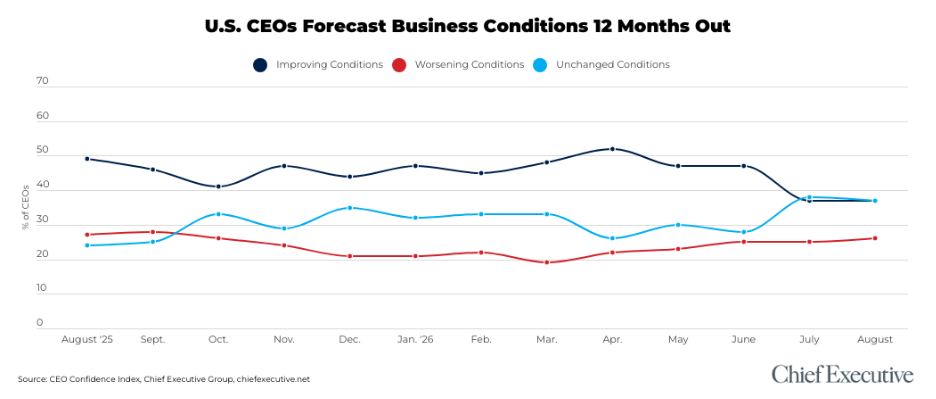
The distribution of CEOs expecting improvement, deterioration, or little change in business conditions remained stable in August. However, the key differentiator was the increased strength of their ratings, suggesting a more robust and confident outlook across the board.
Economic Growth Forecasts Strengthen
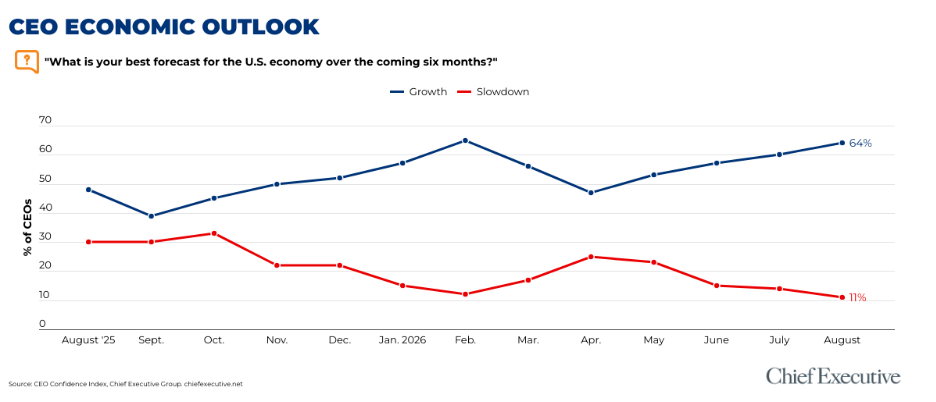
CEOs are also exhibiting increased optimism regarding the near-term U.S. economy. A robust 64 percent of leaders forecast economic growth over the next six months, while only 11 percent anticipate a slowdown. This latter figure is the lowest recorded since Chief Executive began tracking this measure in April 2025, indicating a significant shift towards a growth-oriented economic perspective. The remaining 25 percent expect the economy to remain flat, suggesting a stable but not necessarily expanding environment for those specific respondents.
"The market has remained stronger than expected for longer than expected," observed the CEO of a national wholesaler, echoing a sentiment of markets defying earlier pessimistic predictions. This prolonged period of resilience suggests underlying economic fundamentals that are proving more durable than anticipated.
Inflationary Pressures and Outlook
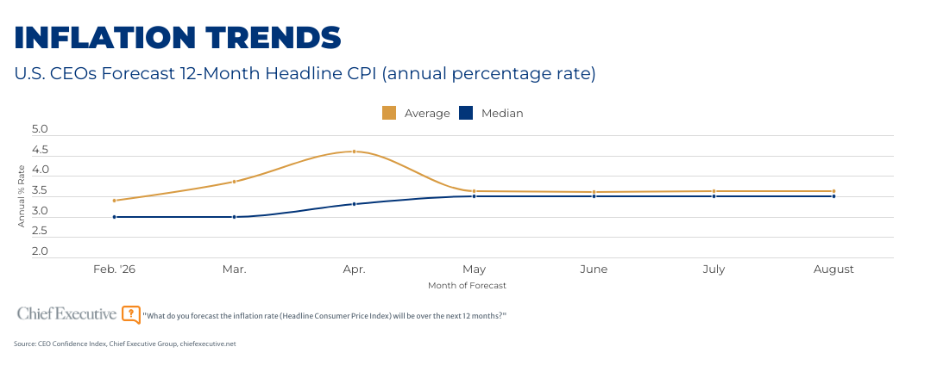
Despite the positive outlook on growth, rising costs and margin pressure remain a significant concern, identified by 44 percent of CEOs as a major challenge to achieving their goals this year. However, respondents do not anticipate inflation to accelerate further. Their average 12-month headline Consumer Price Index (CPI) forecast held steady at 3.6 percent.
This forecast has remained relatively stable for the past five months. However, it is still 0.3 percentage points above the 3.3 percent average recorded at the start of the year. This increase followed the commencement of the war in Iran, a period when CEOs collectively raised their inflation expectations. The current stability suggests that while the initial shock of geopolitical events may have led to a recalibration of inflation expectations, businesses are now anticipating a plateau rather than a further surge.
Tim Zimmerman, CEO of Mitchell Metal Products, provided a stark illustration of the impact of inflation: "Inflationary factors leading to rapid and sustained price increases are squeezing our margins severely and pricing some of our products out of the market." This sentiment highlights the direct and significant impact of inflation on business operations and product competitiveness.
Conversely, some CEOs anticipate inflationary pressure to ease as geopolitical disruptions subside. George Sheth, managing partner at Diligent Partners, expressed a hopeful outlook: "the Iran war to be over, affordability for the general consumer to improve, inflation to be more in control and pent-up demand to come to fruition in a number of sectors." This perspective links the resolution of global conflicts to improved economic conditions, including a moderation of inflation and a subsequent boost in consumer spending.
Execution as a Key Differentiator
While optimism is on the rise, several CEOs acknowledged the persistent challenges facing business leaders. One CEO in the travel and leisure sector pointed to declining consumer confidence, political turmoil, election uncertainty, and drought conditions as significant concerns. The observation that some consumers are cutting back on discretionary travel was described as "a canary in the coal mine," signaling potential broader economic headwinds.
Despite these external uncertainties, many CEOs anticipate their companies will conclude 2026 in a stronger position than they began it, even among those who hold a less favorable view of the broader business environment. The survey reveals a surprisingly weak relationship between CEOs’ perceptions of overall business conditions and their specific forecasts for their own companies. This suggests a notable degree of internal confidence and strategic control within individual organizations.
Remarkably, even among CEOs who expect business conditions to worsen over the next year, a substantial 83 percent forecast revenue growth, and 71 percent expect profits to increase. Pessimistic CEOs were, in fact, the most likely of the three surveyed groups (optimists, neutral, and pessimists) to forecast revenue growth, with 83 percent anticipating an increase, compared to 79 percent of neutral CEOs and 66 percent of optimists. This pattern strongly suggests that many leaders are adept at separating their assessment of the macro-economic landscape from their expectations for their own firm’s performance, prioritizing internal strategy and execution.
Profit-growth expectations were more consistent across the groups, ranging from 65 percent among optimists to 72 percent among neutral CEOs and 71 percent among pessimists. This indicates a general belief in the ability to drive profitability regardless of broader economic sentiment.
One key finding that may help explain this internal confidence is the belief that strong execution and organizational alignment are the primary drivers of achieving company goals. A significant 53 percent of CEOs polled in August identified these factors as paramount for success this year. This emphasis on internal operational efficiency and strategic alignment underscores a proactive approach to navigating economic complexities.
Investment and Hiring Trends
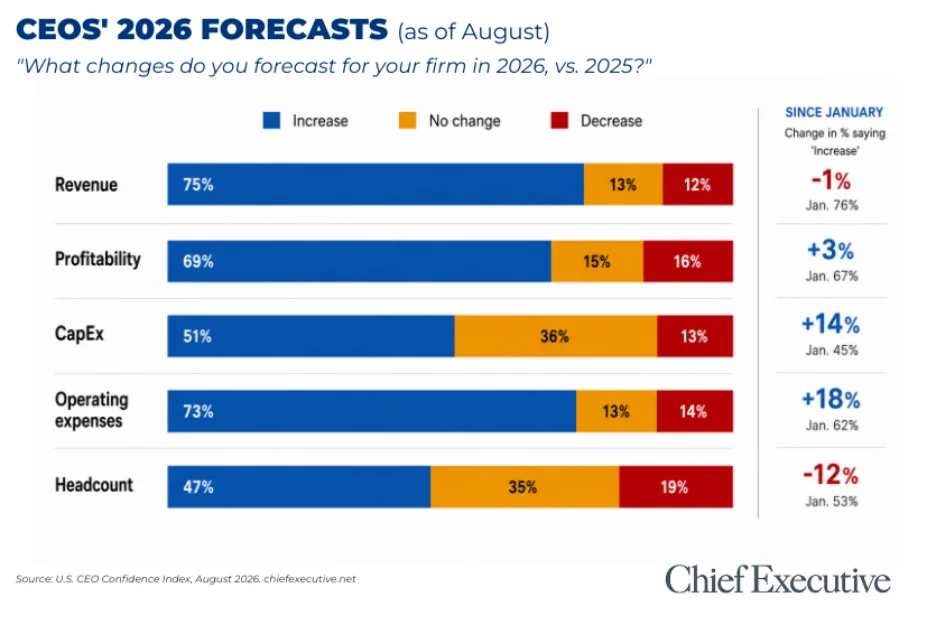
Looking ahead, 75 percent of CEOs expect 2026 revenue to exceed 2025 levels, a slight increase from 73 percent in July and generally in line with the beginning of the year. Furthermore, 69 percent forecast higher profits, up from 65 percent in July and 67 percent in January, signaling a positive trend in both top-line growth and profitability.
Capital expenditure (CapEx) showed the most significant month-over-month rebound. Fifty-one percent of CEOs plan to increase CapEx, a substantial 12-percentage-point jump from 39 percent in July and a 6-point increase from 45 percent in January. This surge in planned investment suggests a growing confidence in future opportunities and a willingness to allocate resources towards growth initiatives, infrastructure, and technological advancements.
Concurrently, 73 percent of CEOs expect operating expenses to rise. This continued upward pressure on costs is likely a reflection of ongoing inflation, supply chain issues, and increased labor costs. Managing these rising expenses while pursuing growth will be a critical challenge for many businesses.
Hiring, however, remains the laggard in terms of growth indicators. While 47 percent of CEOs expect to increase headcount, an improvement from 43 percent in July, this figure remains below the 53 percent who planned to add employees at the start of the year. This suggests that while companies are expanding and investing, the pace of hiring is more tempered, possibly due to persistent labor market tightness, the focus on efficiency, or a strategic approach to workforce growth that prioritizes skilled talent over rapid expansion.
The emphasis on execution and internal strategy is further highlighted by the sentiment of one CEO respondent who stated, "Like many business leaders, I am navigating the uncertainty, and my focus remains on supporting our people, strengthening customer relationships and preparing the business to take advantage of opportunities when the market improves." This statement encapsulates the prevailing attitude among many CEOs: a pragmatic approach focused on building resilience, fostering strong relationships, and positioning their organizations for future success, irrespective of the broader economic climate.
