

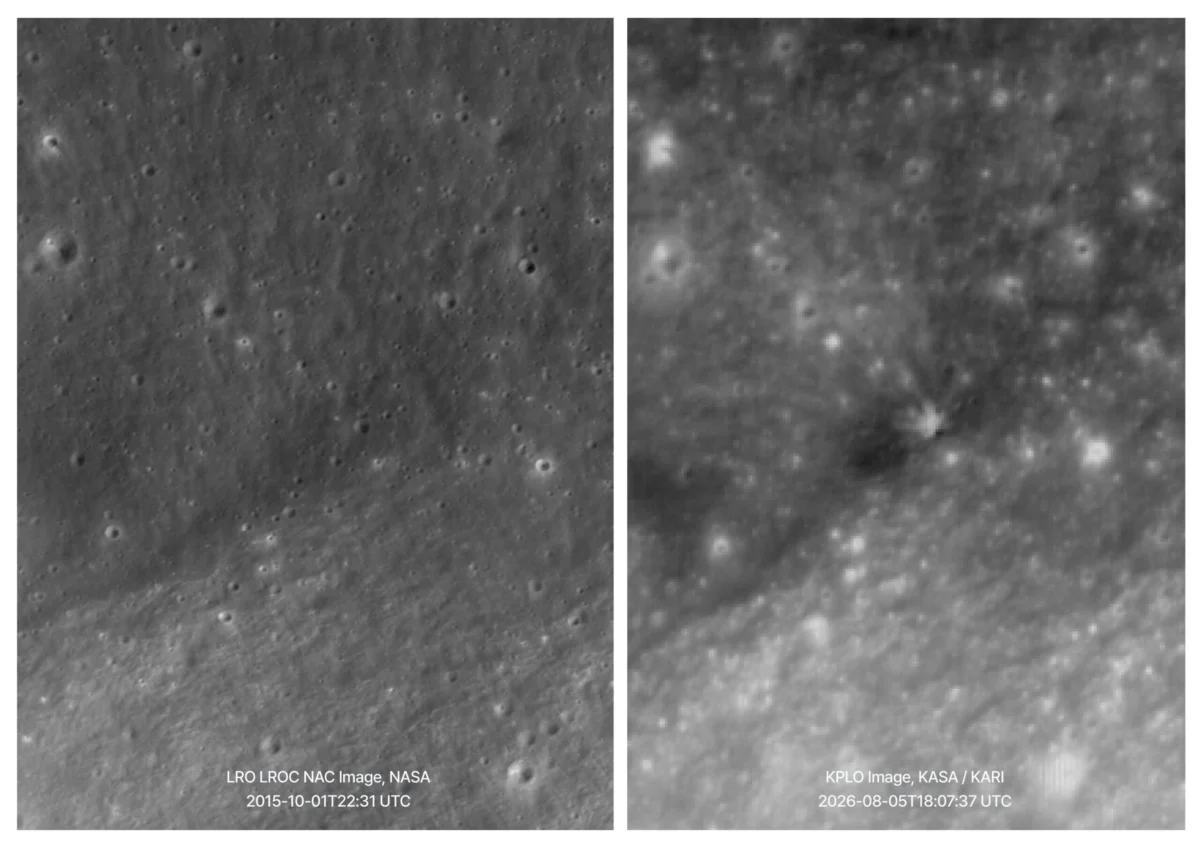
The Korea Aerospace Research Institute (KARI) has released the first definitive photographic evidence of a SpaceX Falcon 9 rocket stage following its high-velocity impact on the lunar surface. These images, captured by the Danuri orbiter—South Korea’s inaugural lunar mission—provide a rare glimpse into the aftermath of an artificial object striking the Moon. South Korea currently stands among an elite group of nations capable of maintaining active satellites in lunar orbit, with the Danuri spacecraft operating at a precise altitude of approximately 100 kilometers (62 miles) above the lunar terrain. The orbiter was strategically positioned to fly over the projected impact zone shortly after the event occurred, allowing for a comparative analysis of the site.
According to technical briefings provided by KARI via its official communication channels, the Danuri orbiter utilized its high-resolution imaging suite to document the specific coordinates of the collision both before and after the impact. The resulting data set reveals a distinct new feature on the lunar landscape: a crater that astronomers and planetary scientists estimate to be dozens of feet in diameter and nearly 12 feet (3.6 meters) deep. While the Moon is covered in millions of natural impact craters, the "freshness" of this site and its known origin provide researchers with a unique opportunity to study how low-density, man-made materials interact with the lunar regolith compared to high-density metallic or stony asteroids.
The visual evidence provided by KARI does not stand alone. It serves as the final confirmation of a series of observations made by terrestrial observatories. Astronomers utilizing the European Southern Observatory’s Very Large Telescope (VLT) in Chile previously reported the detection of specific chemical signatures—namely sodium and lithium—rising from the lunar surface at the time of the predicted impact. These elements are not found in high concentrations in natural lunar soil but are primary components of aerospace alloys and rocket propellants. The presence of these elements in the lunar exosphere provided the first chemical "fingerprint" confirming that the SpaceX fragment had successfully reached its unintended destination.
The Chronology of an Unplanned Lunar Encounter
The journey of this specific Falcon 9 second stage began in January 2025, when it was launched to deliver a suite of lunar landers into a transfer orbit. While the primary mission was a success, the second stage was left in a highly elliptical orbit. Under normal circumstances, SpaceX maneuvers Falcon 9 second stages to perform a controlled deorbit, ensuring they burn up in Earth’s atmosphere or land in a remote "spacecraft cemetery" in the southern Pacific Ocean. However, for high-energy missions heading toward the Moon, the fuel margins are often too slim to allow for such a maneuver.
For more than a year, the rocket stage existed as a piece of "zombie" space debris. Its trajectory was dictated by a complex gravitational tug-of-war between the Earth, the Moon, and the Sun—a classic example of the "three-body problem" in orbital mechanics. Throughout 2025 and early 2026, solar radiation pressure and subtle gravitational perturbations slowly shifted its path. By late 2025, orbital dynamics experts began to project that the stage would likely intersect with the Moon’s far side or limb.

The final descent occurred after the stage’s orbit became terminally unstable. Astronomers were able to predict the timing and location of the impact with high precision weeks in advance, though observing the actual moment of impact remained a challenge. NASA and other international space agencies noted that while the impact would be significant, factors such as lunar shadows, weather conditions affecting ground-based telescopes, and the sheer vastness of the lunar surface made real-time observation difficult. It was only through the persistent monitoring of the Danuri orbiter and NASA’s Lunar Reconnaissance Orbiter (LRO) that the exact "before and after" state of the surface could be verified.
Technical Analysis of the Impact Site
The images released by KARI highlight the scale of the impact relative to the lunar environment. In the photographs, the crater appears as a small, dark blemish against the grey, desolate expanse of the Moon. Despite its small appearance from an altitude of 62 miles, the crater is larger than several full-sized automobiles combined. The depth of 3.6 meters suggests the rocket stage hit at a velocity of several thousand miles per hour, likely around 2.5 kilometers per second.
Unlike natural meteoroids, which are usually solid and dense, a rocket stage is essentially a hollow aluminum-lithium tube. This difference in structure affects the "ejecta pattern"—the way dust and rock are thrown out from the impact point. Scientists are currently analyzing the Danuri images to see if the ejecta is asymmetrical, which would provide clues about the angle at which the rocket hit the surface. If the stage hit at a shallow angle, it might have "skidded" or created a double crater, a phenomenon previously seen when other man-made objects have struck the Moon.
The confirmation of the impact site is a testament to the precision of modern orbital tracking. To put the difficulty into perspective, the Moon has a diameter of approximately 2,160 miles. Finding a 12-foot-deep hole on such a vast body is akin to finding a single specific pebble on a massive beach. KARI has indicated that further data checks are underway, and there is a high probability that even higher-resolution images will be released as the Danuri orbiter makes subsequent passes over the region during different lighting conditions.
Official Responses and Space Safety Implications
SpaceX has addressed the incident by emphasizing the complexities of deep-space missions. In a statement regarding the event, the company explained that controlled deorbiting is a priority for missions in Low Earth Orbit (LEO). However, for lunar transfer orbits, the vehicle’s performance is pushed to its limits to ensure the payload reaches its destination. "In higher-energy missions… nearly all of the vehicle’s performance is dedicated to successfully placing the payload into the intended orbit, and a controlled deorbiting maneuver is not always possible," the company stated.
The aerospace firm further noted that it is collaborating with NASA and other international partners to find "optimal disposal solutions" for hardware left in cislunar space. This incident has reignited a global conversation about "space junk" beyond Earth’s immediate orbit. While the Moon has no atmosphere to be polluted and no indigenous life to be harmed, the accumulation of debris on the lunar surface poses a potential risk to future lunar bases and sensitive scientific equipment.

NASA, which operates the Lunar Reconnaissance Orbiter, has also been monitoring the site. The agency expressed that while these impacts are rare, they provide inadvertent scientific data. By observing how the lunar surface reacts to an object of known mass and velocity, researchers can better calibrate their models of how natural craters form. However, NASA officials have also echoed the need for more stringent tracking of objects in the "cislunar" region—the space between Earth and the Moon—as traffic to the lunar surface is expected to increase exponentially over the next decade.
The Broader Impact on Lunar Exploration
The Falcon 9 impact serves as a poignant reminder of the increasing human footprint on the Moon. As the Artemis program and various international missions (including those from China, India, and the European Space Agency) move forward, the Moon is becoming a busy destination. This incident marks one of the few times an artificial impact has been documented with such clarity since the Apollo era, when NASA intentionally crashed S-IVB rocket stages into the Moon to calibrate seismometers left on the surface by astronauts.
The event also underscores the importance of international cooperation in space. The fact that a South Korean satellite provided the primary visual evidence for the impact of an American commercial rocket highlights the interconnected nature of modern space exploration. Data sharing between KARI, NASA, and the broader scientific community ensures that even unplanned events like this contribute to the global body of lunar knowledge.
As lunar exploration transitions from occasional robotic probes to sustained human presence, the management of orbital debris will become a critical policy issue. The Danuri images provide more than just a look at a new crater; they provide a visual argument for the development of international standards for the disposal of spent rocket stages in deep space. For now, the new crater remains a permanent addition to the lunar geography—a man-made mark on a world that has remained largely unchanged for billions of years. Future missions to the same region may one day visit the site, turning this piece of "space junk" into an archaeological site of the early commercial space age.
