

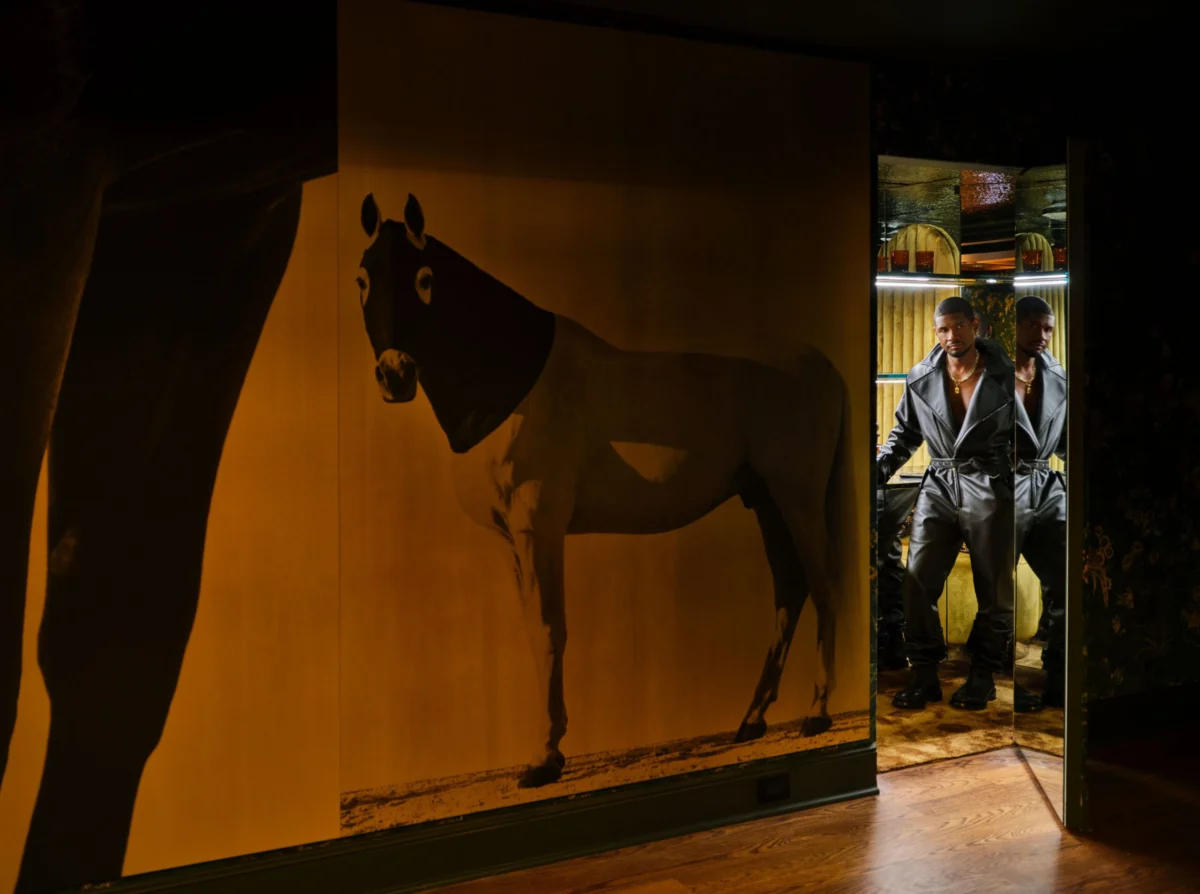
Usher Raymond IV, the global R&B icon whose career has spanned three decades and defined the trajectory of contemporary pop music, has unveiled his meticulously designed Atlanta residence, a property that serves as both a sanctuary for his family and a profound statement on African American history and creative evolution. The white-brick Georgian-style estate, which underwent a comprehensive four-year renovation, represents a collaborative triumph between the singer and his long-time interior design partner, Nicole Fuller. Far from being a mere showcase of wealth, the home is a curated environment where high-concept contemporary art intersects with deeply personal relics of a Southern upbringing, effectively "rebranding" the traditional narrative of the Black superstar’s domestic space.

A Visionary Approach to Interior Design and Heritage
The architectural foundation of the home is a classic Georgian structure, characterized by its symmetrical proportions and refined elegance. However, Usher and Fuller have transformed this traditional canvas into a multi-layered narrative of Black excellence and resilience. The tone is set immediately in the foyer, where visitors are met by five portraits by Gordon Parks, the legendary photographer known for his documentation of the Civil Rights Era. Among these is the seminal 1956 photograph of a Black woman and child standing outside a "colored entrance" in Alabama. Usher’s decision to place such a stark reminder of Jim Crow-era segregation at the entrance of his luxury estate is intentional and provocative.

According to the artist, the placement is a method of reframing history. By positioning these images within a space of modern Black success, the narrative shifts from one of exclusion to one of triumph and progress. This philosophy of "rebranding" extends throughout the property, where historical markers are used not as fossils of the past, but as springboards for future imagination.

The Evolution of a Collector: A Thirty-Year Chronology
Usher’s journey into the world of fine art collection began at the age of 21 when he commissioned his first piece from the Los Angeles-based muralist Retna. This initial foray sparked a lifelong pursuit of visual literacy, fueled by his travels to international museums and stays in world-renowned luxury hotels. The singer has noted that as his "creative eye" opened to the world of visual arts, his musical output became more experimental, leading to the genre-defying success of albums like Confessions and his recent ventures into high-concept residencies.

The Atlanta home serves as a chronological map of this growth. The "Gentleman’s Lounge" acts as a personal archive, housing eight Grammy Awards, a jewel-encrusted football commemorating his 2024 Super Bowl LVIII halftime performance, and the 2016 Larry O’Brien Championship Trophy from his tenure as a part-owner of the Cleveland Cavaliers. These accolades are juxtaposed with contemporary works, such as Kathleen Ryan’s Bad Cherries—a sculpture of rotting fruit encrusted with gemstones—which serves as a nod to a viral moment from his recent "My Way" Las Vegas residency.

Collaborative Synergy with Nicole Fuller
This project marks the fourth residential collaboration between Usher and Nicole Fuller, a designer known for her ability to blend opulence with raw, textural elements. Fuller describes Usher as an exceptionally hands-on client who engages with the minutiae of design, from measuring dimensions to selecting specific fabric swatches. The design process for the Atlanta estate was heavily influenced by the palette and mood of the Gordon Parks photography—utilizing tones of lavender, plum, and caramel to create a sense of "moody" sophistication.

One of the most striking examples of this collaboration is found in the living room: a custom sofa upholstered in clear vinyl. This "Grandma’s Sofa" is a direct homage to a common fixture in many Black households of the mid-20th century, where furniture was often covered in plastic to preserve its "pristine" condition. By elevating this mundane cultural marker into a piece of high-end bespoke furniture, Usher and Fuller have created a conversation piece that bridges the gap between the restrictive reverence of the past and the inviting luxury of the present.

Integrating Family and Whimsy into Fine Art
While the home features museum-quality works by artists such as Julian Schnabel, Damien Hirst, and Rashid Johnson, Usher has made a concerted effort to ensure the space remains functional for his four children: Usher V, Naviyd, Sire, and Sovereign. The design rejects the notion that "precious" art must be kept in sterile, off-limits environments. Instead, the home is filled with "living art" and interactive elements.

In the breakfast room, a troweled concrete wall bears the handprints of the entire family, including the paw prints of their Goldendoodle, Scarlett. The children’s wing is perhaps the most vibrant expression of this philosophy. A custom-designed wall of stuffed animals, inspired by the iconic plush furniture of the Campana Brothers, leads to a playroom equipped with a performance stage and a foam pit. The bedrooms of his children further blur the lines between professional and personal art; daughter Sovereign’s room features a ceiling mural based on her own drawings, placed alongside paintings by Justin Bieber and Usher’s late stepson, Kile.

Supporting Data: The Rising Valuation of Black Contemporary Art
The curation of Usher’s home aligns with a broader trend in the global art market: the significant rise in the valuation and institutional recognition of Black contemporary artists. Works by Rashid Johnson and Lauren Halsey, both of whom have prominent placements in the home, have seen record-breaking auction results over the last decade. By investing in these artists, Usher is not only decorating his home but also participating in a movement of cultural wealth preservation.

| Artist | Movement/Style | Notable Work in Home |
|---|---|---|
| Gordon Parks | Civil Rights Photography | Foyer Portraits (1956) |
| Rashid Johnson | Post-Black Art | Primary Bedroom Sitting Area |
| Lauren Halsey | Afrofuturism/Social Practice | Barbershop Commission |
| Yoshitomo Nara | Neo-Pop | Garden Peace Head |
| Anthony James | Minimalism/Light Art | Snub Cube Sculpture Gallery |
The inclusion of these artists reinforces the home’s status as a "creative hub." The presence of a 60-year-old bonsai tree in an antique Tokoname pot and a Studio Drift "dandelion" chandelier further emphasizes a theme of endurance and the delicate nature of beauty.

Professional Amenities and Personal Reflection
Beyond the public and family spaces, the estate includes a suite of amenities tailored to the lifestyles of Usher and his wife, Jennifer Goicoechea Raymond. These include:

- The Barbershop: A fully equipped grooming station featuring a custom leather-upholstered Collins barber chair and a portrait of Usher by Lauren Halsey.
- The Media Room: A space for reflection and entertainment featuring a large-scale horse photograph by Steven Klein and walls upholstered in floral velvet.
- Wellness Facilities: A dedicated yoga deck, a basketball court, and a golf simulator.
- The Sculpture Gallery: A mirrored room housing Anthony James’s Snub Cube (Solar Black) and furniture by the late Virgil Abloh, designed to create a visual effect of infinite reflection.
Broader Impact and Future Implications
Usher’s Atlanta estate represents a new paradigm for celebrity residences. Moving away from the "McMansion" aesthetics of the early 2000s, this home prioritizes narrative, heritage, and the curation of intellectual property. It serves as a physical manifestation of Usher’s current career phase—one characterized by a deep respect for his roots and an aggressive pursuit of future innovation.

The completion of the home coincides with a period of intense professional activity. Following his recovery from knee surgery earlier this year, Usher has returned to the road for a global stadium tour alongside Chris Brown, which is scheduled to run through the end of December. The tour, much like his home, is a retrospective of his hits while pushing the boundaries of stage production and performance art.

Ultimately, the estate is a testament to the power of environment in shaping legacy. By surrounding his family with images of both struggle and success, Usher is ensuring that the next generation of the Raymond family understands their history while feeling empowered to "color over the lines." As the singer moves forward with his career, his Atlanta home remains the definitive anchor—a place where the echoes of a 1950s department store entrance in Alabama coexist with the infinite reflections of a futuristic sculpture gallery, proving that in the house of a superstar, history is never just a memory; it is a foundation.
