

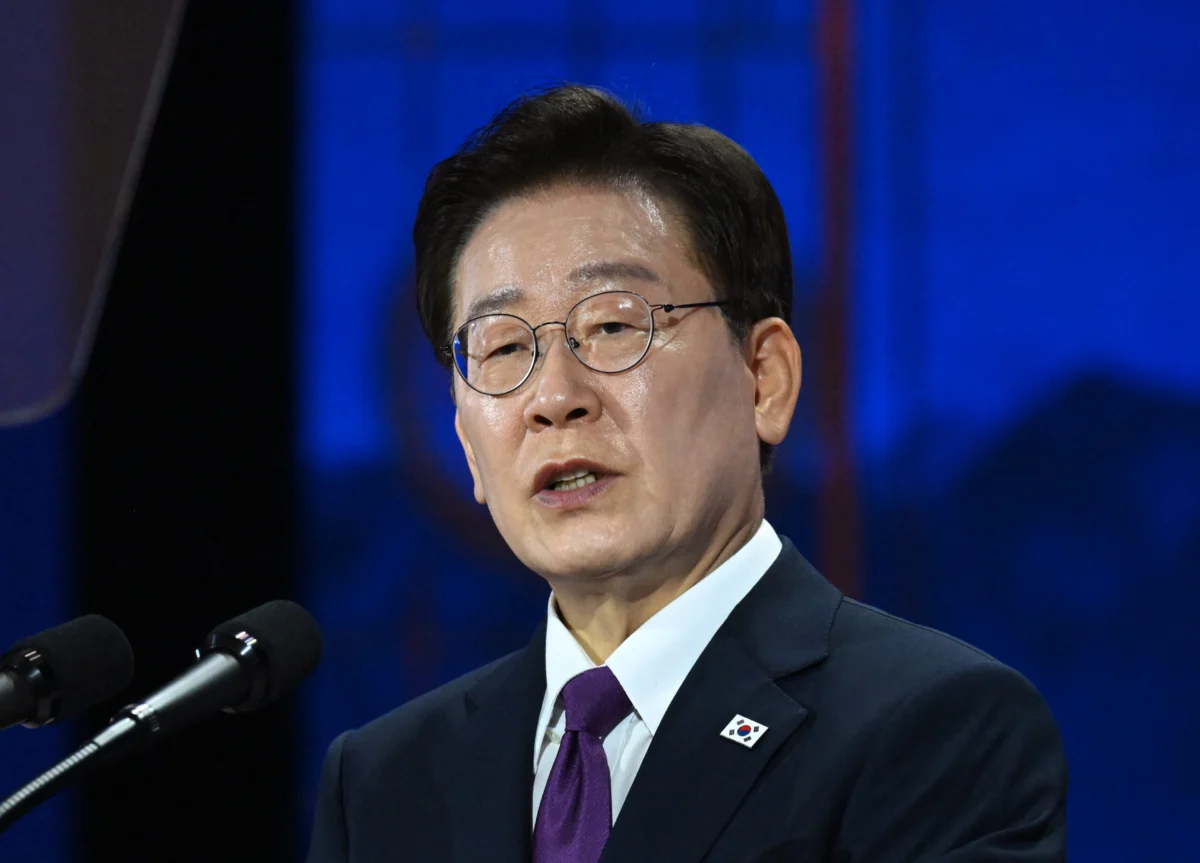
South Korean President Lee Jae Myung has issued a stark warning regarding the nation’s real estate market, drawing parallels to Japan’s "lost decades" — a period of prolonged economic stagnation that followed a monumental property and stock market crash in the early 1990s. Speaking at a public discussion on real estate policy, President Lee underscored concerns about an overheating housing sector, particularly as his administration prepares to introduce revised tax measures aimed at fostering stability. The President’s remarks, made during a critical period of economic re-evaluation, highlight the deep-seated anxieties within South Korea’s financial and social landscape concerning its heavily real estate-centric household wealth.
President Lee articulated that "quite a few people" in South Korea fear the country could similarly face 20 or 30 years of economic deceleration, reminiscent of Japan’s post-bubble era. He specifically referenced how Tokyo’s housing market had "burst like a balloon" in the early 1990s, a historical event often cited as a cautionary tale for economies with asset bubbles. This comparison serves to amplify the urgency of the government’s efforts to recalibrate housing policies and mitigate potential systemic risks.
The concentration of wealth in real estate in South Korea is exceptionally high, a fact President Lee emphasized with alarming data. As of the end of March 2025, real assets constituted a dominant 75.8% of Korean household assets, dwarfing the 24.2% held in financial assets. This disproportionate allocation of wealth makes households highly vulnerable to fluctuations in property values, raising concerns about consumer spending, financial stability, and broader economic resilience. This scenario creates a significant policy challenge for the government, as any sharp correction in property prices could have widespread repercussions across the economy.
A History of Bold Proclamations and Economic Interventions
President Lee Jae Myung is no stranger to making bold pronouncements, particularly concerning economic targets. His tenure has been marked by a willingness to set ambitious goals and implement decisive policies. Prior to the 2025 presidential election, when the benchmark Kospi index hovered around 2,500 points, then-candidate Lee notably set an audacious target of 5,000 for the index during his term. This ambitious goal was underpinned by pledges to address the long-standing "Korea discount," a phenomenon where South Korean stocks trade at lower valuations compared to global peers due to factors like corporate governance issues, geopolitical risks, and complex ownership structures.
Remarkably, the Kospi briefly surpassed the 5,000-point mark in January 2026, a little over six months after Lee assumed office. This achievement was largely propelled by a global surge in demand for AI-powered semiconductor chips, a sector where South Korean conglomerates like Samsung Electronics and SK Hynix hold dominant positions. This success in the stock market, however, has not entirely alleviated concerns about the underlying structure of household wealth, which remains heavily skewed towards real estate. Despite government efforts to encourage a shift of household wealth from an overheated housing sector into financial markets, this strategy has yielded only partial success. The South Korean benchmark index, while having reached highs, now hovers around 6,700, reflecting volatile swings largely due to its heavy dependence on these semiconductor giants, rather than a broad-based shift in household investment patterns.
Understanding Japan’s "Lost Decades"
To fully appreciate President Lee’s cautionary analogy, it is crucial to delve into the specifics of Japan’s economic experience. The "lost decades" refer primarily to the 1990s and 2000s, following the bursting of Japan’s asset price bubble. This bubble, characterized by rampant speculation in both real estate and stock markets, began to inflate significantly in the mid-1980s. Fueled by loose monetary policy, an appreciating yen (following the Plaza Accord in 1985), and a pervasive belief in ever-rising asset values, land and stock prices soared to unsustainable levels.
At its peak in 1989, the value of land in Japan was estimated to be four times that of the entire United States, despite Japan being only 1/25th the size geographically. The Nikkei 225 stock index reached an all-time high of nearly 39,000 points at the end of 1989. However, sensing an impending crisis, the Bank of Japan began aggressively raising interest rates in December 1989. This swift tightening of monetary policy, coupled with increased capital gains taxes, triggered a sharp reversal. The stock market crashed, followed shortly by the property market. Banks, burdened with massive non-performing loans secured against vastly devalued assets, faced severe balance sheet problems. This led to a credit crunch, reduced corporate investment, and prolonged deflation, trapping Japan in a cycle of slow growth and economic stagnation that continues to influence its policy decisions today.
Economists Offer a Nuanced Perspective on South Korea’s Risks

While President Lee’s comments reflect legitimate concerns about housing affordability and financial stability, several economists suggest that the comparison with Japan might overstate the immediate danger to South Korea. Kang Min Joo, senior economist for South Korea and Japan at ING, acknowledges the President’s concerns but believes "the probability of a real asset bubble burst in Korea is limited."
Kang points to several key differences and mitigating factors:
- Tight Mortgage Lending Conditions: South Korean authorities have maintained relatively stringent controls on mortgage lending for several years. Unlike Japan’s lax lending practices during its bubble, South Korea has enforced strict loan-to-valuation (LTV) and debt-to-income (DTI) ratios. While LTV ratios were once as high as 80% in some areas, they have significantly fallen, now sitting below 40% and even lower in the highly speculative Seoul metropolitan area. This prudential approach reduces the risk of widespread negative equity and minimizes the exposure of financial institutions to sudden market downturns.
- Household Debt-to-GDP Ratio: While South Korea’s household debt-to-GDP ratio is notably high, standing at 90.14% as of 2024, it has seen a decline from its record high of 98.67% in 2021. Although it remains the second highest in Asia, behind Australia, the recent downward trend suggests some level of deleveraging or at least a slowing accumulation of new debt. This indicates that the authorities are actively monitoring and attempting to manage this critical metric.
- Regional Price Discrepancies: Gareth Leather, senior economist for Asia at Capital Economics, further supports the view that "fears of a bubble appear exaggerated." He highlights that property price increases are not uniform across the country. While prices in Seoul have indeed risen rapidly, they are still only about 10% above their level in January 2022. In contrast, cities like Busan have experienced price declines, with values falling to almost 80% of their January 2022 levels. This regional divergence suggests that while speculative pressures exist in prime urban centers, the nationwide market is not uniformly overheated, reducing the systemic risk of a synchronized collapse.
- Large Down Payments: Leather also points out that the requirement for significant down payments from house buyers acts as a crucial buffer. This reduces the likelihood of homeowners falling into negative equity even if prices decline, thereby limiting the risk of widespread defaults and subsequent difficulties for banks.
Shared Characteristics and Divergent Policy Approaches
Despite these distinctions, experts acknowledge that South Korea shares several financial and demographic characteristics with Japan prior to its crash. Ma Tieying, senior economist at DBS Group Research, highlights similarities such as a high credit-to-GDP ratio and a substantial stock market capitalization, both of which can expose an economy to higher interest rates, tighter credit conditions, and global economic shocks. South Korea’s aging population and declining birth rates also echo Japan’s demographic challenges, which contribute to long-term economic headwinds.
However, Ma also underscores crucial differences in the current economic environment and policy responses. Unlike Japan in the years leading up to its bubble burst, South Korea is not experiencing large capital inflows or persistent currency appreciation. This gives the Bank of Korea (BoK) greater flexibility in calibrating its monetary policy without being unduly constrained by external pressures. Furthermore, the BoK has demonstrated a more pre-emptive approach to managing inflation and financial imbalances compared to Japan’s central bank in the late 1980s. South Korean policymakers have shown a greater willingness to implement macroprudential measures, such as loan-to-value limits and debt-to-income ratios, to cool down the housing market proactively, rather than waiting for a full-blown crisis.
Official Responses and Policy Implications
President Lee’s administration, along with the Ministry of Economy and Finance (MOEF) and the Bank of Korea, is acutely aware of these challenges. The planned tax revisions mentioned by President Lee are expected to be multi-faceted, potentially including adjustments to property holding taxes, transaction taxes, and capital gains taxes, all aimed at discouraging speculative investment and encouraging more productive uses of capital. The MOEF has consistently affirmed its commitment to fostering a stable and sustainable housing market, emphasizing that policy tools will be utilized to ensure affordability for genuine homebuyers while curbing excessive speculation.
The Bank of Korea, for its part, continues to monitor financial stability risks, with particular attention to household debt levels and asset price movements. While balancing inflation control with economic growth, the central bank maintains a vigilant stance on macroprudential measures, ready to adjust them as market conditions evolve. Statements from BoK officials often highlight the importance of "gradual and predictable" policy adjustments to avoid market shocks.
Broader Impact and Future Outlook
The discussions initiated by President Lee underscore a critical juncture for South Korea’s economic trajectory. The high concentration of household wealth in real estate poses significant societal and economic risks. It can exacerbate wealth inequality, making homeownership increasingly difficult for younger generations and potentially stifling entrepreneurship by tying up capital in illiquid assets. A sharp correction could trigger a negative wealth effect, dampening consumer spending and investment, thereby impacting overall economic growth.
The government’s challenge lies in engineering a "soft landing" for the real estate market—cooling prices without triggering a destabilizing crash. This requires a delicate balance of fiscal and monetary policies, alongside structural reforms to diversify household wealth and improve capital allocation. While the immediate danger of a Japan-style implosion may be overblown, the structural vulnerabilities highlighted by President Lee’s comparison remain valid and necessitate sustained policy attention. The success of the upcoming tax revisions and other housing policies will be crucial in determining whether South Korea can navigate these complexities and foster a more balanced and resilient economy for the future. The international community, keenly observing Asian economies, will be watching South Korea’s response as a potential blueprint for managing asset inflation in an era of demographic shifts and global economic uncertainty.
