

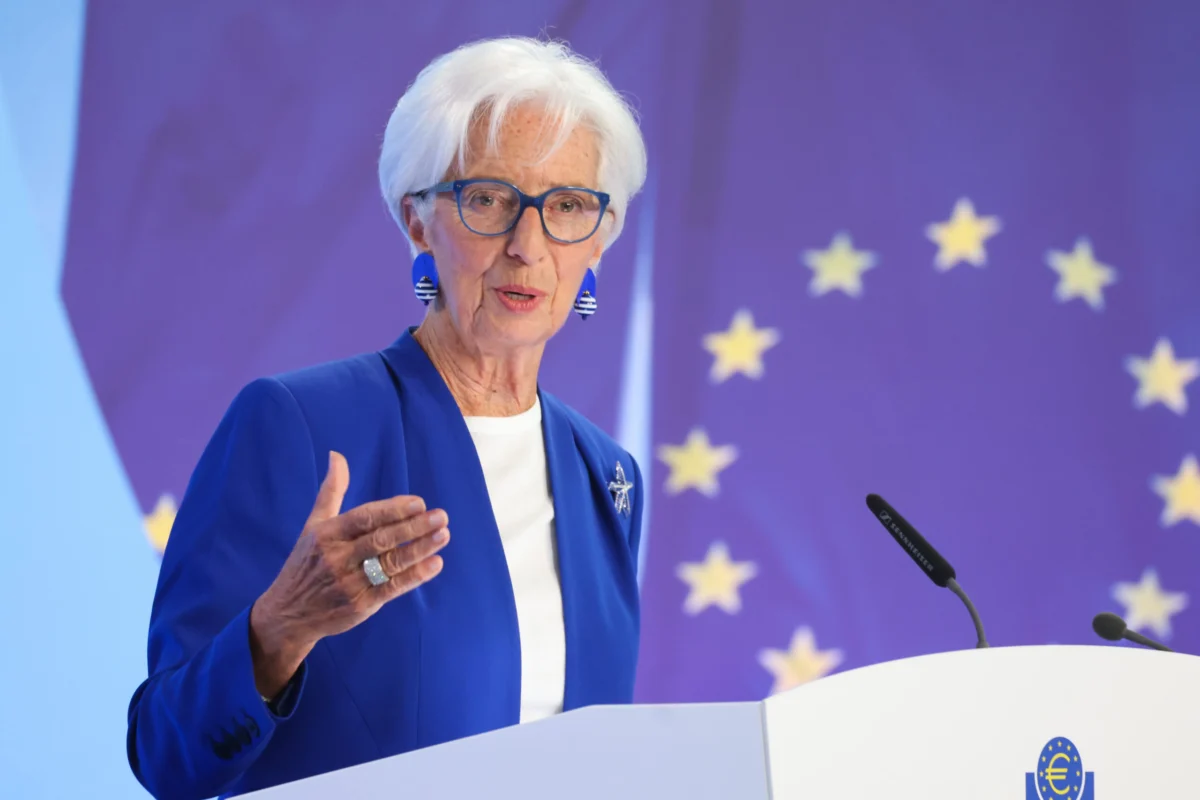
European Central Bank President Christine Lagarde has strategically left open the possibility of an early departure from her influential role at the helm of the central bank, sparking considerable interest and speculation regarding a potential pivot towards French politics. In a candid interview with the French business daily Les Echos, Lagarde indicated that an earlier exit from her ECB presidency, which is currently slated to conclude in October 2027, is "possible," particularly in the context of France’s upcoming presidential elections in the same year. This nuanced statement has ignited discussions about her future engagement with the French political landscape and its potential implications for both the European monetary union and France’s national governance.
Lagarde articulated a strong conviction that a distinct "European voice must be heard in the French presidential debate." She emphasized her concern that any political discourse which might diminish France’s pivotal role within the European Union would necessitate her intervention. "If this debate were to present a perspective that diminishes France’s place within Europe, I think it would be necessary to explain why this would be a painful path for our country and our citizens," she stated, underscoring her deep-seated commitment to the Franco-European nexus. When directly questioned about the prospect of personal involvement in the French Presidential campaign, whether by endorsing a candidate or mounting a bid herself, Lagarde responded with a deliberate introspection: "I’m going to ask myself some questions." This measured response, devoid of definitive commitment but pregnant with possibility, has fueled considerable analysis among political observers and financial market participants.
The timing of Lagarde’s remarks is particularly significant, occurring as France gears up for a consequential presidential election in 2027. Current polling data suggests that Jordan Bardella, the leader of the far-right National Rally party, is the frontrunner to succeed President Emmanuel Macron. Macron, who entered office in 2017, is constitutionally barred from seeking a third term, creating a significant political vacuum and a potential shift in France’s political trajectory. The first round of the presidential election is scheduled for April 2027, with a runoff anticipated if no candidate secures an outright majority. This electoral cycle has historical resonance, as Macron faced the National Rally (then known as the Front National) in the runoff stages of both the 2017 and 2022 elections. Bardella has openly advocated for a significant recalibration of France’s relationship with the European Union, proposing to reorient the European Commission and the EU to "be at the service of nations and no longer the other way around." This vision of a more nationalistic EU contrasts sharply with the federalist ambitions of Macron’s administration and raises questions about the future of European integration.
This is not the first time Lagarde’s potential departure from the ECB has caused market jitters. In February, the euro experienced a notable sell-off in the wake of a Financial Times report suggesting that Lagarde was contemplating an early exit from her ECB tenure. At the time, the ECB issued a statement clarifying that no such decision had been made. In response to inquiries from CNBC regarding Lagarde’s latest remarks, the ECB maintained its stance of declining to comment.
Lagarde’s Commitment to the ECB and French Identity
Despite the open door to political involvement, Lagarde reiterated her unwavering commitment to her current responsibilities at the European Central Bank, at least in the immediate term. "My term ends in October 2027," she affirmed to Les Echos. "And I believe my mission is to maintain price stability. As we are once again in a period of turbulence, I believe the captain of the ECB ship must remain on board." This statement highlights her dual commitment: fulfilling her mandate as the guardian of price stability within the Eurozone while acknowledging the profound connection she feels to France’s political destiny.
She further elaborated on the nature of her potential engagement in the French political discourse. When asked about the possibility of having a "frank discussion" with presidential candidates in the coming months, Lagarde responded affirmatively: "That’s very possible." She emphasized the unique position she occupies, stating, "I would have a French and a European voice because I am deeply committed to both." Her intention, she explained, would be to convey a crucial message: "I would tell them that, in terms of the economic future of our continent, France must play a decisive role. And that without this European environment and these European roots, the economic outlook is, at the very least, clouded." This position underscores her belief that France’s economic prosperity is intrinsically linked to its active and constructive engagement within the European Union.
France’s Fiscal Tightrope and Political Fragmentation
Lagarde’s contemplation of French politics occurs against a backdrop of significant fiscal challenges and political instability in France. The French government is currently grappling with the difficult task of implementing substantial budget cuts, projected to be at least 4 billion euros ($4.6 billion), in an effort to curb national debt and reduce its public deficit. The objective is to bring the deficit down to the 3% of Gross Domestic Product (GDP) benchmark mandated by the European Union by 2029. French Finance Minister Roland Lescure has recently reinforced the government’s commitment to this path, reaffirming a short-term target of 5% deficit reduction en route to the EU’s benchmark.

Lescure, in an interview with CNBC’s Charlotte Reed, stressed the imperative of separating the immediate budgetary concerns from the broader political debates surrounding the 2027 election. He articulated a vision where "reason will prevail," allowing for the passage of the current budget without it becoming "hostage to the campaign." He explained, "There’s a win-win one in which we focus on the budget, they let us pass it, we find a compromise that…[not all parties will be happy with], but at least that’s going to make sure we have a budget. And on the other hand, the big debates about 2027 and beyond take place. We can decorrelate both, [but] if we don’t, and if one becomes the hostage of the other – the budget hostage to the campaign – it’s not going to work." This plea for pragmatic governance highlights the delicate balancing act the French government faces.
The political landscape in France has become increasingly fragmented since President Macron’s re-election in 2022. The nation has witnessed a rapid succession of five prime ministers, a testament to the challenges of forging legislative consensus in a fractured parliament. This political volatility has rendered the passage of crucial economic reforms a protracted and often arduous process.
Lagarde’s interview also touched upon the preparedness of the French populace for a more candid political discourse. She asserted that, contrary to the perceptions often projected by politicians, "the French people are perfectly aware of the situation and they expect a discourse of truth and solutions." This suggests a belief that the electorate is ready for a more direct and honest engagement with the complex economic and political challenges facing the nation, a sentiment that might embolden leaders willing to confront difficult truths.
Economic Context and Potential Implications
The Eurozone, under Lagarde’s stewardship at the ECB, has navigated a period of significant economic headwinds, including persistent inflation, geopolitical instability, and the lingering effects of the COVID-19 pandemic. The ECB’s monetary policy has been instrumental in attempting to steer the bloc towards stable price growth, a mandate that remains paramount. Lagarde’s potential departure, especially if it were to coincide with a significant political shift in France, could introduce a new layer of uncertainty into the already complex economic environment.
France, as the second-largest economy in the Eurozone, plays a crucial role in the stability and direction of the monetary union. Any perceived weakening of France’s commitment to European integration or a significant divergence in its economic policies could have ripple effects across the continent. Bardella’s stated intention to reassert national sovereignty within the EU framework, while popular with a segment of the electorate, raises questions about the future of existing EU treaties and collaborative economic initiatives.
The implications of Lagarde’s potential entry into French politics are multifaceted. If she were to support a pro-European candidate, her considerable experience and stature on the international stage could provide a significant boost. Conversely, if she were to run herself, her candidacy would undoubtedly reshape the political narrative, potentially offering a more centrist or pro-European alternative to the current frontrunners. Her unique position as a former head of the International Monetary Fund (IMF) and current ECB President lends her an unparalleled understanding of global economic dynamics and fiscal responsibility.
The market’s reaction to Lagarde’s latest comments, while not as pronounced as the February sell-off, will be closely watched. Investors often react to perceived shifts in monetary policy leadership and the stability of key Eurozone economies. The potential for a prominent figure like Lagarde to transition from monetary policy to national politics introduces an element of unpredictability that financial markets generally dislike.
A Timeline of Potential Events
- April 2027: First round of French Presidential elections.
- Late April 2027: Runoff election for the French Presidency, if required.
- October 2027: Scheduled end of Christine Lagarde’s term as President of the European Central Bank.
Lagarde’s statement serves as a strategic signal, allowing her to voice her concerns about the future direction of France within Europe while maintaining her current role. It also places a degree of pressure on French political actors to engage in a discourse that considers the broader European context. Her commitment to "price stability" at the ECB and her desire for France to play a "decisive role" in Europe suggest that any future involvement would be guided by a strong conviction in the benefits of European cooperation and economic prudence. The coming months will likely see continued scrutiny of Lagarde’s intentions and the unfolding political dynamics in France, as both the ECB and the French nation navigate a period of significant transition and potential recalibration.
