

The Canadian Climate Institute has released a comprehensive strategic framework aimed at guiding the federal government through a massive overhaul of the national electricity system to ensure long-term economic stability and industrial competitiveness. The report, published Wednesday, serves as a blueprint for the economic strategy championed by Mark Carney and the current administration, emphasizing that Canada’s historical advantage—abundant, low-cost, and clean power—is under immediate threat. As the global race for industrial supremacy shifts toward decarbonized supply chains, the institute warns that Canada’s current trajectory of cautious planning and underinvestment could result in a significant loss of market share to more aggressive international competitors.
For decades, Canada has enjoyed a privileged position among high-income economies, boasting some of the lowest industrial electricity prices in the world. Currently, approximately 85% of the Canadian grid is non-emitting, underpinned by a robust foundation of hydroelectric and nuclear power. This clean energy profile has long been a primary selling point for attracting heavy industry, from aluminum smelting to automotive manufacturing. However, the report contends that this "clean electricity advantage" is no longer guaranteed. As the twin forces of artificial intelligence (AI) and economy-wide electrification accelerate, the demand for power is projected to surge at a pace not seen in over half a century, threatening to outstrip supply and drive up costs for industrial players.
The Shift from Stagnation to Rapid Growth
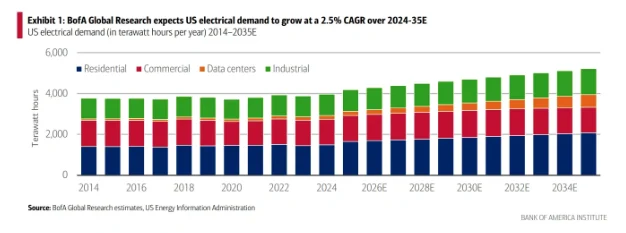
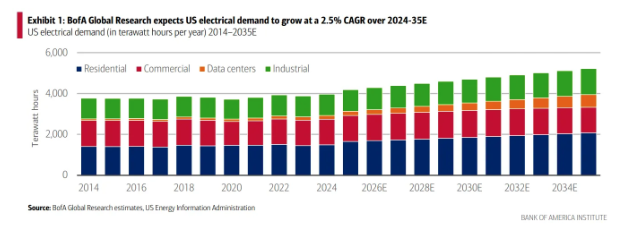
The Canadian electricity sector is entering a period of unprecedented volatility and opportunity. Following a decade defined by flat or negligible demand growth, the landscape has shifted abruptly. The Bank of America Institute recently updated its forecasts to reflect this new reality, projecting a 2.5% compound annual growth rate in electricity demand through 2035. This represents a seismic shift for utility providers and regulators who have spent the last 20 years focused primarily on cost containment and maintaining aging assets rather than expansion.
The primary drivers of this demand spike are diverse but interconnected. The rapid proliferation of AI and the massive data centers required to power it are consuming vast quantities of electricity. Simultaneously, the transition to electric vehicles (EVs) and the domestic manufacturing of batteries are adding gigawatts of new load to provincial grids. Furthermore, the push to decarbonize traditional industries—such as mining, steel, and chemical production—requires a massive shift from fossil fuels to electric processes. The Canadian Climate Institute argues that investment capital will not simply flow to regions with the most natural resources, but to those that can provide the most reliable, scalable, and modern electrical grids.
A Comparative Analysis of Regional Power Systems
To illustrate the challenges and opportunities facing the country, the "Power Play" report provides a side-by-side comparison of Canada’s four largest electricity systems against global counterparts. This analysis categorizes jurisdictions based on their market structures and resource mixes, highlighting that a "one-size-fits-all" federal policy is insufficient.
Market-Led Systems: Alberta and Texas
The report groups Alberta and Texas as market-led systems, where private competition drives investment decisions. These regions are often faster at deploying new technologies, particularly wind and solar, due to lower regulatory hurdles for market entry. However, they also face unique challenges regarding grid reliability during extreme weather events and the need for market mechanisms that incentivize long-term storage.

Coordinated Market Systems: Ontario and the United Kingdom
Ontario and the United Kingdom are classified as coordinated market systems. In these jurisdictions, the government or a central agency plays a more active role in long-term planning and procurement. While this allows for large-scale projects like nuclear refurbishments or offshore wind farms, it can also lead to bureaucratic bottlenecks and a slower response to sudden shifts in industrial demand.
Hydro-Led Systems: Quebec, British Columbia, Washington, and Norway
Quebec and British Columbia are grouped with Washington State and Norway as hydro-led systems. These regions possess a significant inherent advantage: large-scale reservoir storage. This "dispatchable" power allows these jurisdictions to balance the intermittency of wind and solar more effectively than others. The report specifically notes Quebec’s integration with California’s carbon market as a strategic "bonus" that enhances its attractiveness to ESG-conscious investors.
Overcoming the Ethos of Risk Avoidance
A central theme of the research is the need to dismantle the culture of risk-avoidance that permeates Canadian utility regulation. Historically, utilities and provincial regulators have been incentivized to avoid "overbuilding" to protect ratepayers from unnecessary costs. This cautious approach was logical during periods of low growth, but the Canadian Climate Institute argues it has become a liability in the current economic climate.
The report suggests that the risk of "underbuilding" now far outweighs the risk of having excess capacity. If Canada cannot provide the power required for new EV battery plants or green hydrogen facilities, those multi-billion-dollar investments will move to the United States, where the Inflation Reduction Act (IRA) is providing massive subsidies for clean energy infrastructure. The authors contend that Canadian jurisdictions are systematically underplanning for industrial demand, treating new load requests as theoretical rather than inevitable.
To counter this, the institute calls for a "growth-oriented" regulatory framework. This would involve streamlining the permitting process for high-voltage transmission lines and adopting more flexible procurement strategies that allow for the rapid integration of renewable energy and battery storage.
Strategic Priorities for National Grid Modernization
The "Power Play" script outlines several critical pillars for federal and provincial action to ensure the electricity system remains a competitive engine for the economy.
Increasing Grid Flexibility and Interties
One of the foremost recommendations is the enhancement of grid flexibility. This includes the deployment of "firm" low-emissions power sources—such as long-duration battery storage, small modular reactors (SMRs), and geothermal energy—to complement variable wind and solar. Additionally, the report emphasizes the need for increased inter-regional transmission lines (interties). By connecting provincial grids more effectively, Canada can share surplus clean energy across borders, reducing waste and improving overall system reliability. The report argues that funding these interregional lines should be elevated to a national policy imperative, similar to the construction of the national railway or the Trans-Canada Highway.
Indigenous Ownership and Equity
A transformative aspect of the report’s recommendation is the focus on Indigenous ownership in the energy sector. Beyond the moral and legal imperatives of reconciliation and self-determination, the report identifies Indigenous participation as a massive source of untapped capital. Citing data from the First Nations Major Projects Coalition, the institute suggests that Indigenous ownership could unlock an additional $12 billion in power generation and $5 billion in transmission equity. By becoming equity partners rather than just stakeholders, Indigenous communities can provide the long-term stability and local support necessary to move large-scale energy projects through the approval process more quickly.
Predictable Policy and Rate Design
The report underscores that investors require a stable policy environment to commit the capital necessary for grid expansion. This includes a clear, long-term price on carbon and a consistent regulatory approach to clean electricity standards. Furthermore, the institute suggests that "modernized rate design"—such as time-of-use pricing and industrial interruptible rates—can help manage demand more effectively, reducing the need for costly peak-power infrastructure.
Broader Economic and Geopolitical Implications
The findings of the Canadian Climate Institute echo a similar warning issued in February by the Shareholder Association for Research and Education (SHARE). In their Power at Risk report, SHARE noted that grid constraints and slow infrastructure build-outs are colliding with skyrocketing demand from the tech, AI, and mining sectors. The inability to deliver clean power at scale is becoming a material risk for investors, who are increasingly prioritizing carbon-neutral operations.
The geopolitical context cannot be ignored. The United States is currently engaged in a massive industrial "re-shoring" effort, fueled by clean energy incentives. For Canada to compete, it must offer more than just raw materials; it must offer the clean energy required to process those materials into high-value goods. The "Power Play" report argues that if Canada fails to modernize its grid, it risks becoming a "branch-plant" economy that exports raw resources while the high-tech, high-wage manufacturing jobs remain south of the border.
The transition to a supercharged clean electricity system is not merely an environmental goal; it is a fundamental economic necessity. The report concludes that the Carney-led economic strategy—focused on trade, building, and innovation—cannot succeed without a massive, proactive investment in the wires and turbines that power the nation. As other regions move quickly to capitalize on low-cost renewable technologies, Canada’s window of opportunity to leverage its clean energy advantage is narrowing. The "Power Play" script provides the roadmap; the question remains whether provincial and federal leaders possess the political will to move from a posture of caution to one of ambitious growth.
