

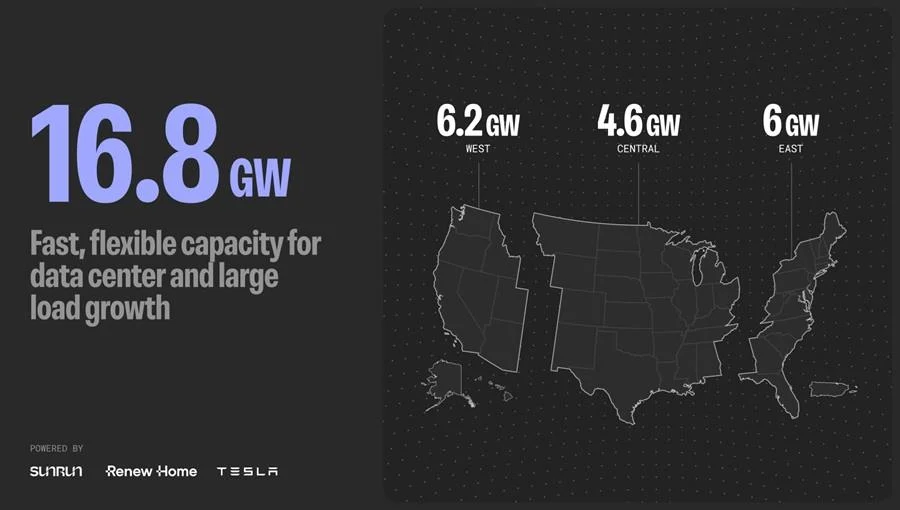
In a landmark collaboration that signals a transformative shift in the American energy landscape, Tesla, Sunrun, and the Google-backed energy management firm Renew Home have announced a massive partnership to aggregate millions of residential energy devices into the nation’s largest distributed power plant. This ambitious initiative aims to harness the collective power of home batteries, solar panels, and smart thermostats to create a virtual power plant (VPP) capable of delivering more than 16 gigawatts (GW) of flexible energy capacity. The primary objective is to provide a reliable, clean energy reservoir for utilities and hyperscale data center operators—often referred to as hyperscalers—while simultaneously lowering costs for residential consumers and fortifying the national electricity grid.
The partnership arrives at a critical juncture for the U.S. power sector, which is currently grappling with the dual pressures of aging infrastructure and an unprecedented surge in demand driven by the rapid expansion of artificial intelligence (AI) data centers and the broader electrification of the economy. By leveraging existing technology already installed in millions of American homes, the three companies intend to create a "capacity-as-a-solution" framework that can be deployed rapidly, bypassing the lengthy timelines typically associated with building traditional power plants or transmission lines.
The Mechanics of a 16 GW Virtual Power Plant
At its core, a virtual power plant is a cloud-based network of decentralized energy resources that can be dispatched as a single, unified power source. This specific collaboration combines the hardware and software strengths of three industry leaders. Tesla, a pioneer in residential energy storage with its Powerwall systems, and Sunrun, the leading provider of residential solar and battery solutions in the U.S., will contribute hundreds of thousands of home battery systems. Renew Home, formed through the merger of Google’s Nest Renew and OhmConnect, brings a massive footprint of more than 8 million smart thermostats and other connected devices.
The synergy of these assets allows for two distinct but complementary functions: energy injection and demand response. During periods of peak demand, home batteries can discharge stored solar energy back into the grid. Simultaneously, Renew Home’s software can subtly adjust the energy consumption of smart thermostats and appliances across millions of households—a process known as load shifting—to reduce the total strain on the grid. This coordinated effort creates "flexible capacity" that can be ramped up or down in seconds, providing the kind of agility that traditional coal or gas-fired "peaker" plants cannot match.
Importantly, the companies emphasized that this platform will span multiple states and does not require new physical infrastructure, such as additional land, water usage, or complex interconnection permits. Because the hardware is already in place, the capacity can be unlocked through software integration, making it a highly scalable and environmentally friendly alternative to traditional utility-scale projects.
Solving the Hyperscaler Energy Crisis
The rapid rise of generative AI and cloud computing has led to a construction boom for massive data centers, particularly in regions like Northern Virginia’s "Data Center Alley." These hyperscalers, including giants like Amazon Web Services, Microsoft, and Google, require vast amounts of electricity to keep their servers running 24/7. However, the sheer scale of this demand has begun to outpace the ability of local utilities to provide power, leading to delays in data center projects and concerns about grid stability.
Mary Powell, CEO of Sunrun, highlighted the strategic importance of VPPs in addressing this bottleneck. "When data centers are asked to throttle down operations during the most expensive and stressful hours of the day, we can activate our distributed power plants to help provide them the power they need," Powell stated. This approach allows data centers to maintain operations while protecting residential customers from the high costs of building new, expensive infrastructure.
The partnership has already identified Virginia as a primary focus area, with 300 megawatts (MW) of capacity available for immediate deployment. The goal is to scale this to at least 500 MW by 2030 in that region alone. Beyond Virginia, the companies are targeting the PJM Interconnection—the largest regional transmission organization in the U.S., serving 13 states and the District of Columbia. They have committed capacity to PJM’s proposed Reliability Backstop Process, which could immediately unlock over 1 GW of capacity for peak shaving and locational grid relief.
Context and Chronology: The Evolution of Distributed Energy
The concept of virtual power plants is not new, but the scale of this partnership represents a significant leap forward. Over the last decade, Tesla and Sunrun have conducted various VPP pilots. Tesla’s "Emergency Load Reduction Program" in California has previously demonstrated the ability of Powerwall owners to support the grid during heatwaves. Similarly, Sunrun has successfully operated VPP programs in markets like New England and New York, where homeowners are compensated for sharing their stored energy.
However, the inclusion of Renew Home and its 8 million devices changes the math. By moving beyond just batteries and solar to include smart thermostats, the partnership can tap into the "thermal mass" of millions of buildings. This massive scale allows the VPP to compete directly with traditional wholesale power markets.
The timeline for this initiative is aggressive. Unlike traditional power plants, which can take five to ten years to permit and build, the Tesla-Sunrun-Renew Home framework can be deployed in a matter of months. This speed is essential for meeting the near-term capacity shortfalls predicted by many grid operators for the late 2020s.

Supporting Data and Economic Impact
The economic implications of this 16 GW project are substantial. According to industry analysis, virtual power plants can provide grid services at a cost 40% to 60% lower than traditional gas peaker plants. For the consumer, participation in these programs typically results in lower monthly electricity bills and, in many cases, direct rewards or payments for providing grid services.
Data from the Department of Energy (DOE) suggests that the U.S. will need to triple its VPP capacity by 2030 to meet rising demand and decarbonization goals. This partnership alone aims to provide a significant portion of that requirement. By utilizing the 16 GW of flexible capacity, the grid can avoid "congestion" charges—the high costs incurred when transmission lines are at full capacity and more expensive local generation must be turned on.
Furthermore, the "capacity-as-a-solution" model provides a new revenue stream for the participating companies. Instead of merely selling hardware, Tesla, Sunrun, and Renew Home are moving toward a service-based model where they act as intermediaries between the residential consumer and the industrial power buyer.
Official Responses and Industry Reactions
The announcement has been met with optimism from energy experts and industry leaders who see distributed energy as the key to a resilient grid. Colby Hastings, Senior Director of Residential Energy at Tesla, underscored the untapped potential of American homes. "America’s grid faces mounting pressure from data centers, electrification, and manufacturing growth that no single infrastructure solution can solve fast enough," Hastings said. He noted that the solution lies in the "batteries, thermostats, and electric vehicles inside millions of American homes, waiting to be put to work."
While utilities have traditionally been wary of decentralized energy competing with their business models, many are now embracing VPPs as a way to avoid the massive capital expenditures required for new transmission lines. Environmental groups have also signaled support, noting that every megawatt provided by a VPP is a megawatt that doesn’t need to be generated by a fossil-fuel-burning peaker plant, thereby reducing greenhouse gas emissions and local air pollution.
Analysis: Implications for the Future of the Grid
This partnership marks a fundamental change in the relationship between the consumer and the utility. In the traditional model, power flows one way: from a central plant to the home. In the new model, the home becomes a "prosumer"—both a consumer and a producer of energy services.
The focus on hyperscalers is particularly savvy. By linking residential energy to the high-demand, high-margin data center market, the partnership ensures a steady "buyer" for the aggregated energy. This could lead to a "first-mover advantage" for companies that can secure these flexible capacity contracts early. As the companies noted, available capacity will be allocated on a first-come, first-served basis, creating a sense of urgency for tech giants to sign on.
However, challenges remain. Regulatory frameworks across different states vary widely, and the Federal Energy Regulatory Commission (FERC) Order 2222, which mandates that regional grid operators allow VPPs to participate in wholesale markets, is still in the process of being fully implemented. Technical hurdles regarding cybersecurity and the real-time telemetry of millions of devices also require robust management.
Despite these challenges, the Tesla, Sunrun, and Renew Home alliance represents a powerful proof of concept. If successful, it could serve as a blueprint for how modern economies balance the massive energy needs of the digital age with the necessity of a stable, clean, and affordable power grid. By turning millions of homes into a "massive distributed power plant," the partnership isn’t just changing how we use energy—it’s changing what a power plant looks like in the 21st century.
