

The Canadian Climate Institute has released a comprehensive roadmap designed to guide the federal government and economic architects, including special advisor Mark Carney, in a massive overhaul of the nation’s electricity infrastructure. The report, published Wednesday, serves as a strategic script for what it terms a necessary "power play" to preserve Canada’s historical competitive advantage: an abundance of clean, low-cost electricity. As the global economy pivots toward decarbonization, the authors argue that Canada’s ability to attract major industrial investments—ranging from artificial intelligence (AI) data centers to electric vehicle (EV) battery plants—depends entirely on the speed and scale of its grid modernization.
For decades, Canada has enjoyed some of the lowest industrial electricity prices among high-income economies. This advantage is built on a foundation of massive hydroelectric projects and a robust nuclear sector, resulting in a national grid that is currently 85% non-emitting. However, the Canadian Climate Institute warns that this "clean energy edge" is rapidly eroding. As jurisdictions around the world aggressively subsidize renewable energy and modernize their transmission systems, Canada’s traditional lead is no longer guaranteed. The report contends that a shift in mindset is required, moving away from a culture of regulatory caution and toward a proactive, growth-oriented strategy that treats electricity as the primary engine of the 21st-century economy.
The End of the Era of Flat Growth
For the better part of the last decade, electricity demand in Canada remained relatively stagnant. Utilities and provincial regulators grew accustomed to a predictable environment where incremental improvements were sufficient to maintain reliability. That era has come to an abrupt end. The convergence of AI development, the electrification of transportation, and the "re-shoring" of heavy industry has triggered a surge in projected demand that many planners were unprepared for.
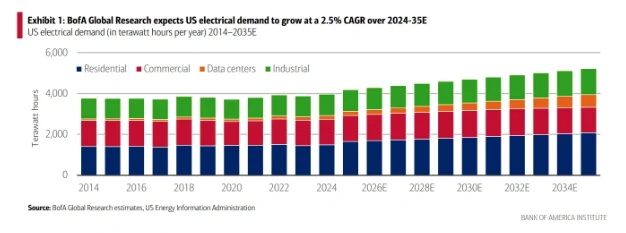
The Bank of America Institute recently updated its forecasts to reflect this new reality, predicting a 2.5% compound annual growth rate for electricity demand through 2035. This follows ten years of near-zero growth. In the United States and Canada, the sudden appetite for power from data centers—driven by the processing requirements of large language models and generative AI—has caught many utilities off guard. A single large-scale data center can consume as much electricity as a medium-sized city, and the wait times for grid connections in some North American jurisdictions have stretched to five or even ten years.
The Canadian Climate Institute argues that Canadian jurisdictions are "systematically underplanning" for this industrial demand. While provinces like Ontario and Quebec have recently announced multi-billion-dollar energy strategies, the report suggests these plans may still underestimate the sheer volume of power required to support a modern, electrified industrial base.
Rethinking Regulatory Risk: The Cost of Underbuilding
A central theme of the "Power Play" report is the need to redefine "risk" in the context of utility regulation. Historically, the primary goal of energy regulators in Canada has been cost containment and ratepayer protection. To prevent "gold-plating"—the practice of utilities building unnecessary infrastructure and passing the costs to consumers—regulators have traditionally favored a conservative approach, requiring proof of demand before approving new generation or transmission projects.
However, the Climate Institute contends that the greatest risk now is not overbuilding, but underbuilding. In a global economy where "green electrons" are the most sought-after commodity, a lack of available power acts as a hard ceiling on economic growth. If a manufacturer cannot secure a guarantee of clean power within a reasonable timeframe, they will simply take their investment to a jurisdiction that can, such as Texas or parts of Northern Europe.
"Resource planning is typically shaped by regulatory incentives that tend to favour caution, cost containment, and protection against near-term rate increases over the opportunity for economic growth," the report states. To overcome this, the authors suggest that the federal and provincial governments must coordinate to provide "predictable procurement" cycles for renewables and modernize rate designs to encourage industrial expansion.
A Comparative Analysis of Global Energy Systems
To illustrate Canada’s current standing and potential trajectory, the research presents a side-by-side comparison of Canada’s four largest electricity systems with international peers. These are categorized into three distinct models:
1. Market-Led Systems: Alberta and Texas
Both Alberta and Texas operate deregulated, market-driven systems where price signals are intended to drive investment. While these systems allow for rapid deployment of renewables when prices are right, they also face challenges regarding long-term reliability and price volatility. The report notes that while Texas has seen a massive surge in wind and solar, it lacks the inherent "firm" power advantages of hydro-rich regions.
2. Coordinated Market Systems: Ontario and the United Kingdom
Ontario and the UK utilize a hybrid approach, combining market elements with strong central planning. These jurisdictions are currently grappling with the retirement of older assets (such as coal or older nuclear plants) and the need to integrate massive amounts of new clean energy. The UK has been particularly aggressive in its offshore wind procurement, a model the report suggests Ontario could learn from as it seeks to expand its own clean energy portfolio.
3. Hydro-Led Systems: Quebec, British Columbia, Washington, and Norway
These jurisdictions possess a "crown jewel" of the energy world: large-scale reservoir hydro. This provides not just clean power, but "dispatchable" power that can be turned on or off to balance the intermittent nature of wind and solar. Quebec’s position is further strengthened by its link to California’s carbon market, providing an additional financial incentive for clean energy exports. However, even these "hydro giants" are facing limits; Quebec recently announced that its era of "surplus" power is over, necessitating a new wave of wind and solar development to preserve its hydro reservoirs for peak demand.
Strategic Priorities for Grid Modernization
The report outlines several technical and policy imperatives to "supercharge" the Canadian grid:
Increasing Grid Flexibility: The report emphasizes that a modern grid must be flexible. This requires a move toward "firm" low-emissions sources. While wind and solar are the cheapest forms of new generation, they require backing by "firm" power like long-duration battery storage, small modular reactors (SMRs), or hydro.
Interprovincial Interties: One of the most significant barriers to a national clean energy strategy is the lack of transmission capacity between provinces. Currently, it is often easier for a province to trade electricity with a neighboring U.S. state than with a neighboring Canadian province. The Climate Institute argues that funding interregional transmission lines should be a national policy imperative to ensure that surplus clean energy in one province can meet demand in another.
Indigenous Ownership and Equity: A unique and vital component of the Canadian energy landscape is the role of Indigenous communities. The report, citing data from the First Nations Major Projects Coalition, states that Indigenous ownership could unlock $12 billion in generation equity and $5 billion in transmission equity. Beyond fulfilling the requirements of the United Nations Declaration on the Rights of Indigenous Peoples (UNDRIP), these partnerships provide the social license and capital necessary to move large-scale infrastructure projects forward quickly.
Aligning with the SHARE "Power at Risk" Findings
The Canadian Climate Institute’s findings align closely with a February report from the Shareholder Association for Research and Education (SHARE), titled Power at Risk. That report warned that "grid constraints, slow infrastructure build-out, and mounting policy and regulatory barriers" are colliding with skyrocketing demand from the tech and mining sectors.
SHARE’s research highlights that for industries like critical minerals mining—essential for the EV supply chain—access to clean electricity is not just a preference but a market requirement. Global investors are increasingly demanding that the products they finance have low embodied carbon. If Canada cannot provide a clean grid, its mining and manufacturing sectors will lose their "green premium" in international markets.
Chronology of the Energy Transition
The urgency of the "Power Play" report is best understood through the timeline of Canada’s climate commitments and market shifts:
- 2015-2022: A period of relatively low demand growth; focus was largely on phase-outs (such as coal in Alberta and Ontario).
- 2023: The "AI Explosion" and the passage of the U.S. Inflation Reduction Act (IRA) radically changed the competitive landscape, providing massive subsidies for clean energy in the United States.
- 2024 (Current): Major Canadian provinces (Quebec, Ontario, BC) release updated long-term energy plans acknowledging the end of energy surpluses.
- 2035: The federal target for a net-zero electricity grid.
- 2050: The target for a net-zero national economy.
Conclusion: The Path Forward
The report concludes that Canada’s economic future is inseparable from its energy policy. The "Mark Carney government" strategy—a reference to the current administration’s focus on high-stakes industrial policy—must prioritize the electricity grid as the foundational infrastructure for all other goals. Whether it is building affordable housing, expanding the tech sector, or decarbonizing the oil sands, every pillar of the Canadian economy requires more power than is currently available.
By moving away from a "wait-and-see" regulatory ethos and embracing a "build-for-growth" model, Canada can leverage its existing 85% non-emitting grid to become a global leader in the clean economy. However, as the Canadian Climate Institute makes clear, the window of opportunity is closing. Investment capital is mobile, and it will flow to the jurisdictions that can offer the most reliable, cleanest, and most affordable "plug-in" for the industries of tomorrow. The "Power Play" is not just an environmental necessity; it is a prerequisite for national prosperity in a decarbonizing world.
