

The "Play Anywhere" philosophy, once a visionary marketing tagline for Microsoft’s Xbox brand, has transitioned from a corporate ambition into a defining characteristic of the modern interactive entertainment landscape. As the video game industry undergoes a radical transformation, cloud gaming—the technology that allows players to stream high-fidelity titles over the internet without the need for expensive local hardware—is becoming the dominant mode of consumption. While this shift promises unprecedented accessibility, it has simultaneously ignited a complex debate regarding the environmental sustainability of a "dematerialized" gaming ecosystem.
According to recent market data, the global cloud gaming user base reached approximately 395 million in 2024. Industry analysts and researchers forecast that this trajectory will continue upward, with the user base expected to approach 500 million by 2027. This rapid adoption signifies that cloud gaming now represents roughly 38% of the global online video game market. The 2025 Cloud Gaming Report further highlights the stickiness of this technology; a survey of over 22,600 players revealed that 51% utilized cloud gaming services on a daily basis, while more than 75% engaged with the technology at least once a week.
However, as games shed their physical forms—moving from arcade cabinets and plastic cartridges to digital downloads and now remote server clusters—the environmental implications are becoming more difficult to ignore. The transition to data centers does not eliminate the industry’s carbon footprint; rather, it relocates and often obscures it.
The Evolution of Gaming Hardware and Energy Consumption
The history of video games is marked by a steady march toward dematerialization. In the 1980s and 1990s, the environmental impact of gaming was largely tied to the manufacturing and distribution of physical media: plastic cartridges, CD-ROMs, and the energy-intensive production of cathode-ray tube (CRT) televisions. The mid-2000s saw a shift toward digital storefronts, which reduced the need for physical logistics but increased the energy demands of global content delivery networks (CDNs).
Today, the industry is entering the era of the "headless" console. In cloud gaming, the heavy computational lifting—rendering graphics, processing physics, and managing artificial intelligence—is performed by high-end servers located in massive data centers. The result is streamed to the user’s device as a video feed. While this allows a low-power smartphone or a smart TV to run a game that would otherwise require a $500 console, it creates a massive, invisible demand for electricity.
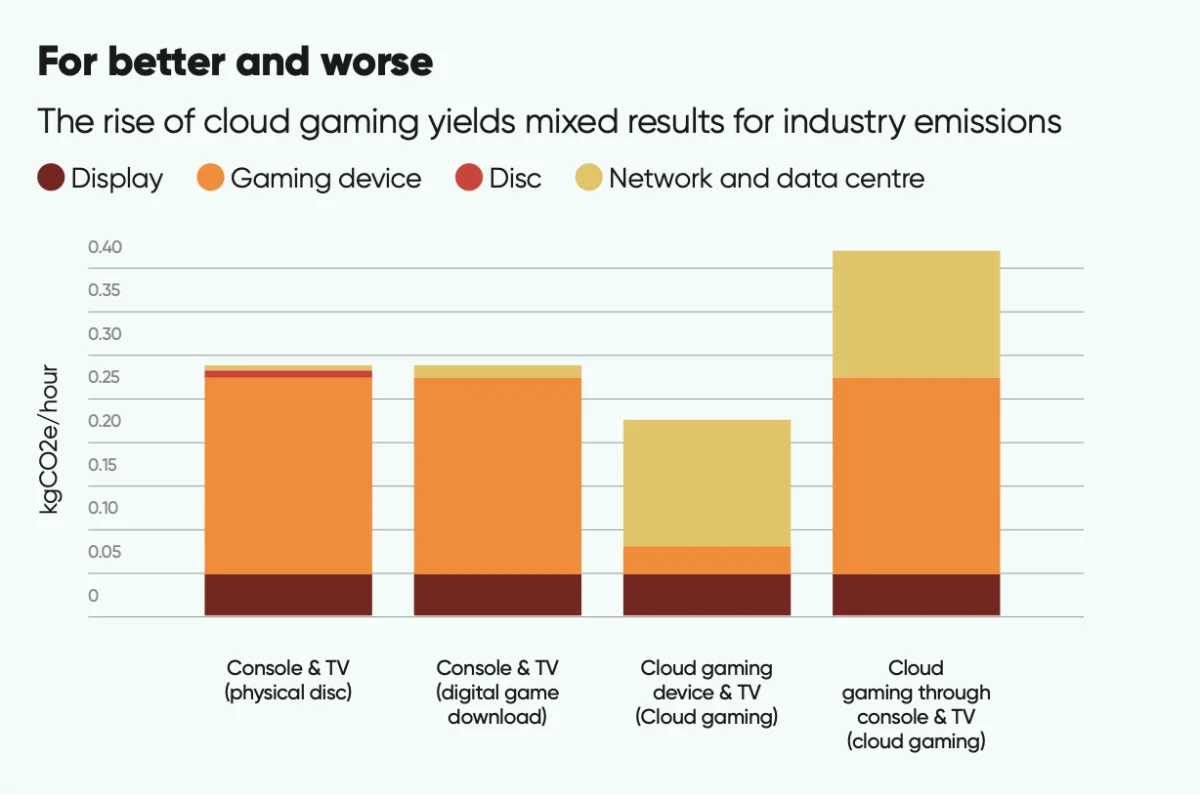
Climate technology firm Greenly reported in late 2024 that the electricity usage for gaming consoles in the United States alone reached 3.9 terawatt-hours in 2025. This consumption resulted in approximately 1.6 million metric tons of carbon dioxide equivalent (CO2e). Critically, these figures only account for the consoles themselves, excluding the electricity consumed by the televisions or monitors required to display the games. When the focus shifts specifically to cloud-based gaming, the report quantifies the impact at 0.44 kilograms of CO2e per hour of play.

Comparative Carbon Footprints: Cloud vs. Local Play
Determining which method of gaming is the "greenest" is a nuanced task that depends heavily on the hardware used and the duration of play. A 2023 impact report by Playing for the Planet, a UN-supported alliance of gaming companies, found that the average carbon impact across various forms of play was approximately 50 grams of CO2e per hour. However, the variance between platforms is significant.
Research indicates that dedicated cloud-gaming devices—such as the Logitech G Cloud, Nvidia Shield TV, or specialized streaming handhelds—produce the fewest emissions during active play because they are designed for extreme energy efficiency. Conversely, cloud gaming performed on a high-powered console (like an Xbox Series X or PlayStation 5) or a desktop PC connected to a large-format television produces the highest emissions. In this scenario, the user is essentially double-spending energy: once at the data center to run the game, and again at home to power a high-wattage device that is merely acting as a receiver for a video stream.
Joshua Aslan, senior manager of environment and climate strategy at Sony Interactive Entertainment, conducted extensive research in 2019 that remains a cornerstone of the industry’s understanding of these dynamics. His findings suggested that while cloud gaming was more carbon-intensive than traditional digital downloads for long-form play, it was more efficient than disc-based gaming when using dedicated, low-power streaming hardware. As data centers become more efficient and internet infrastructure matures, these ratios continue to shift, but the core challenge of energy-intensive remote rendering remains.
The Hidden Infrastructure and Life Cycle Complexity
The true environmental cost of a video game is often "obfuscated," according to Alex Custodio, a researcher at Concordia University. While a player sees only a seamless image on their screen, the back-end process involves a massive chain of energy consumption. This includes the high-end workstations used by developers to build the games, the servers that host the files, and the network routers that transmit hundreds of gigabytes of data across the globe.
"The lion’s share of the energy consumption is happening somewhere else," Custodio notes. "It’s completely invisible to the user."
Furthermore, Michael Iantorno, a postdoctoral researcher at the University of Waterloo, argues that the industry lacks a comprehensive framework for Life Cycle Assessment (LCA). A physical game cartridge manufactured in 1990 can be sold, traded, and played by dozens of different people over several decades with zero additional manufacturing energy. In contrast, every hour of cloud gaming requires a fresh expenditure of electricity.
"It’s very hard to quantify because we can’t just do a one-to-one comparison," Iantorno explains. The "digital-only" model also raises concerns about digital preservation and the "e-waste" generated by data centers, which must frequently upgrade their server racks to keep up with the increasing graphical demands of modern software.

Industry Responses and the Path to Decarbonization
In response to growing scrutiny, the video game industry has begun to organize under various "green" initiatives. The Playing for the Planet Alliance has become a central hub for these efforts, bringing together industry giants and indie studios to develop climate strategies.
Matt Anderson, the decarbonization lead at Playing for the Planet, emphasizes that the transition to renewable energy is the most critical factor. "The simplest way to reduce emissions is to have renewable electricity," Anderson says. This applies to both the data centers operated by companies like Microsoft, Google, and Amazon, and the domestic electricity grids used by players.
Beyond energy procurement, some developers are experimenting with "green coding"—optimizing software to require less computational power, thereby reducing the load on servers. There is also a growing movement among indie developers and gaming enthusiasts toward "perma-computing." This philosophy focuses on creating long-lasting, repairable systems and software that can run on older, less energy-hungry hardware. Other grassroots efforts include:
- Climate-Sensitive Mods: User-created modifications that introduce environmental themes or power-saving modes into existing games.
- Solar-Powered Gaming: The development of handheld devices designed to run entirely on integrated solar cells or low-voltage batteries.
- Hardware Longevity: Initiatives to discourage the "planned obsolescence" of consoles, encouraging players to keep devices for longer cycles.
Analysis of Broader Implications and Future Trajectories
The shift toward cloud gaming represents a classic "Jevons Paradox" in the technology sector: as a service becomes more efficient and accessible, the total consumption of that service increases, potentially offsetting any environmental gains. While streaming might be more efficient than shipping millions of plastic discs around the world, the sheer volume of people gaming for longer hours on more devices could lead to a net increase in the industry’s total carbon output.
Moreover, the infrastructure required to support 500 million cloud gamers by 2027 will necessitate a massive expansion of 5G and 6G networks and edge computing nodes. These technologies, while enabling lower latency for players, require a denser network of hardware, each with its own embodied carbon and energy requirements.
The skepticism voiced by researchers like Custodio highlights a pivotal tension in the industry’s climate response. Many corporate initiatives focus on "nudging" player behavior—such as suggesting "eco-modes" on consoles—but critics argue this shifts the burden of responsibility onto the consumer. The fundamental challenge remains an infrastructural one. True sustainability in the gaming sector would require a total transformation of how hardware is manufactured, how data centers are cooled, and how software is architected from the ground up.
As the industry moves toward 2027, the "Play Anywhere" promise will likely become a reality for half a billion people. Whether that reality is compatible with global carbon reduction targets will depend on the industry’s ability to move beyond marketing slogans and toward a transparent, data-driven model of environmental accountability. The invisibility of the cloud can no longer serve as an excuse for the industry’s very real impact on the planet.
